
This post contains affiliate links. We may earn a small commission when you buy through our links — at no extra cost to you.
A sleeping bag’s temperature rating often leads buyers to expect cozy nights at that exact number. In reality, many down bags use survival ratings — meaning you’ll stay alive at 20°F, not comfortable. The result: shivering campers who thought they’d chosen a warm-enough bag.
This guide focuses on bags where user experience aligns with the label. We highlight down sleeping bags that actually keep you warm near their rating, plus roomier cuts for side sleepers, ultralight options for gram-counters, and zip-together pairs for couples. Choosing a bag that fits your sleep style means you can pack less and sleep better.
Once you understand how fill power and shape affect your comfort, picking the right down bag becomes a matter of matching the spec to your most common camping scenario.



Best for 3-Season Backpacking
Kelty Cosmic 20 Down Mummy
Key Features
- Temperature Rating: 20°F (ISO limit 21°F)
- Fill Power: 550
- Weight & Packed Size: 2 lbs 6 oz
- Shape: Mummy
- Shell Material & DWR: Recycled 20D Nylon, PFC-free DWR
- Price: Mid-Range
Consistent warmth into the mid-20s sets the Cosmic 20 apart in its price tier. The 550-fill down fills a hood, draft collar, and full-length zipper baffle that lock out cold air, keeping heat close through long autumn nights. At 2 lb 6 oz for the regular, the bag hits a sweet spot between insulation and pack weight, stuffing down to a compact bundle that won’t dominate a backpack.
Inside, a soft lining and contoured hood create a cocoon-like feel that traps body heat efficiently. The tailored mummy cut works particularly well for back and stomach sleepers who stay put. That close fit is thermal engineering at work, not a design afterthought.
Kelty wrapped the bag in a recycled 20D nylon shell with a PFAS-free DWR treatment, shedding light moisture without the environmental burden of traditional fluorinated finishes. Stitching and seam work hold up to repeated packing and unpacking, and the zipper glides smoothly past its draft tube with little catching.
This bag targets backpackers who want a single three-season down bag that packs small, sleeps warm, and doesn’t push into premium pricing. The thermally efficient shape rewards still sleepers. Side sleepers and those with broad shoulders may want the roomier semi-rectangular option in this set.
Pros
- Consistent warmth into the 20s with effective draft protection.
- Well-built construction with careful stitching and durable materials.
- Soft lining and snug hood deliver a cozy feel once you settle in.
- Sub-2.5 lb weight and compressibility make it easy to carry on multi-day trips.
- Notable value for a down bag with this warmth and build quality.
Cons
- The mummy cut is narrow; side sleepers and those with broader shoulders may feel restricted.
For backpackers who need a 20-degree down bag that compresses small and stays warm at a mid-range price, the Cosmic 20 delivers. The mummy fit prioritizes heat retention over sprawl — plan accordingly.
Best for Warm-Weather Comfort
Kelty Supernova Down
Key Features
- Temperature Rating: 40°F
- Fill Power: 550
- Weight & Packed Size: 2 lbs 1 oz
- Shape: Semi-Rectangular
- Shell Material & DWR: 50% Nylon, 50% Polyester Recycled
- Price: Mid-Range
The Supernova Down stands apart from the top pick’s mummy profile with a cut that lets side sleepers bend their knees and shift around without waking up bound. It has enough width to accommodate broader shoulders and a zip that mates with a second bag, turning two singles into a double-wide sleep system. This shape adds a few ounces compared to streamlined alternatives, but for campers who find traditional mummy bags claustrophobic, that trade-off is the whole point.
Kelty used a shell made from 50% recycled nylon and polyester, and the 550-fill down lofts consistently across the baffles. The result is a bag that packs small and compresses enough to slide into a backpack without dominating the load. The interior fabric feels soft against skin, and the pad loops keep the bag from twisting off a sleeping pad during the night. Zipper operation is smooth when handled with a steady, aligned pull, though rushing can cause the slider to catch on the draft tube.
The 40°F rating defines the Supernova Down’s boundary. It keeps campers comfortable on mild summer nights and cool shoulder-season evenings, but when temperatures dip into the mid-30s, heat loss becomes noticeable. Anyone camping near freezing or in damp mountain climates will want the warmer temperature ceiling of the top pick. This bag suits fair-weather backpackers, car campers, and couples who plan their trips around the forecast and value space and eco-friendly construction above all.
Pros
- Semi-rectangular cut gives side sleepers and larger body types generous room to move without drafts.
- Construction quality feels durable, with steady stitching and a zipper that runs reliably when used with care.
- Compresses small and weighs just over 2 pounds, making it backpacking-friendly for a roomy down bag.
- Zip-together compatibility turns two bags into a double-wide setup for couples or family trips.
Cons
- Zipper may catch on the draft tube fabric during fast pulls, requiring a slower, more deliberate motion.
- 40°F temperature rating limits safe use to mild conditions; mid-30s nights can feel cold even with a pad.
The Supernova Down earns its place for warm-weather campers who refuse to sacrifice elbow room. The recycled shell and zip-together design add practical appeal, but the 40°F ceiling means it’s a fair-weather specialist — not a quiver-of-one bag.
Best for Budget Ultralight
Naturehike Ultralight Down
Key Features
- Temperature Rating: 40.4°F (comfort)
- Fill Power: 650
- Weight & Packed Size: 2 lbs
- Shape: Semi-Rectangular
- Shell Material & DWR: 400T 20D Ripstop Nylon
- Price: Budget
The Naturehike Ultralight Down wraps 650-fill-power down in a sub-2-pound package, rare at this price. While the ultralight specialist in this set pushes the weight envelope further with 850+ fill, that bag demands a premium and a narrower temperature window. Here, you get genuine down compressibility and warmth for mild conditions without the sticker shock of high-fill-power ultralights.
The semi-rectangular cut gives side sleepers and anyone who tosses at night the freedom that mummy bags deny. At 2 pounds, it’s light enough for backpacking but wide enough that you won’t feel pinched. The 400T ripstop nylon shell resists snags while keeping weight down, and the included compression sack shrinks the bag to the size of a loaf of bread.
This bag suits budget-conscious backpackers, motorcycle campers, and travelers who need compact down warmth for nights above freezing. The 40.4°F comfort rating isn’t conservative. Cold sleepers, or anyone expecting to stay toasty near that limit, will want a warm sleeping pad and a liner. Treat it as a 50°F bag unless you’re a warm sleeper, and the math works.
Pros
- Lightweight build packs down exceptionally small for easy carrying.
- Roomy semi-rectangular cut lets side sleepers shift positions without restriction.
- Down insulation compresses tightly into the included sack for compact travel.
- 650-fill down comes at a price that undercuts most comparable bags.
Cons
- The 40°F rating may not deliver full comfort; chill can set in at around 50°F without extra insulation.
For mild-condition backpackers and travelers who want down warmth without the mummy squeeze, it’s a smart value — just plan to pair it with a well-insulated pad if nights dip toward 40°F.
Best for Ultralight Summer
Sea to Summit Spark UL
Key Features
- Temperature Rating: 45°F
- Fill Power: 850+
- Weight & Packed Size: 14.6 oz
- Shape: Mummy
- Shell Material & DWR: 10D Nylon, PFC-free DWR
- Price: Premium
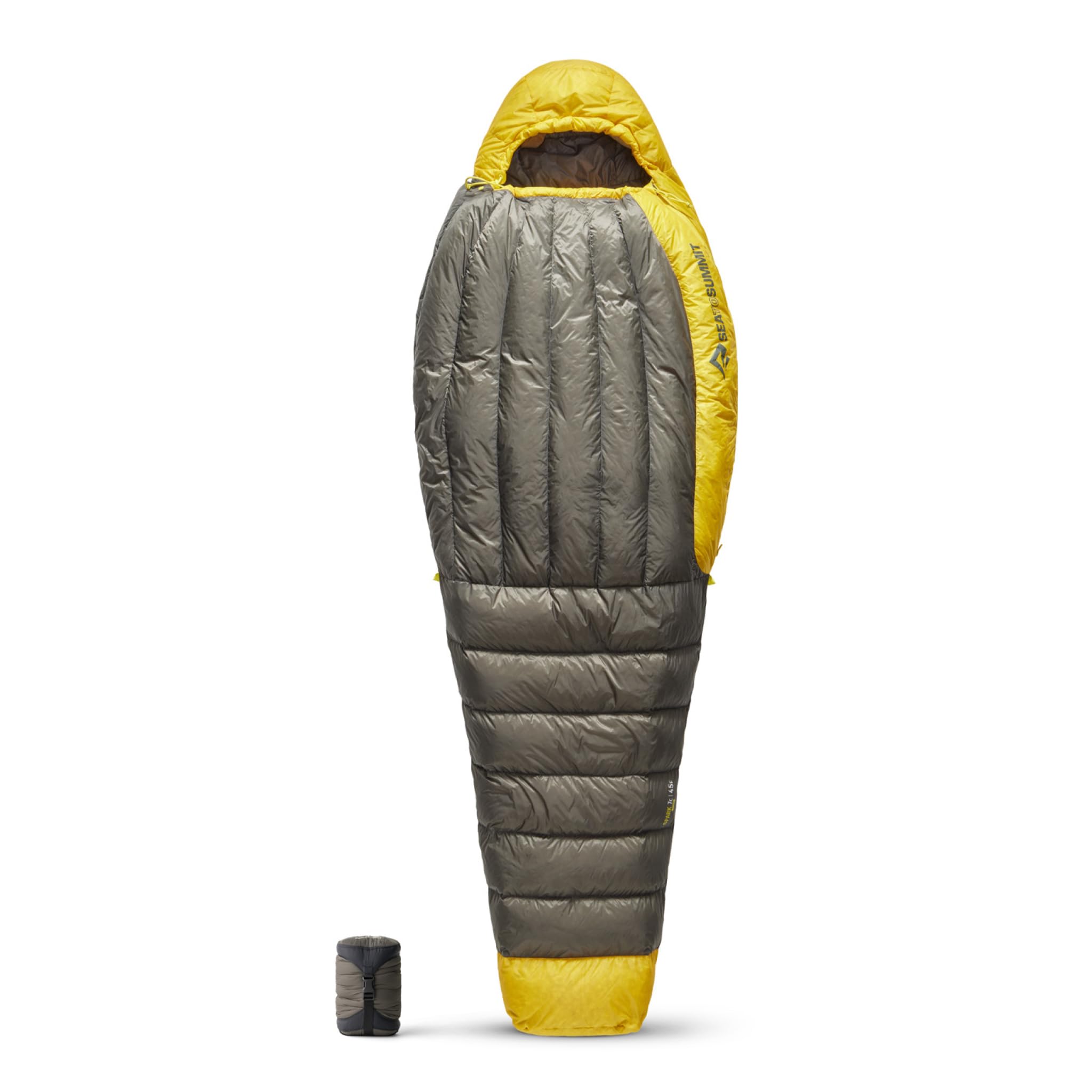
At 14.6 ounces, the Spark UL strips weight where it matters most — for thru-hikers and bikepackers who shave grams, every fraction counts. The 850+ fill down lofts high for its weight, and the 10D nylon shell with PFC-free DWR compresses to a fist-sized bundle, freeing pack space for other essentials. That’s a distinct advantage over the boxier cold-weather option that prioritizes multi-zipper access and a roomy cut over sheer lightness.
High-loft down efficiently traps heat for mild nights, but the 45°F rating draws a clear line: this bag is a summer specialist. Pair it with an insulated pad when overnight lows flirt with the mid-40s, and it will deliver on its promise. The mummy shape hugs the body without excessive compression, which helps conserve warmth despite the minimalist fill.
Ultralight backpackers, bikepackers, and gram-counting minimalists who camp in warm weather will find the Spark UL checks every box. It’s not for shoulder-season chill that dips toward freezing — that’s the domain of a 20-degree bag like the top pick. Those who accept the seasonal boundary get a packable, high-quality down bag that disappears in a pack.
Pros
- Sub-1lb weight in the Long size saves precious ounces for fast-and-light missions
- 850+ fill power down delivers excellent warmth-to-weight efficiency
- Compresses to a very small volume, freeing pack space for extended trips
Cons
- 45°F temperature rating means it’s strictly a summer and mild-shoulder-season bag — no sub-40°F nights
For backpacking trips where the forecast promises nights above 45°F, the Spark UL’s weight savings are unmatched in its class. Those who venture out when temperatures dip will need a warmer bag.
Best for Winter Camping
Sea to Summit Ascent 25
Key Features
- Temperature Rating: 25°F
- Fill Power: 750
- Weight & Packed Size: 2.2 lbs
- Shape: Mummy (relaxed)
- Shell Material & DWR: 20D Nylon
- Price: Luxury
Where ultralight mummy bags keep weight under a pound for summer use, the Ascent 25 opts for a roomier cut and a three-zipper layout that offers ventilation flexibility rare in its class. The relaxed mummy shape gives side sleepers and restless campers extra shoulder and hip space, while the left half-zip, right full-zip, and foot-box zipper make it easy to regulate temperature without contorting inside the bag.
Inside, 750-fill duck down treated with ULTRA-DRY EX resists dampness better than untreated down, and vertical baffles keep insulation locked in place through the night. Temperature ratings on sleeping bags are survival-based — the 25°F mark is a survival threshold, so realistic comfort sits in the low 30s when paired with an insulated pad. The 20D nylon shell balances durability and weight, and the lifetime warranty reflects confidence in long-term construction.
This bag fits winter campers and multi-season backpackers who prioritize livable space and ventilation features over bare-bones minimalism. At 2.2 lbs and a luxury price, it is heavier and costlier than many competitors, making it a tougher sell for ultralight purists and summer-only campers. For those who want a cold-weather bag that does not demand a still, straight spine to sleep in, the Ascent 25 delivers.
Pros
- Relaxed mummy shape provides more shoulder and hip room for side sleepers and restless campers.
- Vertical baffles prevent down from shifting, maintaining consistent warmth even with tossing and turning.
- Three-zipper system (half, full, foot-box) allows precise ventilation and easy in/out access.
- 750-fill power down with ULTRA-DRY treatment resists moisture and retains loft better than standard down.
Cons
- At 2.2 lbs and a luxury price, the Ascent 25 weighs and costs more than many ultralight 25-degree bags.
For winter campers who value room to move, adaptable ventilation, and a lifetime warranty, the Ascent 25 offers a feature set you will not find in stripped-down ultralight bags. It is a deliberate trade-up in weight and price for cold-weather comfort.
How to Choose
The single most critical spec is understanding whether the temperature rating represents comfort or survival — most bags use the survival limit, so you’ll need to add 10-15 degrees for cozy sleep.
Temperature Rating (Comfort vs. Survival)
Manufacturers often label a bag with its lower-limit survival rating, meaning you can survive at that temperature but won’t be comfortable. An ISO 20°F-rated bag may only feel cozy down to 30-35°F, especially for cold sleepers.
To guarantee a restful night, look for comfort ratings or add 10-15°F to the listed rating. Pair the bag with an insulating sleeping pad; without one, ground chill will strip warmth no matter the rating.
Fill Power
Fill power measures down’s loft and weight efficiency, not absolute warmth. A 550-fill and an 850-fill bag can both be rated to 20°F — the 850-fill version weighs less and compresses smaller because it uses less down to achieve the same insulation.
Higher fill power costs more but rewards you with significant weight savings for backpacking. For car camping or shorter hikes, 500-600 fill power keeps you warm without the premium price.
Weight and Packed Size
Ultralight bags shrink to a fraction of the size of budget alternatives, but often use thinner shell fabrics that require more care. A 1 lb bag may save shoulder strain on a thru-hike, while a 3 lb bag fits better for basecamp comfort.
Compression sacks help reduce volume, but long-term compression degrades loft. Store your bag loosely in a large storage sack to preserve fill power between trips.
Shape
Mummy bags cut weight and seal in heat by minimizing dead air space, but the tapered leg room can force side sleepers into an uncomfortable posture. Semi-rectangular and rectangular cuts sacrifice thermal efficiency for freedom of movement.
If you toss or sleep on your side, a roomier shape prevents midnight wrestling matches with your bag. Couples should look for zip-together models to create a double-wide sleep system.
Shell Material and Water Resistance
Thinner denier fabrics (10D-20D) keep weight low but tear more easily if snagged on gear or zippers. Heavier shells add durability at a weight penalty. PFC-free DWR treatments shed light moisture without the environmental concerns of older coatings.
Down loses insulation when wet, so a reliable DWR finish matters more in humid or coastal conditions. In consistently dry climates, the shell’s primary job is stopping wind and minor spills.
FAQ
Why is my 20-degree sleeping bag still cold at 30 degrees?
Most 20°F ratings are survival limits, not comfort ratings. The bag prevents hypothermia but won’t guarantee cozy sleep; add 10-15°F for true comfort. Also, down loft collapses under body weight, so pair your bag with an insulated pad that has an R-value of 4 or higher for below-freezing nights.
How do I wash a down sleeping bag without ruining it?
Use a front-loading washer with down-specific detergent, set to a gentle cycle with extra rinse. Dry it on low heat with clean tennis balls or dryer balls to break up clumps — this can take several hours but restores full loft. Never dry clean or use fabric softener, both strip down’s natural oils.
Can two Kelty sleeping bags be zipped together?
Yes, Kelty designs most of its rectangular and semi-rectangular bags with mating zippers. The Supernova and Galactic models zip together to form a 2-person system, provided you pair a left-zip and right-zip bag. Mummy-style Kelty bags like the Cosmic 20 typically do not offer this feature.
Why does my sleeping bag zipper keep snagging and how can I fix it?
Snagging usually happens when the fabric beside the zipper track gets caught in the slider. A strip of stiffer material added alongside the zipper (common on premium bags) prevents this, but on budget models you can reduce snags by sliding a finger behind the zipper while pulling. If the zipper teeth are bent, a dab of zipper lubricant or running a soft graphite pencil along the track can smooth operation.