
This post contains affiliate links. We may earn a small commission when you buy through our links — at no extra cost to you.
The biggest headache when shopping for an air purifier isn’t the price—it’s that advertised "covers up to 2,000 square feet" rarely means deep cleaning. Many brands quote coverage at a single air change per hour, which barely touches airborne allergens and leaves you with a false sense of cleanliness. What you actually need is a unit with verified CADR that fits your specific room size.
Add in the fact that some purifiers blast noise equivalent to a vacuum at full speed, while others emit a faint chemical odor from their ionizer, and the "clean air" promise gets muddied—especially in a bedroom. These trade-offs aren’t flaws; they’re mismatches. A machine that’s whisper-quiet at night may not be the powerhouse you need for a living room, and an ionizer scent that some find fresh can irritate others at night.
The right purifier isn’t the one with the biggest marketing numbers; it’s the one whose cleaning power, silence, and filter chemistry align with your room.



Best for Allergies & Asthma
Winix 5510
Key Features
- Noise (Sleep Mode): 23.5 dB
- Filter Type: True HEPA, carbon, PlasmaWave
- Smart Features: App, auto mode, sleep mode, AQI indicator
- Price: Mid-Range
The Winix 5510 combines AHAM-verified 392 sq ft coverage with a 23.5 dB sleep mode, making it one of the quietest effective purifiers for a medium-sized room. Its True HEPA filter captures 99.99% of particles down to 0.01 micron, and the auto mode uses a light sensor to adjust fan speed based on real-time air quality. That means it can run continuously without manual fiddling — set it and forget it.
In practice, the unit handles pollen, dust, and pet dander quickly. The washable pre-filter catches larger debris, extending the life of the carbon and HEPA filters. Owners appreciate the marked improvement in air freshness, especially during allergy season. The carbon filter tackles common household odors, though it’s not designed for heavy smoke or strong chemical smells.
This model is well suited for homes with moderate allergy or asthma concerns, where a single unit in a living room or master bedroom can maintain clean air. The app support adds convenience for scheduling and remote monitoring, but the real draw is the automatic operation. If you are sensitive to ozone, you may want to disable the PlasmaWave ionizer via the button — it’s optional and the unit still performs well using mechanical filtration alone.
Pros
- Clears smoke, pollen, and dust quickly in rooms up to 400 sq ft.
- Feels solidly built with few rattles or loose panels.
- Notable improvement in air freshness and reduced allergy symptoms.
- Offers strong value for the feature set — app, auto mode, washable pre-filter.
- Nearly silent in sleep mode — unobtrusive in a bedroom.
Cons
- Fan noise becomes noticeable when running at maximum speed.
- PlasmaWave ionizer can produce a faint ozone odor if left enabled.
For medium-to-large rooms where quiet overnight operation and automated air quality management are priorities, the Winix 5510 delivers consistent performance without unnecessary complexity.
Best for Medium Rooms
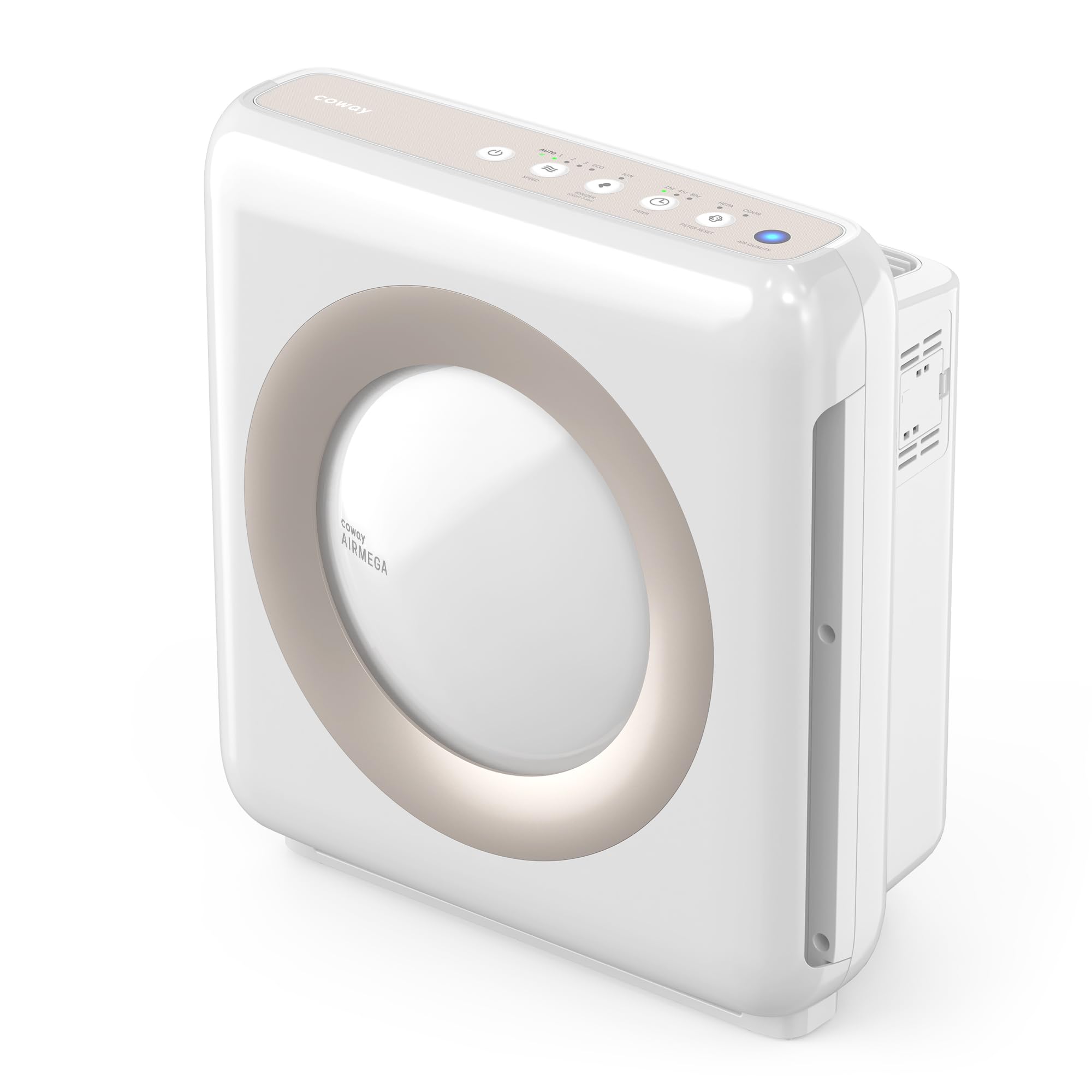
Coway AP-1512HH
Key Features
- Noise (Sleep Mode): 24.4 dB
- Filter Type: 4-stage True HEPA, deodorization
- Smart Features: Auto mode, eco mode, timer, filter indicator
- Price: Upper Mid-Range
Where the top pick leans on whisper-quiet auto-sensing, the AP-1512HH counters with a more muscular fan that can fully turn over the air in a 361 sq ft room in under 13 minutes, making it a particularly fast cleaner for allergy spikes. Its washable pre-filter grabs lint and hair, protecting the durable True HEPA filter, which owners replace less often than predicted.
The AP-1512HH is built for allergy sufferers in bedrooms, nurseries, or home offices up to about 360 square feet, where its fast-clearing airflow tackles pollen and dust. If the faint ozone-like scent from the ionizer bothers you, the unit operates just as effectively with the ionizer switched off—a simple press of a button. At full speed, the fan is audible and some units have a slight vibration, but on auto or eco modes, the noise drops to a hum that easily blends into daytime background sound.
Pros
- High CADR provides thorough air cleaning for rooms up to 361 sq ft.
- Air feels noticeably fresher within minutes of turning on.
- Filters hold up well, reducing long-term costs.
- Controls and filter swaps are straightforward, no manual needed.
Cons
- Ionizer can leave a faint ozone smell—switch it off and mechanical filtration remains fully effective.
- Maximum fan speed is loud and some units vibrate, making high-speed use disruptive in quiet spaces.
If you want a no-nonsense medium-room purifier that filters aggressively on demand and idles quietly in eco mode, the AP-1512HH delivers long-term value with filter durability that outpaces many peers. Just disable the ionizer and enjoy clean air without the chemical whisper.
Best for Small Rooms
Levoit Core 200S-P
Key Features
- Noise (Sleep Mode): 27 dB
- Filter Type: 3-in-1 pre-filter, HEPA, carbon
- Smart Features: Voice/app control, sleep mode, display off
- Price: Budget
AHAM certification at 140 sq ft gives the Core 200S-P a credibility edge over many budget competitors, and the 3-in-1 nylon pre-filter, activated carbon, and True HEPA filtration deliver noticeable dust and odor reduction in modest spaces. Sleep mode drops noise to 27 dB, quieter than a whisper, while the VeSync app and Alexa support let you tweak speed, set schedules, or check filter life without bending over. For a unit this small, the smart feature set is unusually complete.
This purifier is built for dorm rooms, nurseries, and home offices up to about 150 sq ft. The 140 sq ft coverage ceiling means larger living areas will need multiple units, making it a specialist rather than a whole-home solution — if your space tops 200 sq ft, the top pick’s 392 sq ft range is a better fit. Inside its boundaries, filter swaps are tool-free and guided by a simple app prompt, so ongoing upkeep stays minimal.
Pros
- Noticeably cuts dust and odors in small rooms
- Stands up to daily use with durable, well-built construction
- App and voice controls make operation nearly hands-off
- Strong value given the AHAM verification and smart connectivity
Cons
- Coverage caps at 140 sq ft; larger rooms demand multiple units or a more powerful purifier
For small rooms under 150 sq ft, this Levoit brings AHAM-verified cleaning and smart features at a price that’s hard to argue with — just keep expectations within its footprint.
Best for Pet Owners
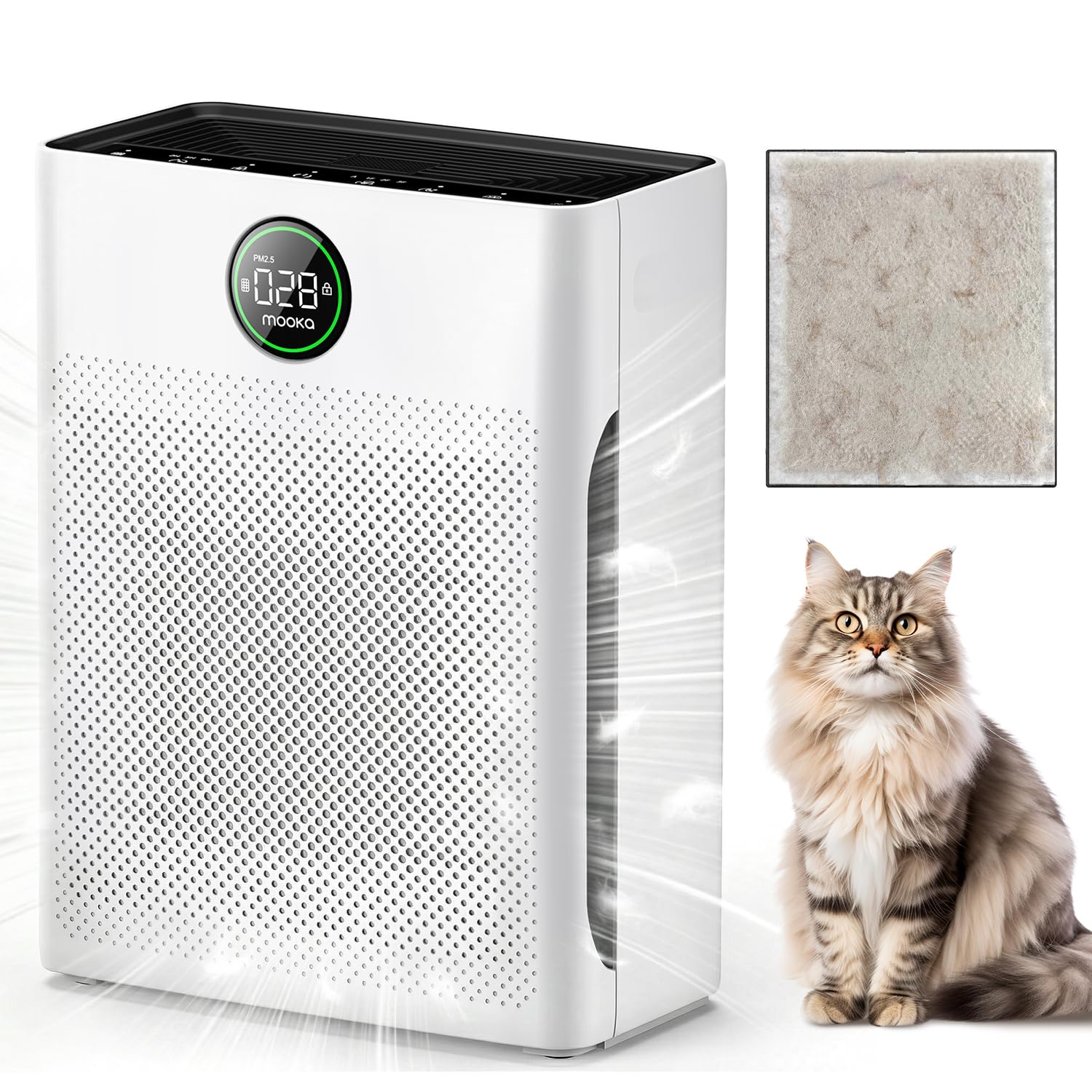
MOOKA PR1
Key Features
- Noise (Sleep Mode): 26 dB
- Filter Type: 4-stage, washable pre-filter, HEPA
- Smart Features: Pet mode, PM2.5 display, auto mode, aroma tray
- Price: Mid-Range
The PR1’s dual-inlet design feeds a pet-specific mode that escalates fan speed when particulate readings rise, capturing dander and fur before they settle. A washable pre-filter intercepts larger debris, prolonging the main HEPA filter’s life, and a front-facing display shows a numeric PM2.5 index that updates in real time — a feature the top-ranked Winix omits.
The filtration output is tangible: a noticeable drop in allergy symptoms and pet-related odors surfaces within the first few days. The tradeoff is the fan. On medium and high, the sound becomes distinctly audible, enough to be a nuisance if the purifier sits in a bedroom. At sleep mode (26 dB) it’s unobtrusive, so light sleepers will want to leave it on the lowest speed overnight.
This makes the PR1 a strong candidate for pet households with large open-plan areas up to 2,200 sq ft, where daytime noise tolerance is higher and the visual AQI feedback helps track pollen or dander spikes. The included aroma tray and child lock are thoughtful, but the real draw is the aggressive odor and particle control at a mid-range price.
Pros
- Highly effective for allergies and dust, working quickly to relieve symptoms
- Noticeably fresher air within days of use
- Outstanding at trapping pet hair and neutralizing odors
- Simple setup and intuitive controls
Cons
- Fan noise on medium and high speeds can be intrusive in quiet bedrooms
If shedding pets and real-time air quality feedback rank high on your list, the PR1’s aggressive dander control and AQI display justify the mid-range price — as long as you accept that its higher fan speeds won’t go unnoticed.
Best for Large Rooms
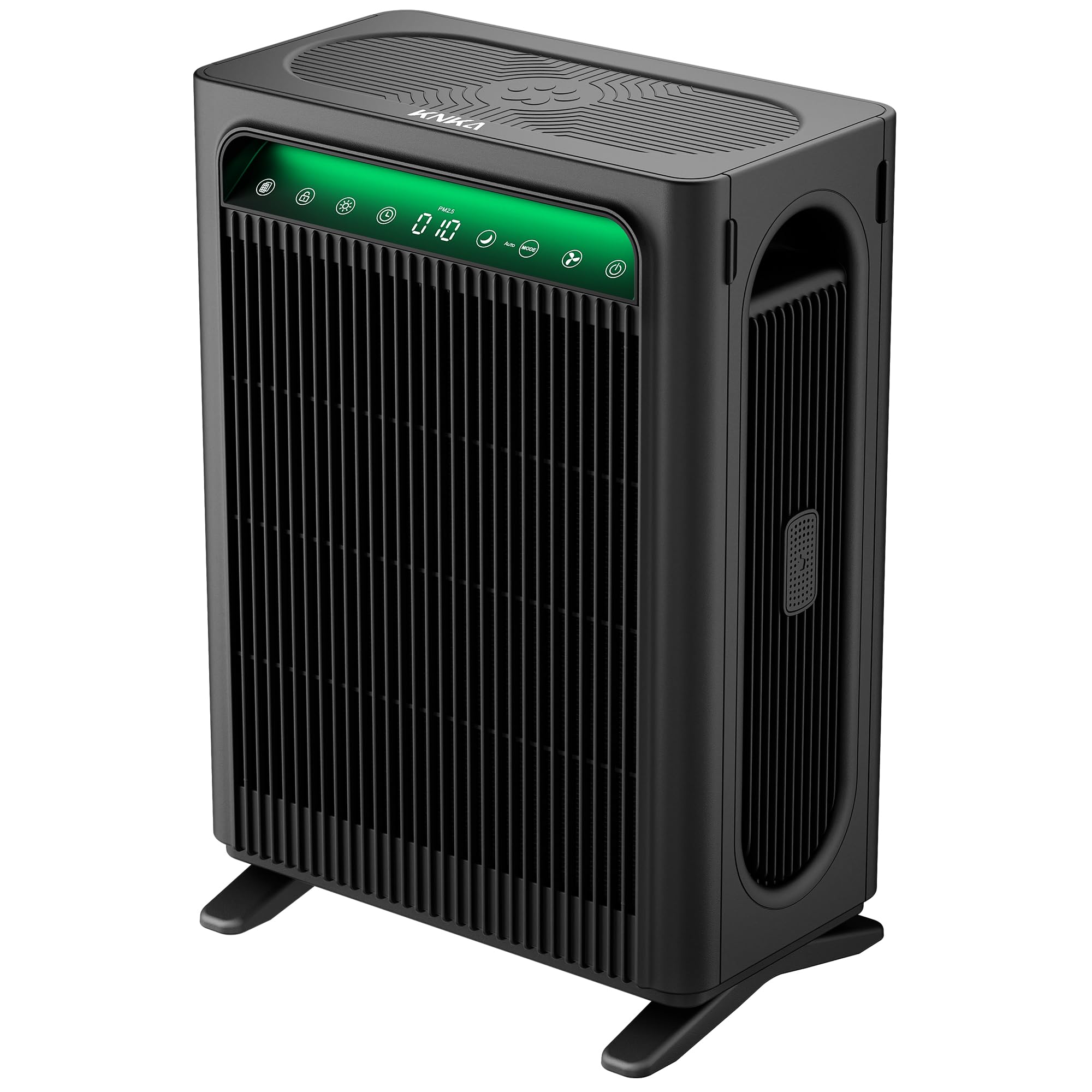
KNKA APH4000
Key Features
- Noise (Sleep Mode): 22–24 dB
- Filter Type: Dual 3-stage, washable pre-filter
- Smart Features: Pet mode, eco mode, auto mode, AQI display
- Price: Mid-Range
The APH4000 anchors its value on AHAM-verified CADR numbers — 226 cfm for smoke, dust, and PM2.5 — that outperform many purifiers in its price bracket. It handles rooms up to 350 sq ft with 4.8 air changes per hour, far exceeding the 1x/hr standard used to inflate coverage claims. Compared to a premium smart competitor with similar square-footage specs, this unit maintains effective purification without the aggressive fan noise that intrudes at high speeds, making it a quieter choice for living areas.
Pet mode, auto mode, and a real-time AQI display come together to reduce manual fiddling. The dual 3-stage filters include a washable pre-filter that captures fur and large particles before they hit the HEPA layer, extending the main filter’s life slightly. From unboxing to first clean air, assembly takes only a few minutes and the filter replacement process requires no tools. Sleep mode drops output to a measured 22–24 dB — truly background-free — and the AQI panel dims to avoid light disturbance.
This purifier suits large-room households that want AHAM-backed filtration, real-time air quality feedback, and silent overnight operation at a mid-range price. Light sleepers and pet owners gain the most from the whisper-quiet sleep mode and pet-specific cycle. The trade-off is ongoing maintenance cost: replacement filter packs are not cheap over time, and while the washable pre-filter helps space out full replacements, yearly filter expenses can erode the initial price advantage.
Pros
- Near-silent 22 dB sleep mode won’t disturb light sleepers.
- Dual 3-stage filtration removes fine particles and odors quickly.
- Large-room coverage with AHAM-certified CADR for true performance.
- Tool-free assembly and simple filter replacement out of the box.
Cons
- Replacement filter costs can add up noticeably over the unit’s lifetime, offsetting the moderate upfront price.
If near-silent operation and AHAM-backed large-room performance matter more than smart home integrations and long-term filter expenses, this purifier delivers exceptional air cleaning for its price.
Best for Very Large Spaces
Blueair 211i Max
Key Features
- Noise (Sleep Mode): 23 dB
- Filter Type: HEPASilent, 99.97% to 0.1 micron
- Smart Features: App, Alexa, scheduling, air quality monitor
- Price: Premium
Where the top pick targets AHAM-certified medium rooms, the Blueair 211i Max scales up with HEPASilent dual filtration that scrubs 3,048 sq ft in one hour on high. Wi-Fi connectivity brings app-based scheduling, geofencing, and Alexa voice control—tools appreciated in multi-room smart homes. Air quality monitoring auto-adjusts fan speed when pollution spikes, and build quality feels substantial, with a dense filter and sturdy housing.
This purifier fits tech-inclined households with open layouts pushing 2,000 sq ft or more. The trade-off: fan noise becomes intrusive at top speed, so bedrooms without lower-speed scheduling may find it disruptive. Replacement filters carry a premium price, making running costs higher than with smaller units. If your priority is whole-floor purification that you can automate from your phone and you accept the ongoing filter expense, the Blueair makes sense.
Pros
- Durable construction with robust fan and high-quality filter materials.
- Auto-sensing quickly adjusts to clear visible dust and pollen, improving air quality without manual input.
- App-guided setup with scheduling, air quality history, and Alexa voice integration.
- Swift particle removal in large, open spaces—effective during renovations and high-pollen seasons.
Cons
- Fan noise can rise to intrusive levels at higher speeds, which may disturb light sleepers or quiet-room use.
For expansive, open-plan homes that need app-driven purification across thousands of square feet, the Blueair 211i Max delivers reach and smart control; noise at high speed and premium-priced filters are the price of that scale.
Best for Large Living Rooms
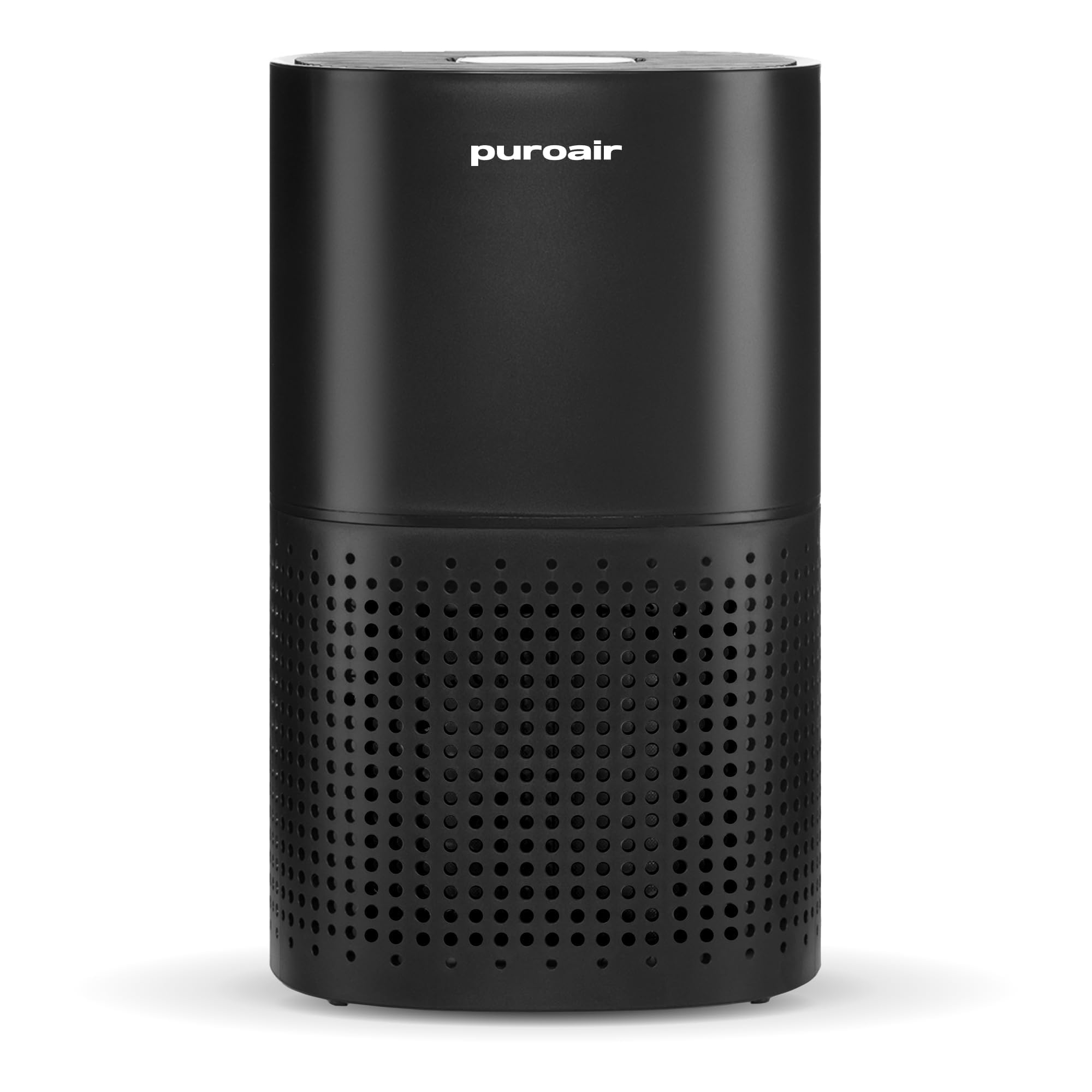
PuroAir 240
Key Features
- Filter Type: 3-stage pre-filter, HEPA, carbon
- Smart Features: Auto mode, sleep mode, filter indicator
- Price: Mid-Range
The PuroAir 240 delivers quiet, effective air cleaning for large rooms, with an auto mode that adjusts fan speed based on its particle sensor. On low, the sound blends into background noise like white noise, making it a favorite for bedrooms and living areas. Air freshness often improves noticeably within hours, and the filter replacement is simple. Build quality holds up well over time. The trade-off: without AHAM verification, its CADR figures cannot be cross-checked against certified competitors. For buyers who prioritize independent lab validation over the quietest operation, this unit leaves an unanswered question.
Pros
- Quiet fan output that fades into background noise, enabling undisturbed sleep.
- Noticeable freshening of indoor air within a short time of starting the unit.
- Effortless setup and filter maintenance, reducing the day-to-day effort.
Cons
- Lacks AHAM certification, so CADR claims remain unverified — a gap when comparing against certified models.
The PuroAir 240 suits families who value near-silent purification in large living spaces and don’t require independent CADR verification for their peace of mind.
Best for Large Rooms
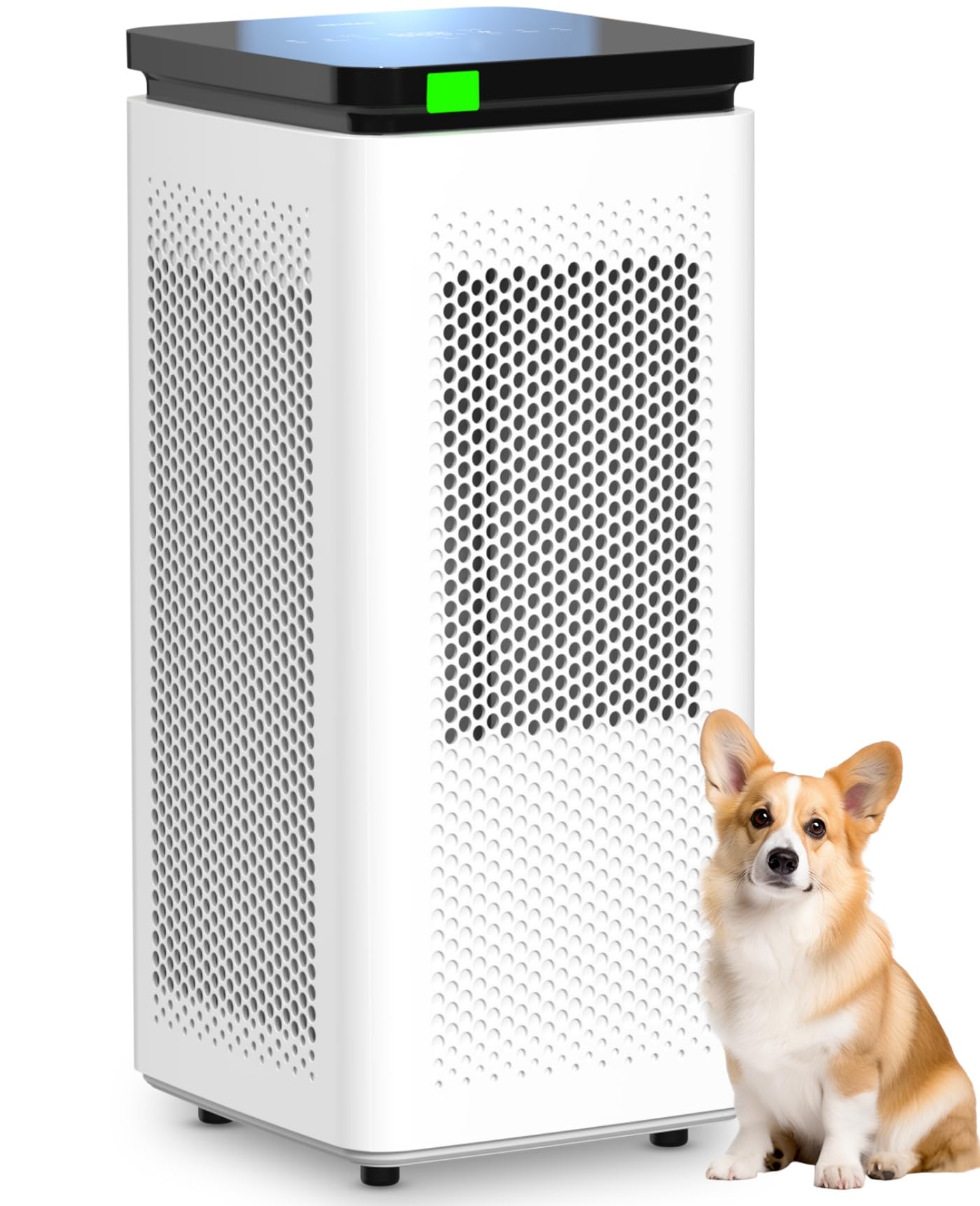
SIESEAN AP-400
Key Features
- Noise (Sleep Mode): 30 dB
- Filter Type: H13 True HEPA + carbon, dual-sided
- Smart Features: PM2.5 display, auto mode, child lock, timer
- Price: Mid-Range
The AP-400 pulls air from both sides, generating enough throughput to refresh 500 square feet in about 15 minutes. That raw CADR sits comfortably alongside units at higher price points, and real-world use backs it up: dust and pollen clear out noticeably, and pet odors drop fast. Sleep mode runs at just 30 dB, making it easy to forget the machine is on at night.
The less certain piece is longevity. SIESEAN hasn’t yet built the multi-year review history needed to confirm how its filters age under constant use. That makes it a better fit for shoppers prioritizing immediate hands-on performance over a tenured brand track record — think large, open-plan homes with pets or smoke where high CADR matters most right now.
Pros
- Improves air noticeably, removing dust and pollen without trace.
- Powerful purification with high CADR suited for large rooms.
- Quiet operation, barely audible in sleep mode.
Cons
Best for open-concept homes dealing with pet dander or smoke where immediate high-CADR performance matters more than an established brand legacy — a strong early-adopter pick for large-room air cleaning.
Best for Large Rooms
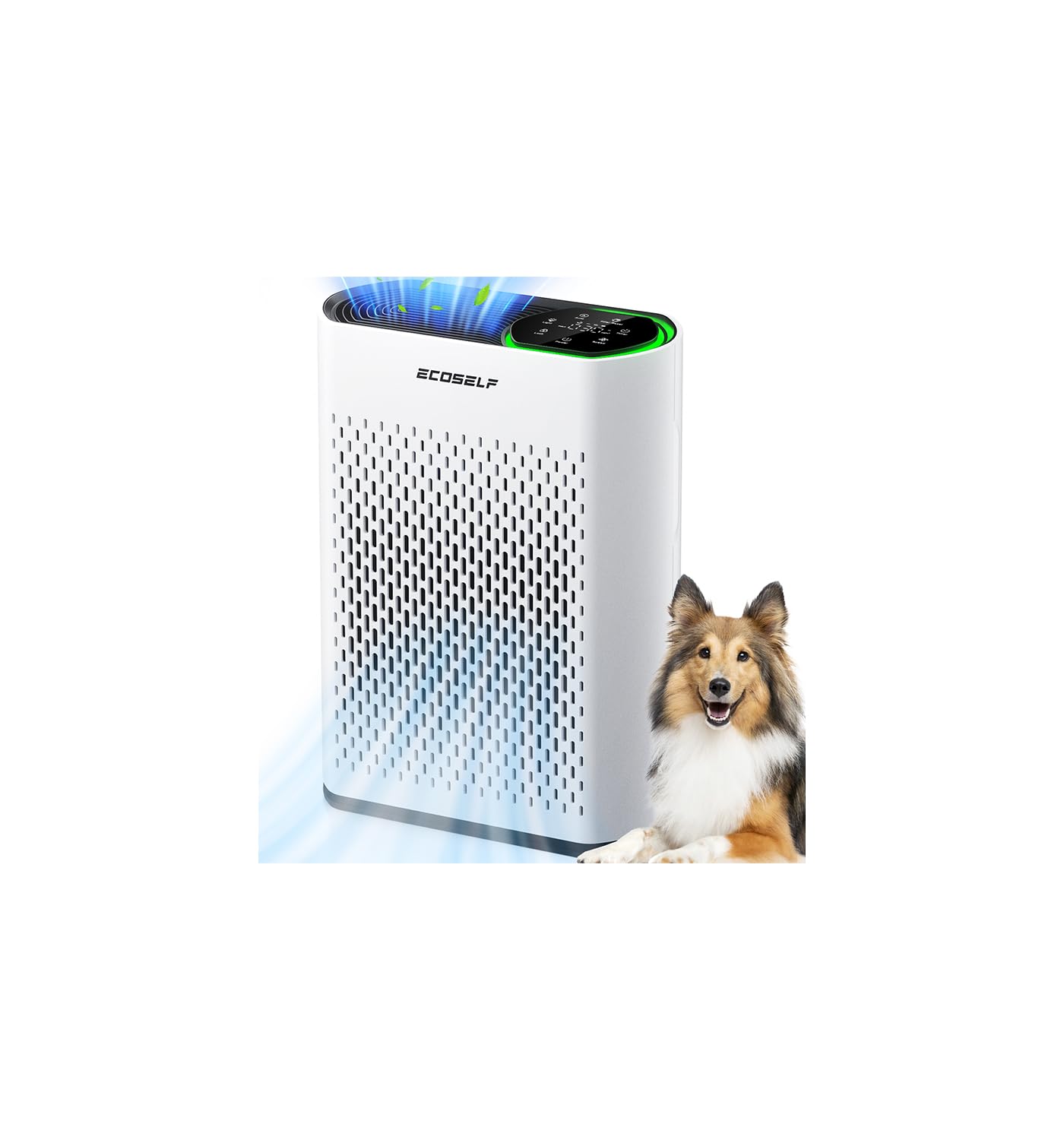
ECOSELF HAP-602
Key Features
- Noise (Sleep Mode): 20 dB
- Filter Type: 3-stage True HEPA, 360° airflow
- Smart Features: PM2.5 display, auto mode, child lock, touch panel
- Price: Budget/Mid-Range
The HAP-602 pairs 360° airflow with a 3-stage True HEPA filter that captures dust, dander, and pollen across open-plan spaces. Users observe a drop in airborne particles and noticeable allergy relief within the first day of operation. The 20 dB night mode is essentially inaudible, doubling as gentle white noise in bedrooms. A large touch panel with PM2.5 readout and intuitive controls keeps the unit straightforward to operate, and the compact floor-stand design fits beside furniture without dominating the room.
Long-term durability and sensor consistency are untested — filter lifespan claims and PM2.5 accuracy over multiple seasons remain open questions. This makes the HAP-602 a strong fit for tech-friendly shoppers who prioritize a low-noise, high-coverage unit and accept the tradeoff of a less-established brand.
Pros
- Noticeable allergy relief within days, with many buyers reporting easier breathing.
- 20 dB night mode runs virtually silent, providing white noise that helps light sleepers.
- Touch panel and filter access are fuss-free — setup and cleaning take minutes.
Cons
For a budget-friendly, ultra-quiet large-room purifier with a clean PM2.5 display, the HAP-602 delivers — as long as you’re comfortable with a newer brand still building its track record.
Best for Small Rooms
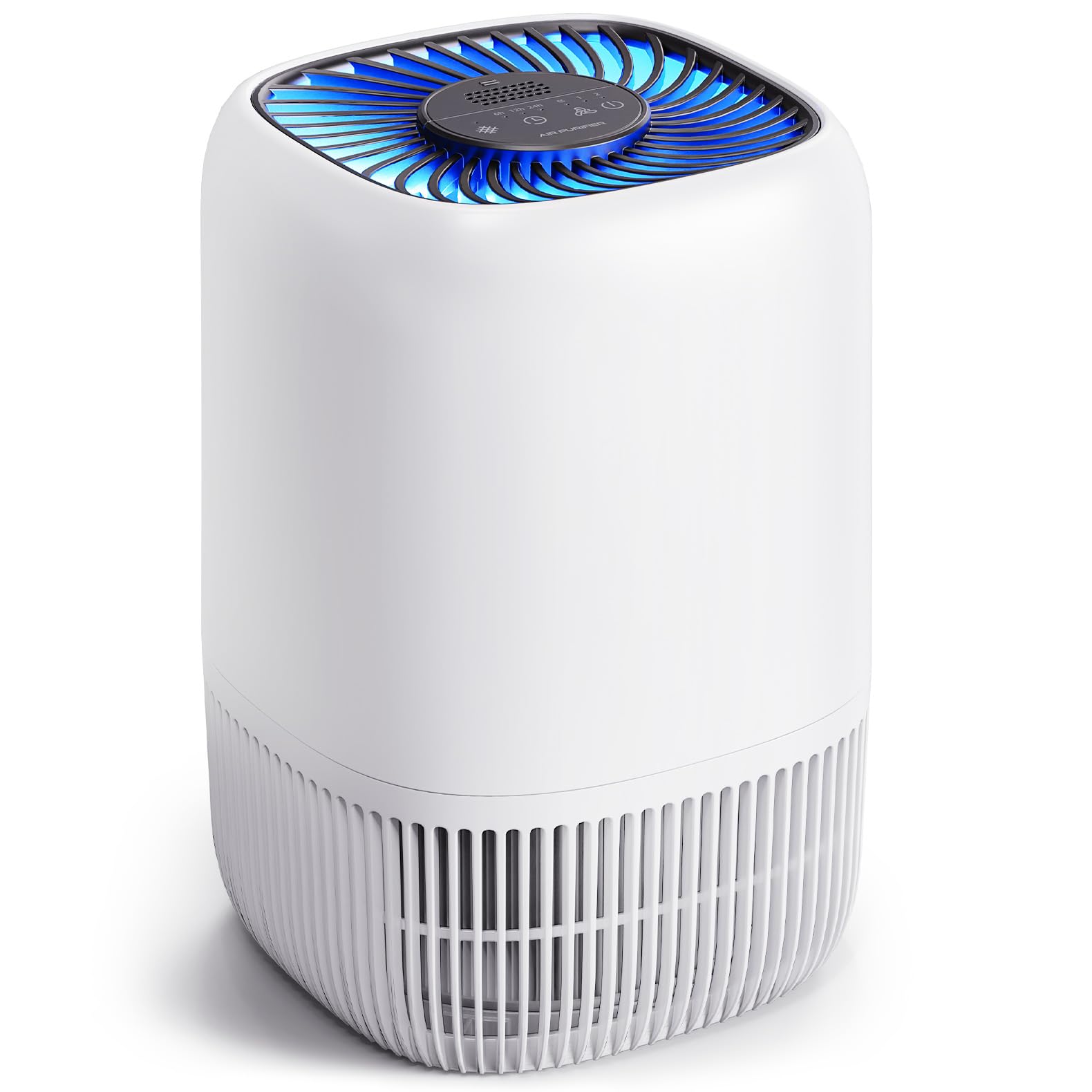
VOOPNU DH-JH12
Key Features
- Noise (Sleep Mode): 22 dB
- Filter Type: H13 HEPA 3-layer
- Price: Budget
The VOOPNU DH-JH12 delivers H13 HEPA filtration at a price that makes it hard to justify breathing unfiltered air in a cramped space. It runs at just 22 dB, so it stays inaudible during work or sleep, and the 360-degree intake pulls dust and pet dander through a three-stage filter effectively. Setup takes minutes, and the compact shape fits on a desk or nightstand without dominating the surface. Its coverage, however, caps out around 250 square feet — it won’t handle living rooms or open-plan areas. You also trade app control, air-quality readouts, and auto-mode smarts for sheer affordability; this is a strictly manual device. For a small office, cubicle, or bedroom where silence and value come first, it’s a sensible low-cost pick.
Pros
- Whisper-quiet at 22 dB for all-day silent operation
- Effectively reduces dust and pet dander in tiny spaces
- Remarkably low price for H13 HEPA filtration
Cons
- Designed for spaces under 250 sq ft — not for living areas or open rooms
- No app, smart sensors, or air-quality display; manual controls only
If your budget is tight and you need a purifier for a small workspace or bedroom, the VOOPNU offers quiet, effective filtration for an entry-level price — just don’t expect it to handle anything beyond that single room.
Best for Tiny Spaces
FULMINARE PU-P05

This compact purifier delivers effective HEPA filtration and whisper-quiet operation on its low setting, ideal for a nightstand or nursery. The built-in night light and aromatherapy tray add convenience for small rooms. However, its coverage is capped at 215 sq ft (based on 5 air changes per hour), making it unsuitable for living rooms or open areas. If your space is a desk corner, dorm bed, or infant room, this affordable unit works well. But for any larger room, you will need a more powerful machine.
Pros
- True H13 HEPA captures allergens, dust, and fine particles effectively in small spaces.
- Quiet enough for sleep at low speed — rated 24 dB, barely audible.
- Budget-friendly with low-cost replacement filters and simple setup.
Cons
- No air quality feedback — you set timers without knowing current particle levels.
- Lacks Wi-Fi or smart home integration, limiting remote control options.
Best reserved for a small desk, nightstand, or nursery where its size, quiet operation, and night light add value — not a primary room purifier.
How to Choose
The biggest mistake when buying an air purifier is trusting the "cleans up to X square feet" claim without checking the cleaning standard behind it—many listings assume just one air change per hour, which does almost nothing for allergies.
AHAM Verified CADR
CADR (Clean Air Delivery Rate) tells you how many cubic feet of clean air the purifier delivers per minute for dust, pollen, and smoke. Independent AHAM verification prevents inflated marketing—without it, you’re gambling on manufacturer claims.
The hidden trade-off: a high CADR requires stronger fans, which can be noisier, but you need enough CADR to achieve 4.8 air changes per hour in your space. For a 150 sq ft bedroom, aim for a dust CADR around 100 cfm to actually reduce allergens while you sleep.
Room Coverage at 4.8 ACH
Allergy relief depends on the purifier clearing the entire room’s volume at least 4.8 times every hour. Advertised "coverage" often means 1 ACH, which merely stirs the air. The real room size for effective purification is the one rated at 4.8 ACH—usually listed on AHAM-certified models.
The practical trap: a unit rated for 500 sq ft at 4.8 ACH will dominate a 120 sq ft room, running at max speed and wasting energy and silence. Measure your room, then divide by the unit’s 4.8 ACH rating to find a match, not a mismatch.
Noise at Sleep Mode
A purifier in the bedroom must run while you sleep, yet many only hit a low dB rating by sacrificing CADR. Sleep modes often throttle the fan so much that air cleaning drops dramatically, leaving you with a silent but ineffective machine.
Look for units with a sleep mode under 30 dB that still maintain a meaningful CADR. Manufacturers that list both the noise and the CADR at that level give you the real picture—otherwise, you’re choosing between noise and clean air.
Filter Type
True HEPA captures 99.97% of 0.3 micron particles, while activated carbon tackles odors. Ionizers, even when marketed as ozone-free, can create a subtle chemical smell that disturbs sleep for sensitive people. Washable pre-filters extend main filter life but require frequent rinsing.
For bedrooms, choose True HEPA without an ionizer, or a unit where the ionizer is easily disabled. Check filter replacement costs—some proprietary filters cost nearly as much as the unit itself every year, eating into the initial savings.
Smart Features
Auto mode uses a particle sensor to adjust fan speed based on real-time air quality, which saves energy and keeps noise low when the air is clean. But sensors can become inaccurate if dust accumulates on the lens, leading to a fan that runs too high or not at all.
Choose models with an exposed sensor window you can wipe, and consider whether you actually need app control or just a reliable auto mode. A basic auto mode with a timer often provides the set-it-and-forget-it experience most sleepers want.
FAQ
Why does my air purifier smell like chlorine or burning plastic?
This smell usually comes from the ionizer producing trace ozone, or from off-gassing of a brand-new carbon filter. Run the purifier in a well-ventilated room for 24 hours on the highest setting to burn off any residue. If the smell persists, turn off the ionizer or replace the carbon filter; a mechanical HEPA-only unit will not produce this odor.
What does ‘cleans rooms up to X square feet’ actually mean?
Most manufacturers assume a single air change per hour, which barely makes a dent in allergens. For real allergy relief, you need a unit that can do 4.8 air changes per hour in your room. Multiply your room’s square footage by the ceiling height to get cubic feet, then divide the purifier’s CADR by that number: a CADR of 100 cfm suits a 150 sq ft bedroom at 4.8 ACH.
Is it safe to run an air purifier with an ionizer in the bedroom overnight?
Ionizers can emit trace levels of ozone, which some people experience as throat irritation or a chemical odor, even if the device is marketed as ozone-safe. If you’re sensitive or want absolute quiet, choose a model without an ionizer, or one where you can disable it. For undisturbed sleep, pure mechanical HEPA filtration is the safest bet.
Can an air purifier really help with dust mite allergies while sleeping?
Yes—air purifiers capture airborne dust mite particles and fecal pellets before you inhale them. Use a True HEPA unit rated for at least 4.8 air changes per hour in your bedroom size, and run it on low speed overnight. The steady circulation keeps allergens out of your breathing zone, making a noticeable difference in morning congestion.