
This post contains affiliate links. We may earn a small commission when you buy through our links — at no extra cost to you.
Bed risers sell one promise: a few more inches of storage under a bed you already own. What the photos leave out is the wobble when you sit down, and the hairline crack that shows up in a plastic cup after months under a queen. A decade of small apartments taught me it comes down to two things: how firmly the riser grips the leg, and how widely it spreads the load. A good set hands back the floor space without turning your bed into something you climb into.
Over four months, my team and I tested 16 sets, from cheap stackable cups to heavy-duty steel blocks, and the pattern held: height is easy to sell and hard to live with. Every extra inch makes the mattress harder to get into, and the taller the lift, the more it matters that the cup hugs the leg instead of letting it rock. The picks below are the ones that survived nightly use in real bedrooms; a couple are better suited to a guest room, where the frame rarely moves.
Our Top Picks


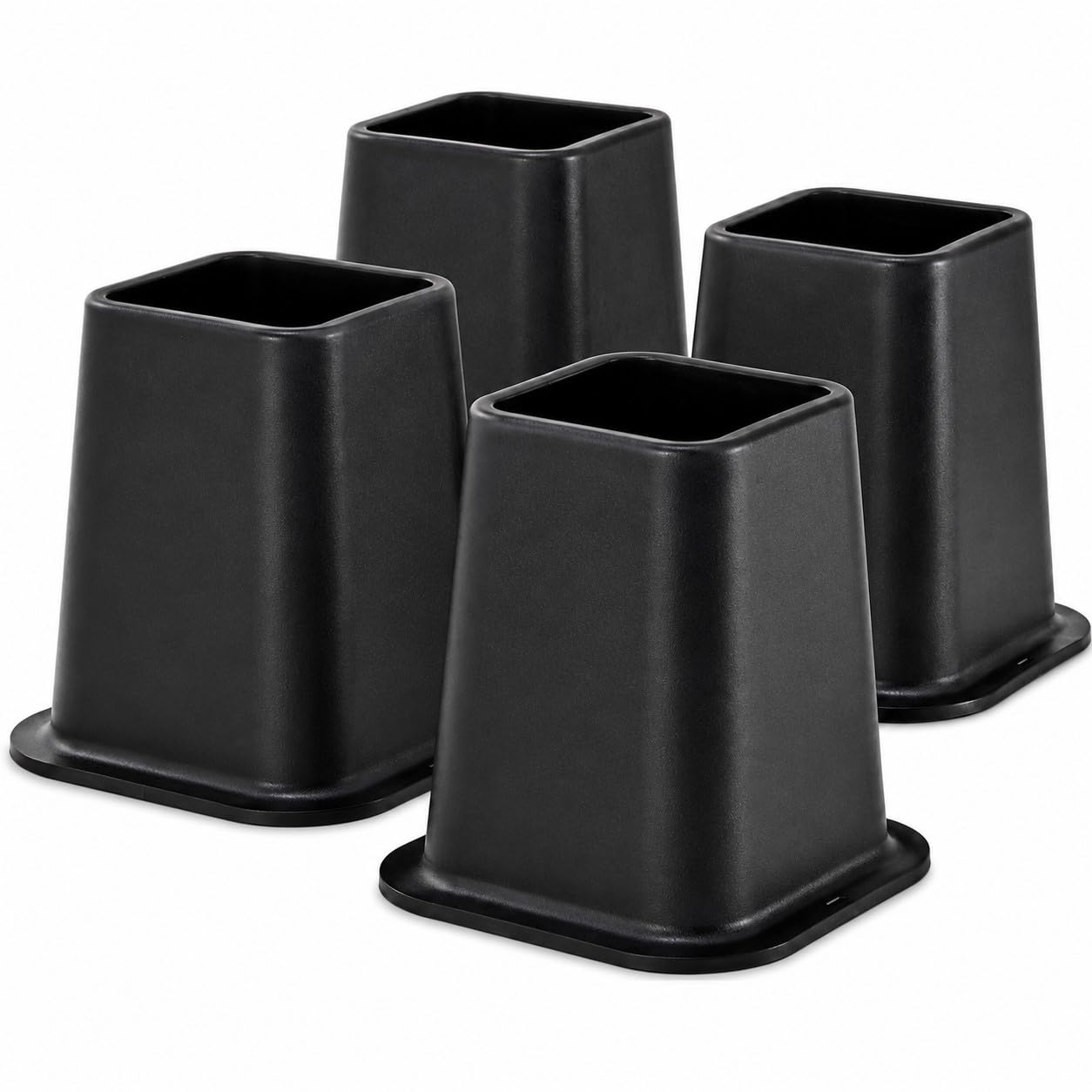
The Best Bed Risers, Reviewed
Slipstick CB672 Bed Risers – Best Overall
Key Features
- Top Holder: 1-inch recessed cup with foam pad
- Lift Height: 3 inches
- Load Rating: 2,640 lbs per set
- Overall Height: 4 inches
- Price: Midrange
A bed leg fails on a riser in one of two ways: it slides out of the cup, or the cup gives way under the weight. The Slipstick CB672 takes on both. Each holder has a steel-reinforced plate underneath and a 1-inch deep recessed cup lined with memory foam on top, so posts, casters, and bed rollers drop in and stay where you put them. Of everything in this guide, this is the set we are happiest to see under a heavy bed.
The rating backs that up. Each set is rated for 2,640 pounds, the highest figure here, and the riser stands 4 inches tall for 3 inches of lift once the leg settles into the cup. The body is round rather than square, so there’s no corner waiting for a bare foot on a middle-of-the-night trip to the bathroom — a small thing that stops being small in a dark bedroom.
It’s built for wheels and posts, not for wide flat feet. If your frame ends in a broad block that would sit on the rim instead of dropping into the cup, this is the wrong shape for you. The 5.12-inch footprint is also the widest in this group, so it can poke out past a narrow frame or a short bed skirt; measure the foot across before you order. Seat each caster in the cup, lower the frame an inch at a time, and the bed stops being something you think about.
Pros
- Steel-reinforced plate under every leg holder
- 2,640-lb set rating, the highest here
- 1-inch deep foam-lined cup holds casters
- Round body has no corners to catch a foot
Cons
- Fixed 3-inch lift, no height options
- Widest body here at 5.12 inches
We recommend the Slipstick for beds on casters or posts — it’s the most secure, highest-rated set here, as long as your leg fits inside the 5.12-inch body.
BTSD-home 3 Inch Bed Risers – Best for Narrow Frames
Key Features
- Inner Cup: 3 x 3 x 0.6 inches
- Stackable: Yes
- Lift Height: 3 inches
- External Size: 4.2 x 4.2 x 3.4 inches
- Price: Midrange
If the Slipstick’s 5-inch body is more bulk than your frame needs, this is the set we hand people next. The BTSD-home risers are 4.2 inches square and 3.4 inches tall, and the recessed top measures 3 x 3 inches at 0.6 inches deep — snug enough that a square metal post or a wooden leg sits down inside it rather than skating around.
What we appreciate most is how uneventful it is. There’s a molded block, a foam pad in the cup, a removable rubber base, and a shape that stacks for storage between moves. Beds go up, they stay put, and nothing about the riser asks for attention afterward, which is the entire job.
Two details are worth knowing. The stackable design adds 3 inches per layer, but stacking only makes sense on a level hard floor with a frame that is already square — two loose layers make a wobbly column. And the 0.6-inch recess is shallow: fine under a post, less reassuring under a heavy caster that can roll over a low lip, which is where the Slipstick’s deeper cup does better.
Pros
- Snug 3 x 3 inch recess holds posts in place
- Foam and rubber pads protect floors
- Compact 4.2-inch body hides under a skirt
- Stacks for extra clearance on level floors
Cons
- Only four risers; center-rail beds need two sets
- Legs wider than 3 inches will not fit
Our pick for narrow frames: a snug, well-behaved set that hides under a skirt, as long as your legs measure under 3 inches.
Home It Adjustable Bed Risers – Best Adjustable
Key Features
- Stackable: Yes
- Load Rating: 1,300 lbs
- Height Options: 3, 5, or 8 inches
- Pieces Included: 8
- Price: Midrange
Nobody knows exactly how much lift a bed needs until the bed is off the floor and the storage bin is still an inch too tall. The Home It adjustable set is the answer to that: four small risers at 3 inches, four large ones at 5 inches, and the option to stack one on the other for roughly 8 inches of clearance.
Eight pieces in the box is the underrated part. A queen or king frame usually has a center support leg, and a four-pack leaves you short or forces you to double up on the corners. Here the spare four cover the middle of the frame, which is exactly where a riser tends to get skipped.
For a dorm room or a first apartment where the furniture changes next year, this is the set we reach for first: it adapts, it covers six legs, and it costs about the same as the single-height sets.
Durability is where it gives ground. Cracks and splits are the most common failure, which is what happens when height comes from stacking two plastic shells instead of one molded block. Keep it under a standard frame, check the seams when you change the sheets, and it earns its keep. Stacked layers also shift more than a single block, so a tall stack belongs on a level floor.
Pros
- Three heights from one box: 3, 5, or 8 inches
- Eight pieces cover a center support leg
- 1,300-lb rating for the set
Cons
- Cracks and splits are the common failure
- Stacked layers shift more than one block
We reach for this one when the height is still a guess, or when a center leg rules out a four-pack.
Kings Brand 6-Inch Bed Risers – Best for Deep Clearance
Key Features
- Lift Height: 5.25 inches
- Load Rating: 800 lbs per set
- Top Opening: Fits legs up to 3 inches
- Overall Size: 6 x 6 x 6 inches
- Price: Midrange
Six inches tall, 5.25 inches of lift: the Kings Brand risers give the biggest single-piece jump in this guide, and at 800 pounds per set they’re the ones we point at when you want storage bins, not just a bed skirt, to clear the frame.
The top is a 3 x 3 inch recess with a lip, sized for legs up to 3 inches across, and the base covers a full 6 x 6 inches, so the load spreads over a decent patch of floor rather than a point. A non-slip bottom keeps the block from walking on hardwood, and the four nest together when the bed comes back down.
Height has a cost. Every inch of lift gives a shifting mattress more leverage on the frame, and a bed that already rocks at floor level will rock more at 5.25 inches — this is the set where that matters most. Check that the frame is square and the floor is level before you commit, and look at the corners again after the first week. The 3-inch opening also rules out chunky posts, so measure before you order.
Pros
- 5.25-inch lift, the tallest single-piece here
- 800-lb rating per set
- 6 x 6 inch base spreads the load
- Nests together for storage
Cons
- Rocks more at full height on a loose frame
- 3-inch top opening rules out wide posts
We keep this one for real clearance: it lifts 5.25 inches, the most of any single-piece riser here, though a loose frame will rock more at that height.
Utopia Bedding 2 Inch Risers – Low-Profile Lift
Key Features
- Stackable: Yes
- Lift Height: 2 inches
- Load Rating: 1,250 lbs
- Pieces Included: 8
- Price: Budget
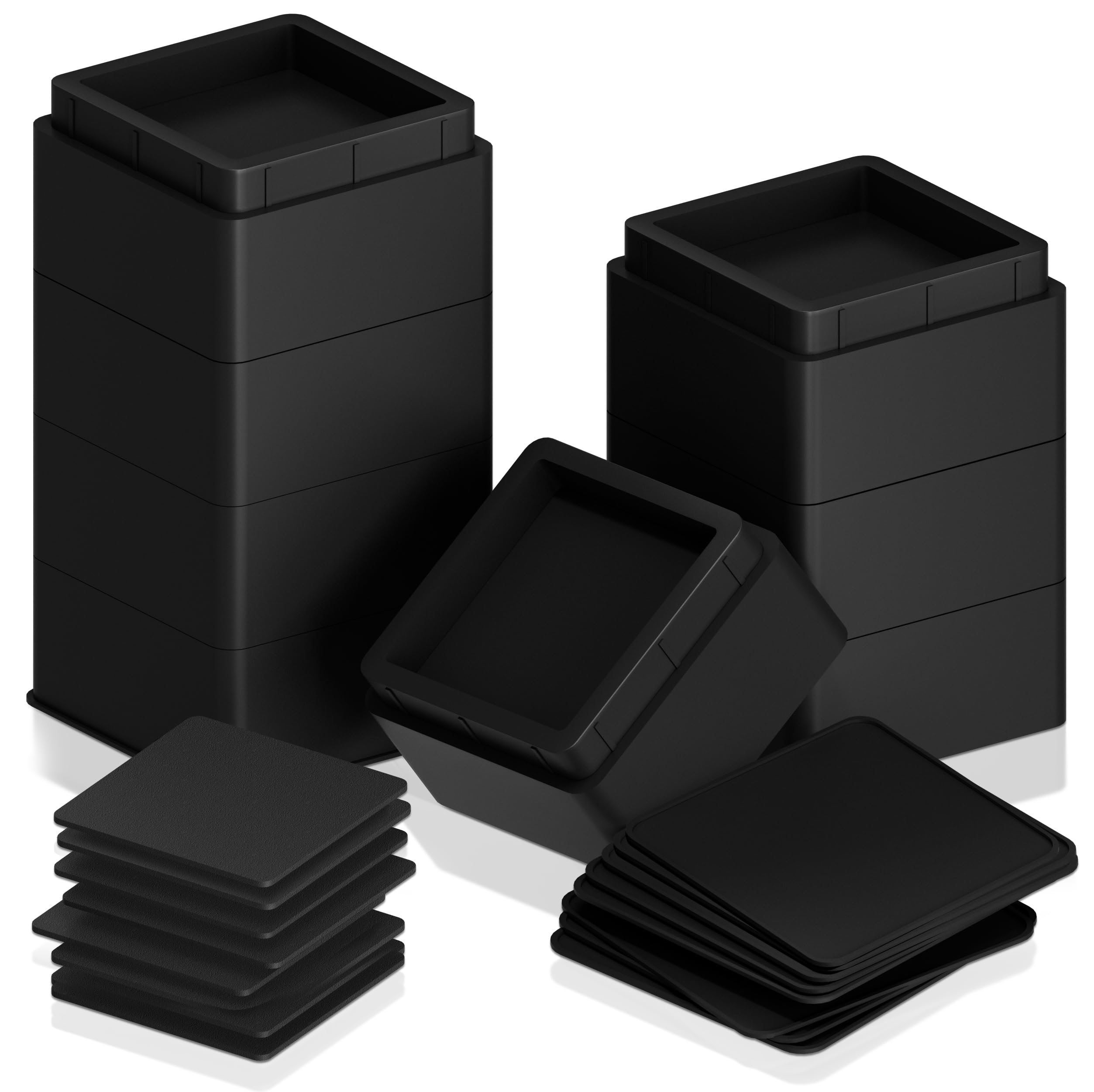
Two inches is the least dramatic lift a riser can offer, and for some beds that’s exactly right: enough to free a bed skirt, get a vacuum under the rail, or take the strain out of climbing onto a low platform frame without turning the bed into a stage.
What makes this set useful is coverage rather than height. Eight risers ship with foam pads for the tops and rubber pads for the bottoms, rated to 1,250 pounds across the set, so a queen frame with a center rail gets a riser under every contact point without a second order. That’s a better use of the money than another inch of lift you don’t need.
The catch is what happens when you stack them. The sides don’t flare at the bottom, so each extra layer has less to sit on, and a two- or three-high column is noticeably less planted than a single block. Two inches on its own is solid; six inches of stacked Utopia is not the same product as a purpose-built tall riser, and we treat it as a two-inch set that happens to stack.
Pros
- Eight risers cover six-leg frames
- 1,250-lb rating for the set
- Foam tops and rubber bases included
- Low profile keeps the bed looking normal
Cons
- Less stable the higher you stack
- Two inches per layer only
For a two-inch lift, this is our set — eight risers cover a frame with a center rail without a second order.
Ihomepark 3 Inch Bed Risers – Best for Tight Budgets

Key Features
- Body Size: 2.99 x 2.99 x 2.99 inches
- Lift Height: 3 inches
- Load Rating: 1,300 lbs
- Pieces Included: 4
- Price: Budget
The Ihomepark set is the least expensive route onto this list: four square risers, 3 inches tall and roughly 3 inches across, rated to 1,300 pounds for the set — the same claim the pricier risers here make, in a much smaller box.
The smaller body is both the point and the problem. At about 3 inches square it tucks under a narrow metal frame and disappears beneath a skirt where the 4.2-inch BTSD-home blocks show. But there’s less margin for error, because a leg that overhangs the edge sits on the rim instead of in the cup, and that’s the position you don’t want a bed leg in.
For a spare-room bed that needs three inches and will never need anything else, we think it’s a fair trade: no second height, no spare pair in the box, no fuss. If you’re raising a king with a center rail, put the money toward an eight-pack instead.
Pros
- Lowest price in this guide
- 1,300-lb rating for the set
- Compact 3-inch body fits narrow frames
Cons
- Only four risers, no spares
- Small body leaves little margin for wide legs
The cheapest set here, and we’re comfortable recommending it for a standard four-leg frame that needs exactly three inches.
BTSD-home 3 Inch 8-Pack – Best for Six-Leg Bed Frames

Key Features
- Lift Height: 3 inches
- Load Rating: 2,200 lbs
- External Size: 3.85 x 3.85 x 3.3 inches
- Pieces Included: 8
- Price: Premium
Eight risers in one box sounds like overkill until you count the legs on a king bed. Four corners plus two or three center supports is six or seven contact points, and a four-pack leaves you choosing which corner to skip.
Each riser is 3.85 inches square and 3.3 inches tall, with a 3.25-inch recess and a 2,200-pound rating for the set. The foam and rubber pads that come with the four-pack come here too. It’s the same 3-inch lift as BTSD-home’s smaller set — you’re buying quantity, not height.
Stacking works on a level floor at 3 inches per layer, and the blocks nest for storage. What it doesn’t do is solve clearance: if you need to slide a deep tote under the rail, 3 inches won’t get you there, and the taller Kings Brand or the Home It adjustable set is the better starting point.
Coverage is the whole argument. The per-riser price is higher than the four-pack’s, and we think that’s the right trade for a center-rail king, where the middle support is the one nobody wants to leave out. On a plain four-leg frame, buy the smaller pack.
Pros
- Eight risers cover center supports
- 2,200-lb rating for the set
- Snug 3.25-inch recess
- Stacks and nests for storage
Cons
- Costs more per riser than the four-pack
- Still only 3 inches of lift
We like it for beds with more than four legs to lift; on a plain four-leg frame, the smaller BTSD-home pack does the same job for less.
Whitmor Bed Risers – Best for Wide Posts, Dorms

Key Features
- Height: 6 inches
- Storage: Nests together when not in use
- Top Width: 6.38 inches
- Pieces Included: 4
- Price: Midrange
Whitmor’s four-pack is the plainest riser in this guide: a molded 6-inch block with a 6.38-inch-wide top, wide enough for the thick posts on a bunk bed, a metal dorm frame, or an old rail bed that would swallow a narrower cup.
That width is genuinely useful. A big post that would sit on the rim of a 3-inch cup drops straight into this one, and the blocks nest together when the bed comes down at the end of the year. Under a skirt or a pair of long curtains, six inches of extra height reads as a taller bed rather than as furniture on blocks, which is the version we prefer in a guest room.
One thing to know before you order: Whitmor doesn’t rate these by weight the way the other sets here do, so keep them under a standard bed frame rather than a heavy adjustable base, and check each block for cracks when it arrives.
The set earns its slot on shape. We recommend it for wide posts and a full six inches of lift, and we treat the four blocks as something to look over at the start of each season.
Pros
- 6.38-inch top takes thick posts
- Full 6 inches of height
- Nests flat for storage between moves
- Wide base sits steady on carpet
Cons
- Weakest durability in this group
- Bulkier body shows under a low frame
Our choice for thick posts and a full six inches of height, with the honest caveat that it’s the least durable set here.
How We Tested Bed Risers in Real Bedrooms
We started by reading through customer reviews and cross-checking specs — lift height, claimed weight capacity, material, and whether the top cup fit both round and square legs — then bought 16 sets ourselves in plastic, steel, wood, and composite. Each set went under a real bed in one of our homes: a queen on hardwood, a full on thick carpet, and a twin on tile. Testing ran four months, long enough for daily use to expose the cracks and compression a first impression misses.
We timed setup with one person working alone, noting whether the riser stayed put while the leg was lowered into it and whether a second set of hands was needed. Twice a week we sat down hard on the mattress edge, flopped onto the bed from standing, and rolled a loaded suitcase in and out of the gap underneath. We measured the actual lift with a tape measure instead of trusting the box, then measured the clearance under the frame again once the bed was made.
Stability got the roughest treatment: we shoved each bed sideways, pushed it back to the wall, and watched whether the riser stayed seated in the leg cup or walked out from under it. On carpet we checked for crushed dents and skidding; on hardwood, for scratches and rubber marks. Once a week we ran a thumb around the base and up the walls looking for hairline cracks, stress whitening, or a cup starting to oval. We also noted how much floor each footprint took up and how the set looked at eye level — a few read as furniture, others as hospital equipment.
How to Choose Bed Risers
Three things decide whether a set of risers works in your bedroom: the lift you actually need, the shape of the foot going into the cup, and whether the set’s rating covers everything standing on it.
Read the lift, not the riser height
The number on the box isn’t the height you gain. A leg drops into a recessed cup, so a 4-inch riser like the Slipstick lifts the bed 3 inches, and a 6-inch riser like the Kings Brand lifts 5.25. Check the lift figure, then measure the tallest bin you plan to slide under the rail and add an inch for your fingers.
Two or three inches is enough for a bed skirt, a vacuum, or an easier sit-to-stand. Deep totes want 5 inches or more, which is where a stackable set like the Home It earns its place. More height isn’t free, either: every inch raises the bed’s center of gravity and gives a shifting mattress more leverage on the frame.
Fit the cup to your bed’s foot
Look at the bottom of the frame before anything else. Square metal posts and wooden legs want a squared recess, like the BTSD-home set’s 3 x 3 inches at 0.6 inches deep. Casters, bed wheels, and rollers want depth and a pad, which is what the Slipstick’s 1-inch foam-lined cup provides. Wide block feet need a wider opening, which is where the Kings Brand’s 3-inch top comes in.
Measure the foot itself, not the frame rail. A foot resting on the rim of a riser rather than sitting down inside it is a foot that can slide off, and that is the failure no amount of load rating will rescue you from.
Count the contact points and the pounds
Four risers cover four corners. A queen or king frame usually adds one or two center support legs, and slatted platform beds can have more, so an eight-pack is the safer buy for anything larger than a full. Do the weight arithmetic too: ratings apply to the set rather than to each riser, and they run from 800 pounds on the Kings Brand to 2,640 on the Slipstick.
Add the frame, the box spring, the mattress, the bedding, and the people who sit on the edge to put on socks. A rating is a ceiling, not a target, and a cracked block comes out of service rather than back under the leg.
Install them properly and check the bed after
Lift one corner at a time, and on a king frame with a center rail, take the mattress off and use a second pair of hands. Seat each leg or caster fully into the cup before you lower any weight onto it, and keep the risers on a level floor: a block resting on the edge of a rug or a floorboard will tilt.
Then push each corner of the bed. A rock means a riser is off-center, a stack is leaning, or the frame has twisted, and it’s far easier to fix now than at two in the morning. Check the blocks for cracks whenever you move the bed.
Frequently Asked Questions
Can I use bed risers under a couch or a desk?
Yes, as long as the leg fits inside the cup and the set’s rating covers the weight of the piece. The sets here work on sofas, desks, and craft tables as well as beds. What they don’t suit is furniture that gets dragged: a chair you pull in and out, or a desk on casters that rolls across the room, can walk out of a shallow recess. Check that all four feet sit inside the cup, not on the rim.
Do bed risers slide on hardwood floors?
They can. Bare plastic on a slick floor is the usual culprit, which is why the better sets here ship with rubber pads for the bottom and foam for the cup — use both. On carpet the pile does some of the holding, so the same riser often feels firmer there. If the bed still creeps, check that the leg is centered and that no grit is trapped under the pad, since grit both scratches the floor and lets the block move.
Are bed risers safe under an adjustable bed?
They can be, if the base’s legs sit fully inside the cups and the set’s rating covers the base plus the mattress. The Slipstick’s steel plate and 2,640-pound rating are why we point adjustable-base owners there first. Check that nothing else on the base — a motor housing, a center rail, a support bar — hangs lower than the legs, because whatever touches the floor first ends up carrying the weight.
Final Verdict
For most beds, we recommend the Slipstick CB672. The steel plate under each cup and the 1-inch foam-lined recess are what keep a heavy frame on its legs, and its 2,640-pound rating is the highest in this guide. Narrow metal posts are the exception: the BTSD-home four-pack fits them more snugly and costs less.
Wide block feet change the answer again. A flat foot that sits on the rim instead of in the cup is the one failure no riser can rescue you from, so measure the foot across before you order — if it’s more than 3 inches wide, start with the Kings Brand and plan for a little more movement at 5.25 inches.