
This post contains affiliate links. We may earn a small commission when you buy through our links — at no extra cost to you.
A bedside caddy should solve the 11 p.m. problem: phone, glasses, remote, and the book you swear you’ll finish need a landing spot, and the floor is not it. The wrong one sags, slides off the mattress, or turns every reach into a blind excavation. Too many look clever in a photo but collapse under a water bottle and a hardcover. The right one creates a stable, reachable pocket of order beside the bed, holding what you use nightly without turning your mattress into a shelf.
Over four months, my team and I tried 12 bedside caddies, from simple fabric pockets that tuck under the mattress to sturdier frame-mounted designs. We loaded them with the usual clutter—phone, glasses, remote, tablet, water bottle, cables—and lived with each through real bedtimes, not a quick photo shoot. Capacity and pocket size are only half the story; a caddy also has to stay put when you reach in the dark or make the bed. The picks below are the ones that stayed upright, held a useful amount, and still looked worth keeping.
Our Top Picks


The Best Bedside Storage Caddies, Reviewed
Kikkerland Bedside Caddy – Best Overall
Key Features
- Holds: Magazines, glasses, phones, cords
- Material: Felt with polystyrene frame
- Mounting: Insert board under mattress
- Price: Premium
A polystyrene shell sits behind the felt on this one, and that frame does the work the fabric cannot: it keeps the pockets open and stops the whole caddy folding in on itself when the mattress presses against it. Slide the flat back between the mattress and the box spring and you are done — no straps, no hooks, no assembly, nothing clamped to a rail.
It is the pick that stays put most convincingly in this set. The rigid back lies flat, the felt grips the mattress, and the pockets sit against the side of the bed instead of swinging away when you reach in. A hardback, an iPad, a phone, and a pair of glasses go in with room to spare, which is about the ceiling of what a bedside caddy needs to do.
Two things to accept. It is the most expensive caddy here, and the pockets are sized for books and devices rather than a 14-inch laptop or a stack of magazines — the Zafit swallows more if your bedside pile is genuinely big. For a normal bedside of book, tablet, phone, glasses, and a charging cable, that is the right compromise, and it is why this one sits at the top.
Pros
- Rigid frame keeps the pockets open
- Stays in place under the mattress
- Felt finish suits a bedroom
- No straps, hooks, or assembly
Cons
- The most expensive pick in this set
This is the caddy we recommend first: the rigid frame holds its shape and stays put, and it carries everything a nightstand usually holds.
DuomiW Bedside Caddy – Best Value
Key Features
- Size: 33 x 44 cm (13 x 17.3 in)
- Pockets: 3 mesh plus 1 large
- Mounting: Insert board under mattress
- Weight limit: 3 lb
- Price: Budget
Four compartments, mesh fronts you can see through, and an A4 sleeve, all at the bottom of the price range: as value goes, nothing here beats it. The layout is the familiar one — three mesh pockets across the front and a large sleeve behind them — and the Oxford cloth body wipes clean with a damp cloth.
The mesh is the detail we appreciate most. Reaching for a remote in the dark, you can see the shape of what is in each pocket instead of patting at fabric, and the fronts are open enough that a phone goes in one-handed. The A4 sleeve takes a magazine or a tablet, and the pockets handle glasses, a remote, and a watch without any of it bunching up.
The board that tucks under the mattress is thin and flexible. Pushed a hand’s width past the edge, it stays where you put it on a standard mattress and frame; if it starts creeping out, that is usually the fix rather than a fault. The stitching is what to watch. Four loaded pockets will test the seams, so keep the load inside the three-pound limit rather than treating the sleeve as a hold-all.
Pros
- Four pockets including an A4 sleeve
- Mesh fronts show what is inside
- Inexpensive for the storage it gives
- Nothing to assemble
Cons
- Seams are the first thing to give out
If you want four pockets and an A4 sleeve without spending much, this is the caddy we point to.
Surblue Bedside Caddy – Best for Bunk Beds
Key Features
- Size: 11.42 x 3.94 x 7.87 in
- Pockets: 4 plus 2 hooks
- Material: 600D waterproof Oxford
- Mounting: Two hook-and-loop belts
- Price: Midrange
Two adjustable hook-and-loop belts wrap a bed rail and pull tight, and that is the entire argument for this one: it grips a bunk, a hospital rail, or a metal frame that has nothing to tuck a board under. There is no board to slide out and nothing to wedge under a mattress.
Dorm rooms are where it makes most sense. The 600D Oxford body is waterproof and wipes clean, there are four pockets plus two hooks, and the whole thing measures about 11 by 4 by 8 inches — compact enough that it does not crowd a narrow bunk. A water bottle goes in a side sleeve, a book and a tablet in the main pocket, a phone up front.
The trade-offs are minor and predictable. The side sleeves do not stretch far, so a wide bottle will not go in, and hanging from a rail it swings open slightly under its own weight, which is why small loose items sit better in the front pockets. What we liked is that the two belts tension separately, so the caddy hangs level even when the rail does not.
Pros
- Belts wrap a rail and hold tight
- Four pockets plus two hooks
- Waterproof Oxford wipes clean
- Suits bunks, dorms, and hospital rails
Cons
- Side sleeves are tight on wide bottles
Our pick for bunks and dorm rooms: the belts wrap a rail and hold tight, and the pockets take a bottle, a book, and a remote.
Zafit Bedside Caddy – Best for Tablets and Laptops
Key Features
- Pockets: 8
- Material: Felt
- Mounting: Insert board with velcro strips
- Tablet and laptop fit: Up to 14 in
- Price: Premium
Eight pockets and enough room for a 14-inch laptop: nothing else in this set is built for that much bedside gear. If your bedside is really a desk, a charging station, and a magazine rack in one, this is the one to start with.
The felt body is thick and stands up on its own, so the pockets stay open and a tablet slides in without you holding the caddy steady with your other hand. Two velcro strips on the back of the board add grip on top of the mattress weight, which is the part that matters on a bed that gets leaned on, adjusted, and made every morning.
Capacity costs space. It is the bulkiest caddy we recommend, so it eats into the gap between mattress and nightstand more than the flat fabric models do, and it is priced near the top of the group. What you get for that is a caddy that takes a laptop, a tablet, a water bottle, magazines, and a phone at once and keeps its shape while doing it.
Pros
- Eight pockets, the most here
- Takes a 14-inch laptop
- Velcro backing adds grip
- Felt body keeps its shape
Cons
- Takes up more of the gap beside the bed
Buy this one if a laptop or a stack of magazines lives by your bed — nothing else here swallows that much.
Mkono Macrame Bedside Caddy – Best Looking
Key Features
- Size: 17.3 x 13 in
- Pockets: 1 large plus 3 small
- Material: Cotton canvas
- Mounting: Insert board with adhesive strip
- Price: Midrange
Woven cotton, an ivory finish, and macrame pockets: this is the one caddy here that reads as part of the bedding rather than as a storage accessory. On the visible side of a bed, that matters more than another pocket does.
The construction is more conventional than the look suggests. A flat panel with a plastic insert slides between the mattress and frame, and a low-tack strip on the back helps hold it in position. The main pocket is 13 by 7 inches, which takes a hardback or a tablet; the three front pockets are 5.9 by 4.3 inches, sized for a remote, glasses, and a phone.
We recommend it wherever the caddy will be seen. It is the one we keep coming back to for a guest room, where a woven pocket beside the bed does half the decorating, and it is the easiest of these to live with if you would rather your bedroom did not look like a charging station.
Pros
- Woven cotton looks like part of the room
- Large 13-by-7-inch main pocket
- Slides under the mattress with a grip strip
- Light enough to leave in place
Cons
- Front pockets are small for bulky items
- Cotton is harder to wipe clean than Oxford
We recommend it to anyone who wants the caddy to read as part of the bedroom rather than as a storage gadget.
Tenyond Bedside Caddy – Best for Rails and Headboards

Key Features
- Size: 10.63 x 13.39 x 0.59 in
- Pockets: 3 mesh plus 1 large
- Material: 600D Oxford
- Mounting: Three adjustable straps
- Price: Budget
The large pocket is the reason to look at this one. On a compact strap caddy, a front pocket that takes a Kindle or a small tablet is unusual — most reserve that space for a remote — and it is the difference between a remote holder and a proper bedside organizer.
Three adjustable straps run across the back, so it wraps a bed rail, a headboard post, or a hospital side rail and pulls level even when the rail sits at an angle. There is no assembly: open the straps, wrap, press. The 600D Oxford body has reinforced seams, and at 165 grams it does not drag a rail down before you have put anything in it.
Three mesh pockets plus the large one is a sensible split for a phone, glasses, a remote, and a book, and the compact footprint suits a bed pushed into a corner. The straps are the part we trust: three of them, each independently adjustable, so you can pull the caddy level on a rail that is not.
Pros
- Large pocket fits a tablet
- Three straps hold it level
- No assembly needed
- Light enough not to drag on a rail
Cons
- Smaller in person than the photos suggest
We like it best on a rail or headboard post where space beside the bed is tight, and the large pocket is the reason.
HAKACC Bedside Caddy – Best for Heavy Bedside Loads
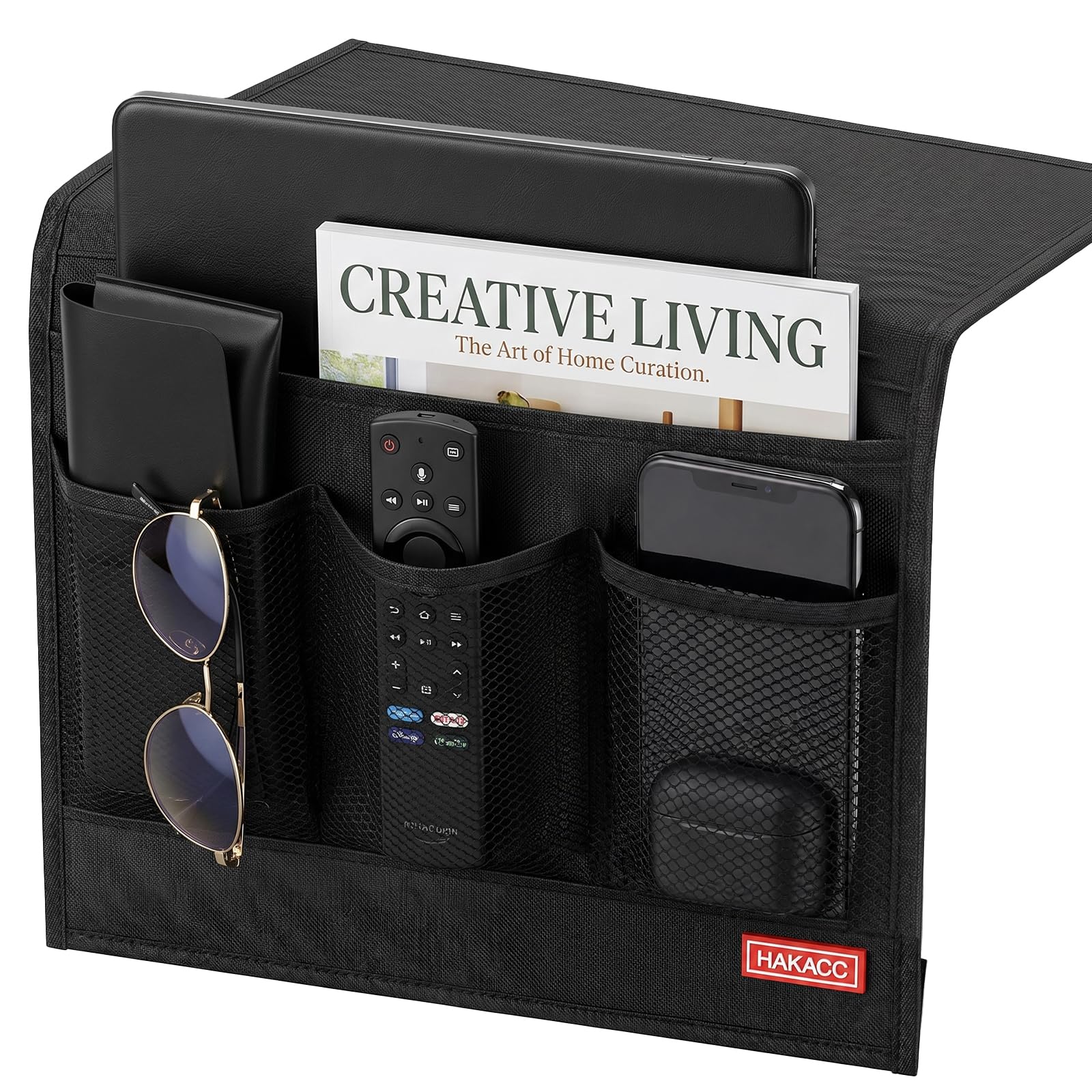
Key Features
- Size: 13 x 17 x 0.3 in
- Material: Linen with leather edge
- Mounting: Insert board under mattress
- Weight limit: 12 lb
- Price: Budget
Twelve pounds is the highest load rating in this set, and it is the number that tells you what this caddy is for. The board is a linen-backed panel with a leather edge that tucks between the mattress and the frame, and the pockets in front are sized for a hardback, a tablet, remotes, glasses, and the small things that otherwise end up under the covers.
Three mesh pockets and one large sleeve is the standard layout, and it is executed well enough here. The mesh does not stretch, which sounds like a downside and mostly is not: the pockets keep their shape instead of sagging out over a year of nightly use.
The insert board is the part to think about. It is thin and relies on the mattress above it, so it can work its way out over time; pushing it back a hand’s width past the edge is the fix, and keeping the heaviest item in the pocket nearest the bed helps it stay. Nothing about that is unusual for an insert caddy, and it is the trade for not having a strap across the bedding.
Where that leaves it: this is the capacity pick, and the one to choose if you want to spend as little as possible and do not mind a bit of maintenance. We reach for the Kikkerland when we want to set something and forget it, and this one when the pile by the bed is genuinely large.
Pros
- 12-pound load rating, the highest here
- Pockets keep their shape
- Cheap for the capacity it offers
- Large sleeve takes a tablet
Cons
- Non-stretch mesh is tight on chunky remotes
For maximum capacity at the lowest price in this set it earns a spot — just tuck the board deep and check it now and then.
How We Tested Bedside Storage Caddies
We started by pulling together a shortlist of caddies sold for bedside use, then narrowed it by attachment style, pocket layout, fabric or frame material, and price. That left 12 models, which we used for four months. Each caddy was set up where it was designed to go—tucked under a mattress, hung from a bed rail, or clamped to a frame—and stocked with the things people actually keep within reach: phone, glasses, remote, tablet, paperback, water bottle, charging cable, and a few odds and ends.
The first test was simply loading each one. We counted how many items it held before the pockets bulged or the body sagged, measured the openings to see whether a tablet or hardcover fit without a fight, and tried reaching for a phone and glasses while lying down, including in a dark room. Convenience came down to whether we could get something out one-handed without sitting up or knocking the whole thing sideways.
Stability and sturdiness got the rougher treatment. We bumped each caddy getting in and out of bed, made the bed around it, and adjusted the mattress and bedding as usual, noting whether it slid, tilted, or needed re-hanging. Every week we checked seams, zippers, fabric loops, and any rigid frame for stretching or wear. After four months, we compared how each one looked and functioned against what it cost—pricey models had to earn it with cleaner stitching and no sag, while cheaper ones had to hold their shape and stay put. The caddies that made the list did both without constant fussing.
How to Choose a Bedside Storage Caddy
Every caddy here solves the same problem, and almost every disappointment comes down to one decision you make before you count pockets: how the thing attaches to the bed.
Start With the Mount
Two designs cover the field. An insert caddy is a flat board that slides between mattress and box spring or frame, with the pockets hanging over the side. A strap caddy wraps hook-and-loop belts around a rail or post and pulls them tight. A platform bed with a box spring suits an insert board; a metal bunk, a hospital rail, or a headboard with nothing to tuck under needs straps.
The design we trust least is a rigid hook that hangs from a single round rail. The caddy swings when you reach into it, and the hooks work loose as the load shifts, which is why none of those made our list.
Staying Put Is the Whole Job
The usual failure is not a torn pocket, it is the board creeping out from under the mattress or a belt going slack. Insert boards hold through friction and the weight above them: tuck one a hand’s width past the mattress edge, and keep the heaviest item in the pocket nearest the bed. A textured or velcro-backed board, like the one on the Zafit, gives you more margin.
Beds that lift or adjust are the hard case, because the mattress rises away from the board. If the head of your bed raises every night, check that the board sits under a section that does not move, or choose a strap model that hangs from the rail instead.
Match Pockets to Your Thickest Item
Three mesh pockets and one large sleeve is the template, and it holds a phone, glasses, a remote, and a magazine. Two details beat pocket count. Depth decides whether a hardback or a 14-inch laptop fits flat, which puts the Zafit’s eight pockets in a different class from a compact strap caddy like the Tenyond. Stretch decides what grips: elastic mesh holds a slim remote, while non-stretch mesh keeps its shape but will not take a chunky one. Measure the thickest thing you keep by the bed.
Materials and What They Cost You
Oxford cloth is the workhorse: light, wipeable, forgiving. Felt over a rigid frame, as on the Kikkerland and the Zafit, holds its shape and looks more like furniture, and on the Kikkerland the polystyrene shell is what keeps the pockets open. Woven cotton, like the Mkono, is for looks first and needs gentler handling.
Whichever you choose, seams are where a caddy fails first, so respect the stated weight limit instead of treating the big sleeve as a hold-all.
Frequently Asked Questions
How much weight can a bedside caddy hold?
The stated limits in this group run from 3 pounds on the DuomiW to 12 pounds on the HAKACC, with the Zafit rated at 6 kilograms. A phone, glasses, a remote, and a hardback sit comfortably inside 3 pounds. A tablet, a laptop, or a water bottle pushes you toward the higher-rated caddies, and the limit is as much about the insert board staying put as about the stitching.
Can I use a bedside caddy on a hospital bed or a crib?
Hospital beds are straightforward: the strap models here, the Surblue and the Tenyond, wrap a side rail and pull tight, which is exactly what a rail with nothing to tuck under needs. Cribs take more care. Keep the caddy and every strap on the outside of the rail, and stop using it once a child can pull up and reach over the rail.
Will a caddy mark the mattress or the bed frame?
The insert models are flat panels with no adhesive, so they leave nothing behind on a mattress — the friction does the holding. The Mkono is the exception here, with a low-tack strip on the back of its panel. Press that onto a hidden stretch of frame first and check it lifts away cleanly before you commit it to a visible one.
Final Verdict
We recommend the Kikkerland first. The polystyrene frame is the difference between a caddy that hangs open and one that sags into the gap, and it is the pick that stays put with the least fuss — a hardback, a tablet, glasses, and a phone all within reach without giving up nightstand space. If the budget is tight, the DuomiW gives you four pockets and an A4 sleeve for very little.
If your bed has a rail and nothing to tuck a board under, take the Surblue instead and belt it on.