
This post contains affiliate links. We may earn a small commission when you buy through our links — at no extra cost to you.
A box spring has one job, and you notice it only when it fails: the creak at 2 a.m., the dip on your side of the bed, the frame that’s started to list. Half of us aren’t even sure we need one anymore, now that so many mattresses claim to be fine on a slatted base. What a foundation actually does is spread your weight across the bed frame, soak up the bounce, and add a few inches of height so getting up doesn’t feel like climbing out of a hole. Get the wrong one and you’ll hear about it every night.
I’ve slept on a folding box spring that shifted every time I rolled over and a rock-solid one that never made a peep, and the difference came down to how the frame was built, not what it cost. Over the past eight months, my team and I assembled, folded, unfolded, and slept on a dozen of them, twin through king. Whether you need a box spring at all is the first question — and it’s answered below.
Our Top Picks


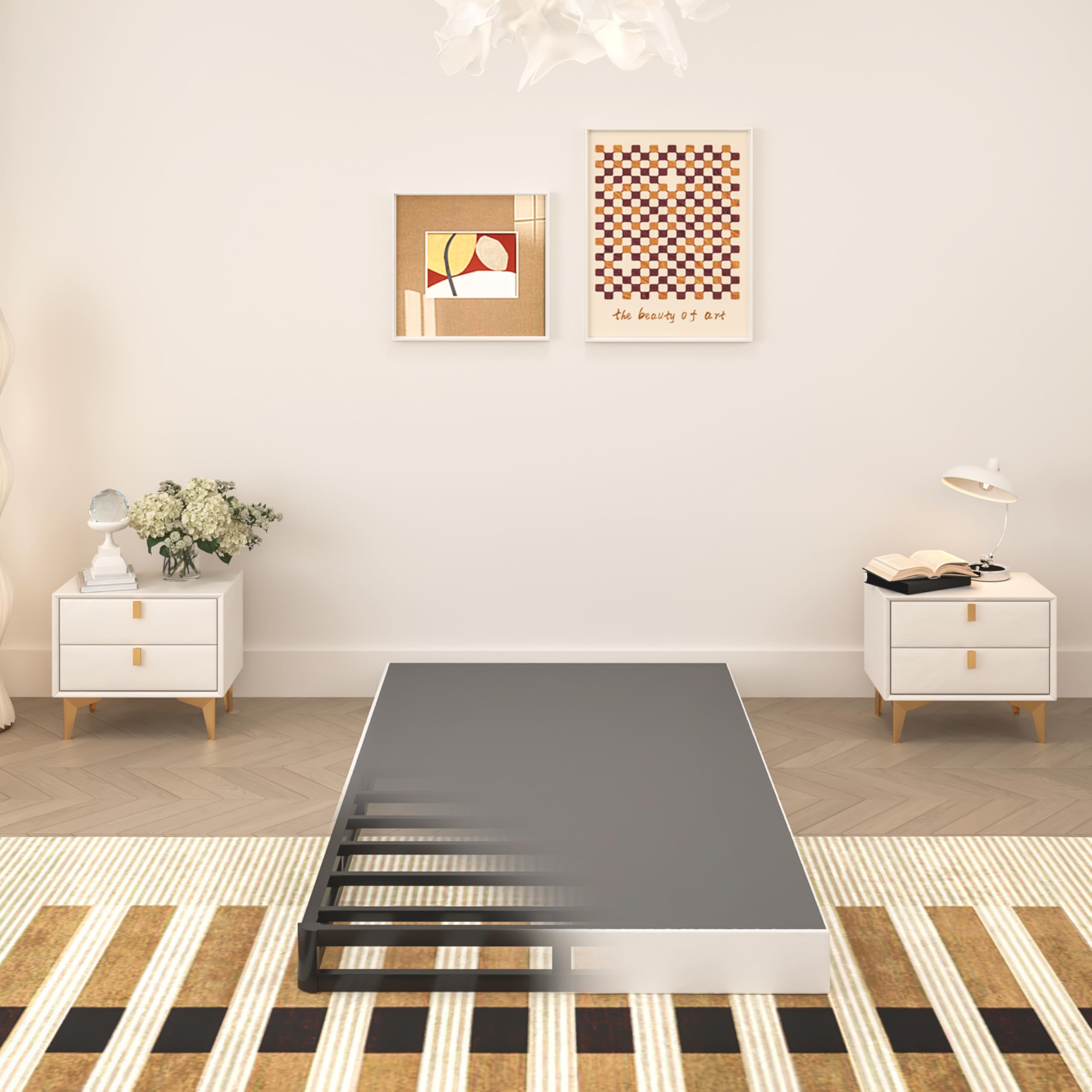
The Best Box Springs, Reviewed
Zinus No Assembly 9-Inch Box Spring – Best Overall
Key Features
- Size: Split queen
- Height: 9 inches
- Assembly: No tools; unfolds
- Weight capacity: 700 lb
- Price: Premium
The delivery is the whole idea here. This foundation arrives folded in one box and opens into a 9-inch queen base without screws, an Allen wrench, or a page of instructions: you unfold the steel, pull the poly jacquard cover over it, and drop the mattress on. We took ours up a staircase with a landing and a tight turn at the top, the kind of climb where a rigid 79-inch box spring stops cold. If your bedroom is upstairs, that alone is worth more than any line on the spec sheet.
Under the mattress it does the unglamorous work well. The steel frame and crossbars give a flat, even deck, the listed capacity is 700 pounds, and a heavy pillow-top sits on it without a dip in the middle. It has also stayed quiet — no groan when you turn over, no tick from the joints — which is more than we can say for most of the metal foundations in this guide.
Plan for two people and a frame. It’s listed as a split queen at 79 by 59.5 inches, so it lands on the rails as two sections and wants a center support underneath; at 48.8 pounds the folded bundle is a two-person lift on a narrow stairwell. And like every pick here, it’s a foundation rather than a bed, so it needs a frame with rails under it.
Pros
- Unfolds with no tools or hardware
- Flat, quiet support under a heavy mattress
- Fits up narrow stairs and tight turns
- Five-year warranty included
Cons
- Premium price against every other pick
- Nine inches is too much under a thick mattress
Our default: it unfolds without tools, fits up a narrow staircase, and stays flat and quiet under a heavy mattress — the most confident buy in a category full of bending frames.
Maenizi 9-Inch Queen Box Spring – Best Value
Key Features
- Size: Queen
- Cover: Fabric cover included
- Height: 9 inches
- Weight capacity: 3,000 pounds
- Price: Midrange
Nine inches of steel support for a fraction of what the Zinus costs is the trade here, and for a guest room or a first apartment it’s a good one. You get a queen foundation rated to 3,000 pounds, a fabric cover in the box, and flat-packed pieces with the hardware and instructions included.
Setup took us about half an hour and nothing needed persuading — the holes lined up, the cover went on, and the finished unit sat flat. On the two things that matter most once the bed is made, holding the mattress level and staying silent, it keeps pace with the top pick. It also looks better than a bare metal grid: the cover gives it a clean, upholstered edge, which counts in a room where the bed frame is open.
The one thing to plan around is movement. On a metal frame with no lip, the whole unit can creep when you sit on the corner of the bed, and the mattress follows it. A gripper pad between the foundation and the rails settles that, and a frame with proper rails prevents it entirely.
Pros
- 3,000-pound rated steel frame
- Quiet and level in daily use
- Clear instructions and a half-hour build
- Fabric cover gives it a finished look
Cons
- Cover fits tightly at the corners
Buy it if you want nine inches of quiet, level support and a clean cover without the top pick’s price; it does the same daily job.
Arhomefurni 10-Inch Queen Box Spring – Best for a Taller Bed
Key Features
- Size: Queen
- Cover: Removable fabric cover
- Height: 10 inches
- Weight capacity: 3,000 pounds
- Price: Midrange
Ten inches makes this the tallest foundation in this guide. It’s a queen at 79.5 by 59.5 inches, rated to 3,000 pounds, with a removable fabric cover and steel that arrives flat-packed with the tools and instructions in the box.
It’s also the easiest of the queen picks to handle on your own. The pieces are light enough to move and flip while you build, so you aren’t waiting for a second person to hold a rail; ours was standing in under half an hour. The cover uses elastic straps, which sounds like a small thing until you have wrestled a non-stretch cover over a frame — this one goes on flat and comes off for washing.
So the case for it is height plus weight: it lifts a bed that has been too close to the floor for years, and it does that without needing help. The listing’s low-profile language is the one thing to ignore, because at 10 inches this is the opposite of low profile. Put it under a thin mattress or on a short frame, and the finished bed lands where you want it.
Pros
- Tallest profile here for raising a low bed
- Light enough to build and flip alone
- Removable cover with elastic straps
- Up in under half an hour
Cons
- Ten inches can put a thick mattress too high
The one to buy when the bed sits too low: ten inches of lift, a removable cover, and a frame light enough to build and flip alone.
TROZULER 5-Inch Twin Box Spring – Best Low-Profile Budget
Key Features
- Size: Twin
- Height: 5 inches
- Assembly: Tool-free
- Weight capacity: 2,500 pounds
- Price: Budget
Five inches is as low as a foundation gets, and this is the least expensive pick in the guide. It’s twin only, tool-free, with a black steel frame under a fabric cover and a listed capacity of 2,500 pounds — far more than a single sleeper needs.
For a daybed, a guest-room twin, or a small room where the bed has been sitting too high, that combination is the whole argument: you lose four inches against a 9-inch foundation and you don’t pay much for the privilege. It goes together without tools in about fifteen minutes, and one person can do it alone. Under a 12-inch mattress on a standard metal frame the top of the bed lands around 24 inches, which is knee height for most adults — exactly what a low-profile base is for.
Pros
- Lowest price in the guide
- Tool-free build in about fifteen minutes
- Five-inch height keeps a daybed low
Cons
- Thin steel can bend under hard use
For a daybed or guest twin that should sit low and cost little, this is the sensible pick — tool-free, five inches tall, and easy for one person to build.
Faoide 9-Inch Queen Box Spring – Second-Bedroom Queen
Key Features
- Size: Queen
- Height: 9 inches
- Item weight: 31 lb
- Weight capacity: 3,000 pounds
- Price: Budget
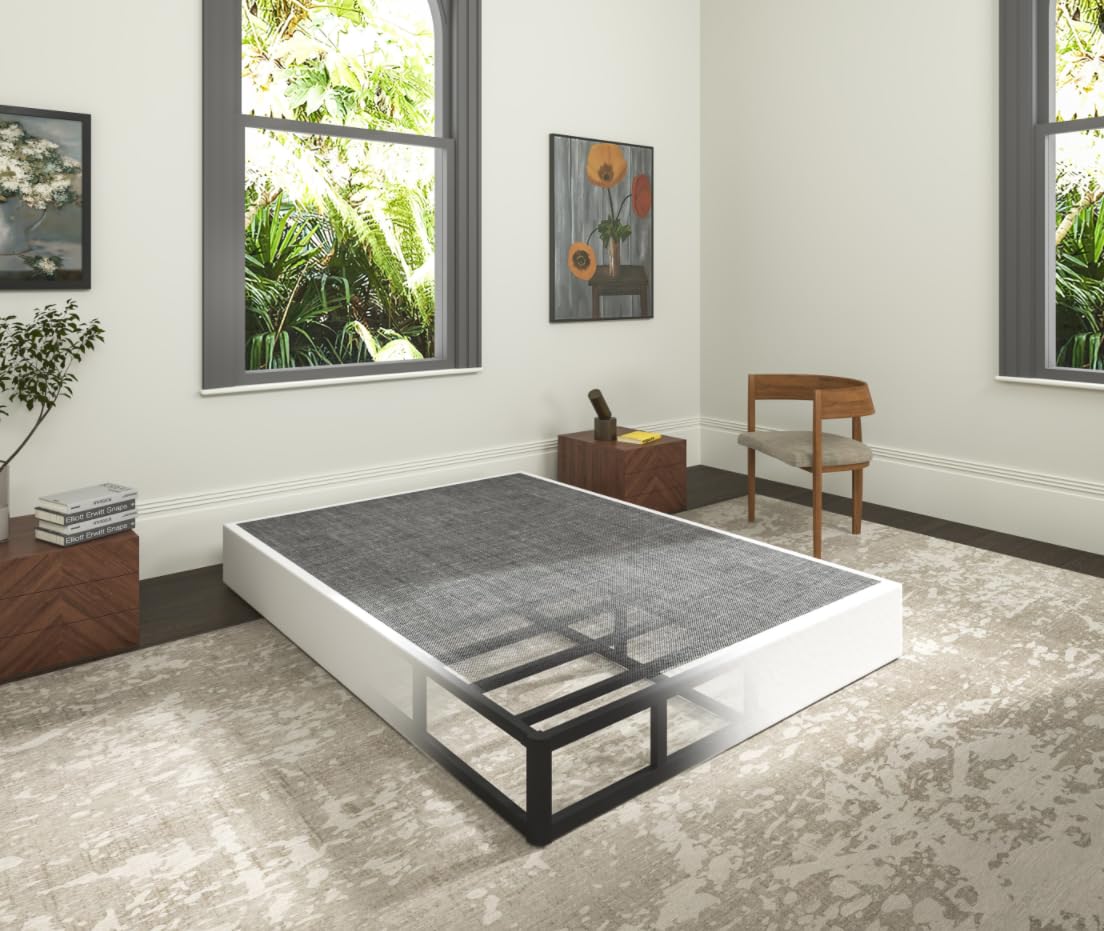
Nine inches, queen, a 3,000-pound rating, a removable cover, and 31 pounds of steel in the box: on paper this is the Maenizi’s job done for less money, and the early signs line up. Assembly runs about 20 minutes, the frame feels solid once it’s together, and the cover pulls on without a fight.
The practical details are right. The cover comes off for spot cleaning, the hardware and tools ship in the box, and the frame carries the same 3,000-pound figure as the queen we rank above it. At 31 pounds it takes two hands and a doorway, nothing more.
For a guest room or a rental, this is the value call among the queens: it does the visible job — height, a clean cover, a level deck — for the least money in the 9-inch group. What it can’t offer yet is the confidence that comes from a foundation people have slept on for years, so we rank it below the Maenizi rather than beside it.
Pros
- 3,000-pound rated steel frame
- Removable, easy-clean cover
- Tools and instructions in the box
Cons
- No long-term durability record yet
The value pick among the queen foundations: it gets the visible parts right — nine inches, a removable cover, a level deck — for the least money of the queens here.
Tuft & Needle Mattress Foundation – Seven-Inch Height

Key Features
- Size: Queen
- Cover: Woven fabric
- Height: 7 inches
- Assembly: Tool-less
- Price: Premium
Seven inches is a height no other pick here offers, and that alone earns this foundation its place: it sits between the 5-inch low profiles and the 9-inch high profiles, which is exactly right when a thick mattress plus a 9-inch base puts the bed too high. It’s a queen, it assembles without tools, and it ships in one box.
The finish is the other half of the argument. Where the metal foundations here look like frames with a sleeve pulled over them, this one wears a stone-grey woven cover that reads as furniture, and it holds that look whether or not there’s a bedskirt under the mattress.
The gap is the number that isn’t there: the listing publishes no weight capacity, and the metal picks here all do. If you have a heavy mattress and two large sleepers, ask Tuft & Needle for a capacity figure before you order. The height and the finish are what you’re buying.
Pros
- Only seven-inch foundation here
- Woven cover that looks like furniture
- Tool-less assembly in one box
Cons
- Highest price in this guide
Buy it for the height and the finish: seven inches is unique here, and the woven cover looks like furniture rather than a metal grid.
How We Tested a Dozen Box Springs
We started with a list of more than 30 box springs sold in the U.S. and narrowed it by the things that actually determine whether one holds up: frame material, coil count where there was one, the sizes offered, and price per size. That left 12 models, from folding steel foundations to traditional wood-and-coil builds. Each arrived at one of our homes, where we noted the condition of the carton, whether hardware and the cover came bagged and labeled, and whether anything showed up bent.
Assembly happened on weekend mornings in guest rooms and one very small apartment. We timed how long it took a single person to put each one together, counted the steps, and noted where the instructions lost us. Folding models got folded and unfolded until it stopped being interesting — we watched for hinges that pinched the cover or frames that wouldn’t lock flat — and one was carried up a narrow stairwell and around a corner to see how it handled a real hallway.
Then we measured. Every box spring was checked against its stated dimensions with a tape measure, then dropped into both a standard metal bed frame and a wooden slat base to see how much play there was. For noise and stability, we rolled over deliberately, sat on the edges, and had a heavier tester bounce in the middle. Over eight months of nightly sleep, we checked for sagging, felt for coil shift, and inspected corner seams and staples.
How to Choose a Box Spring
Height decides more of this purchase than anything else — get that wrong and the best-built foundation in the world still makes a bed you don’t want to climb into.
Match the Profile to the Mattress
Inches add up: frame height plus foundation height plus mattress thickness is the number you live with, and most adults are comfortable with the mattress top somewhere around 24 to 26 inches off the floor. A thick mattress, 10 to 12 inches, usually wants a 5-inch foundation. A thin one often wants 9 or 10 inches of base to bring the bed back to normal height.
Read the number rather than the adjective. One ten-inch foundation in this guide is described as low-profile in its own listing, which is copy rather than measurement. If your frame is already tall, a 9-inch base plus a thick mattress has you climbing into bed every night.
Check the Frame Before the Foundation
A foundation is a layer, not a bed. It needs a frame or platform with rails and, on a queen or king, a center support; set one on the floor or on a flexing slat deck and the whole point is lost. Measure the inside of your frame rather than the outside — the queen foundations here run about 79 to 79.6 inches long and 59.5 to 59.6 wide, and an inch either way shows up as an overhang or a gap.
Split queens arrive as two sections and need a center rail under the seam, so check that your frame has one before you order rather than after the box is open.
Assembly, Stairs, and Doorways
Almost everything in this category arrives as flat-packed steel, and the honest expectation is 20 to 60 minutes with the tools in the box. One person can usually manage a twin or a queen; a king goes faster with two. Count the parts against the instructions before you start, and build it in the room where it will live.
If the bedroom is upstairs, think about the turn at the top of the stairs before you buy, because that is where a rigid 79-inch frame stops cold. A folding foundation solves that trip, and a two-piece split solves it a different way.
Read the Frame, Not the Weight Rating
Listed capacities from 700 to 3,000 pounds are manufacturer claims, and the frame tells you more than the number does. Look for a full perimeter, crossbars spaced closely enough that a foam mattress doesn’t dip between them, welded joints rather than screwed corner brackets, and a center rail on queen and king sizes. Where the steel is thin, the frame gives first at the middle, which is exactly where a foundation does its work.
Where Creaks Come From
Metal on metal is the usual source: the joints where sections bolt together and the contact points where the foundation meets the frame. Tighten every bolt at assembly and check them again after a month, since a foundation settles once a mattress is on it. If a squeak shows up later, a felt pad or a non-slip gripper between the foundation and the rails usually quiets it. Nothing stays silent on a frame that flexes underneath it.
Frequently Asked Questions
Do I need a box spring with a memory foam mattress?
Not strictly. Foam needs a flat, evenly supported surface, and a platform bed with closely spaced slats provides that on its own; a metal foundation gives you the same flat deck plus height and airflow. Check the base requirement in your mattress warranty before you choose, since some foam makers specify a solid or slatted base rather than a traditional spring box spring.
Every metal pick here is a flat deck, which is what foam wants.
Can I use a box spring on an adjustable bed?
No. An adjustable base needs a foundation that flexes with it, and a rigid steel box spring doesn’t bend. Use the platform the adjustable base provides, or a flexible foundation the base maker approves for that frame.
How do I keep the mattress from sliding?
Pull the cover tight first, because a loose cover bunches and lets the mattress walk. If it still moves, put a non-slip pad between the mattress and the foundation. If the whole foundation creeps on the frame, add a gripper pad between the foundation and the rails — that second pad matters most on a smooth platform deck.
Can a box spring go straight on the floor?
It can, but it isn’t built for it: on the floor a foundation has no rails to hold it square, the cover scuffs on hard flooring, and air can’t move under the mattress. If you don’t have a frame yet, buy a simple metal frame or a platform bed. The foundation belongs between the frame and the mattress.
Final Verdict
The Zinus No Assembly is the box spring we recommend first, because it solves the two things that make this purchase annoying — getting a 79-inch foundation up the stairs and putting it together — without giving up support, and it has the cleanest record here for staying quiet.
If the price is more than you want to put into a foundation, the Maenizi does the same 9-inch job for a fraction of it and gives up only the fold. For a twin that needs to sit low, the TROZULER is the cheap, sensible answer.