
This post contains affiliate links. We may earn a small commission when you buy through our links — at no extra cost to you.
A tower fan’s spec sheet may promise a whisper, but in a still bedroom at 3 a.m., even 28 decibels can feel like a conversation. For light sleepers, that gap between lab rating and real-world silence is the difference between a restful night and a restless one.
The market is filled with fans that claim to be quiet, yet buyer experiences repeatedly show that only a handful actually deliver the near-silent airflow needed for deep sleep. This guide cuts through the numbers to identify the few models that keep noise low enough to let you drift off without distraction, while still moving enough air to cool the room.
Whether you need a compact 36-inch unit for a small bedroom or a tall 42-inch fan to clear a king-size bed, the key isn’t the boldest number on the box—it’s the sound that actually reaches your ears.



Best for Light Sleepers
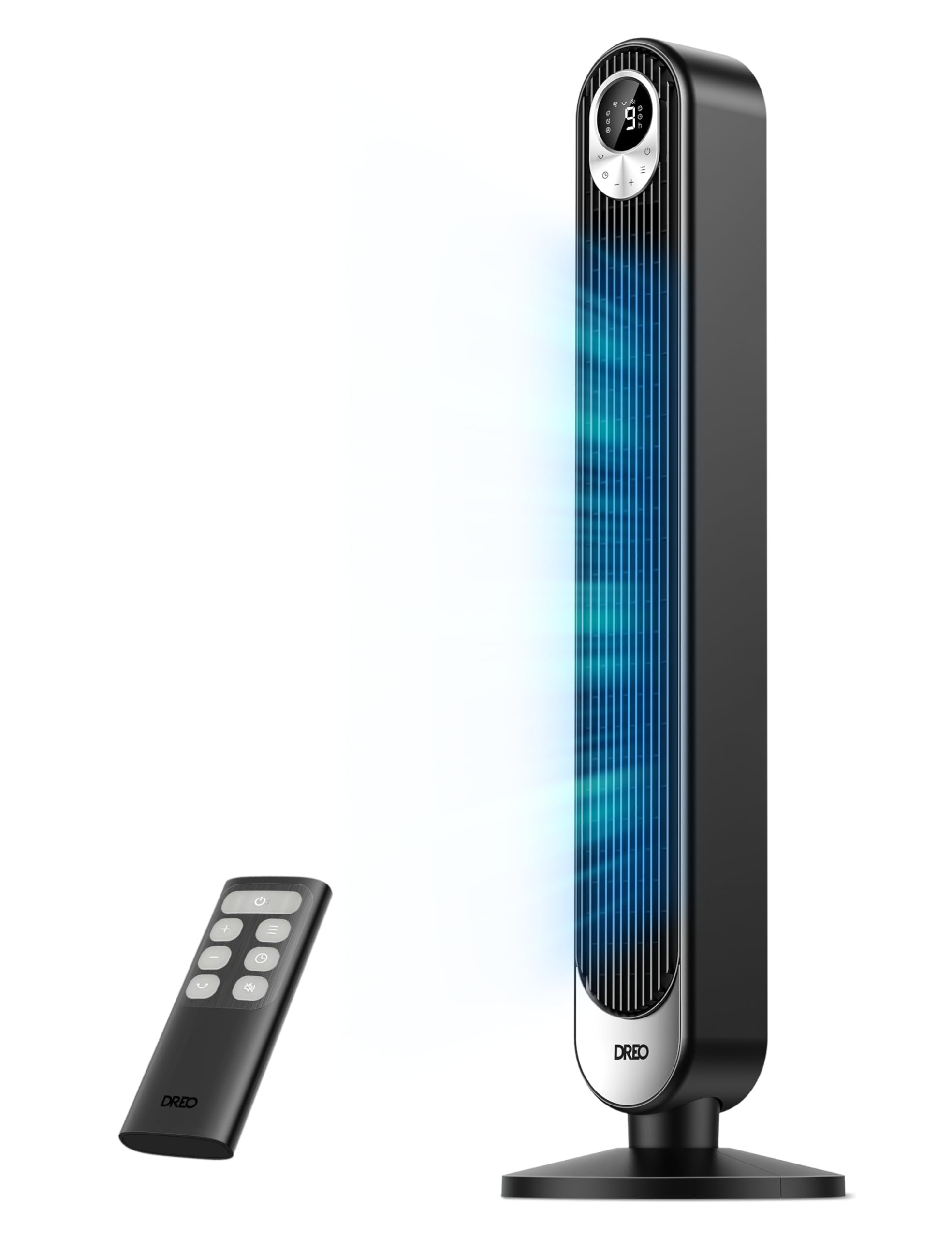
DREO 36" 20dB Tower Fan
Key Features
- Noise Level: 20dB
- Airflow Power: 28 ft/s, 1408 CFM
- Height: 36 in
- Speeds & Modes: 8 speeds, 4 modes
- Remote & Smart: Remote
- Price: Mid-Range
DREO’s 20dB DC motor is the defining feature—on lower speeds it’s genuinely whisper-quiet, letting you sleep undisturbed while delivering 1408 CFM of airflow that reaches across the room. Eight speeds and four modes, including a sleep mode with timer, let you fine-tune cooling, and the 90° oscillation spreads air evenly without dead spots. Even at higher speeds, the noise stays subdued enough for bedroom use. The included remote handles every setting without getting up, and its straightforward button layout requires no learning curve.
This fan is ideal for light sleepers in standard bedrooms who value quiet above all else and don’t need Wi-Fi or smart app control. The 36-inch height fits next to a bed or desk, but anyone with a large master bedroom might prefer the taller 42-inch DREO model for broader coverage. The remote’s compact size makes it easy to misplace—a minor nuisance. Occasional units may develop a motor squeak or fail after extended use; DREO’s support is responsive, but long-term reliability isn’t bulletproof.
Pros
- Whisper-quiet DC motor at 20dB for undisturbed sleep
- Strong airflow reaches across the room without noise penalty
- Intuitive remote controls timer, speeds, and oscillation
Cons
- Remote control is very small and easy to misplace
- Motor may develop a squeaking noise or fail after long-term use
If your priority is a bedroom fan that disappears into the background, this DREO delivers class-leading quietness and strong airflow at a mid-range price—just secure the remote and accept the small chance of a durability hiccup.
Best for Larger Bedrooms
DREO 42" 20dB Tower Fan
Key Features
- Noise Level: 20dB
- Airflow Power: 28 ft/s, 1473 CFM
- Height: 42 in
- Speeds & Modes: 9 speeds, 4 modes
- Remote & Smart: Remote
- Price: Mid-Range
The 42-inch tower adds extra reach to DREO’s signature 20dB quiet operation, delivering a 1473 CFM airflow that circulates air effectively across larger bedrooms. Nine speeds and four modes let you dial in a precise breeze, from a gentle background movement to a strong, far-reaching gust. The included remote and 12-hour timer provide effortless overnight control without leaving the bed.
This fan suits master bedrooms where taller oscillation and more speed options matter. Keep in mind that even the lowest speed feels more present than some 36-inch alternatives—ultra-sensitive sleepers who need an imperceptible draft may notice it. For most, however, the extra height and flexibility outweigh this nuance.
Pros
- Virtually silent on low settings, making it ideal for light sleepers.
- Powerful airflow that effectively cools even large bedrooms.
- 9 speeds provide fine-grained control over breeze intensity.
Cons
- The gentlest speed can still feel brisk for those who prefer a barely-there draft.
If you need taller coverage and more speed choices in a larger bedroom, this DREO delivers the same 20dB quietness—just don’t expect the lowest setting to be as feather-light as its shorter sibling.
Best for Budget-Conscious
Levoit 36" Tower Fan
Key Features
- Noise Level: 28dB
- Airflow Power: 25 ft/s, 1044 CFM
- Height: 36 in
- Speeds & Modes: 5 speeds, 4 modes
- Remote & Smart: Remote, auto sensor
- Price: Mid-Range
At 28dB, this fan runs quietly enough for most sleepers, and the built-in temperature sensor automatically adjusts fan speed to match room warmth — a feature seldom seen at this price. Airflow reaches 25 ft/s across a 90° oscillation, easily circulating air through a medium bedroom. The remote and controls are straightforward, and the 12-hour timer offers flexibility for overnight use.
This model suits budget-conscious buyers who want smart sensing without paying a premium. However, long-term durability is less consistent than the top-pick DREO; some units have experienced issues within a year, so this is a better fit if you value immediate performance and features over multi-year ownership certainty.
Pros
- Quiet 28dB operation suits most bedrooms
- Strong 25 ft/s airflow with smooth oscillation
- Smart temperature sensor adjusts speed automatically
Cons
- Unit longevity may vary; some owners report issues within a year
A smart, quiet fan that delivers strong cooling for medium bedrooms at a competitive price — ideal if you value features and immediate performance over long-term warranty coverage.
Best for Cost-Conscious Quiet
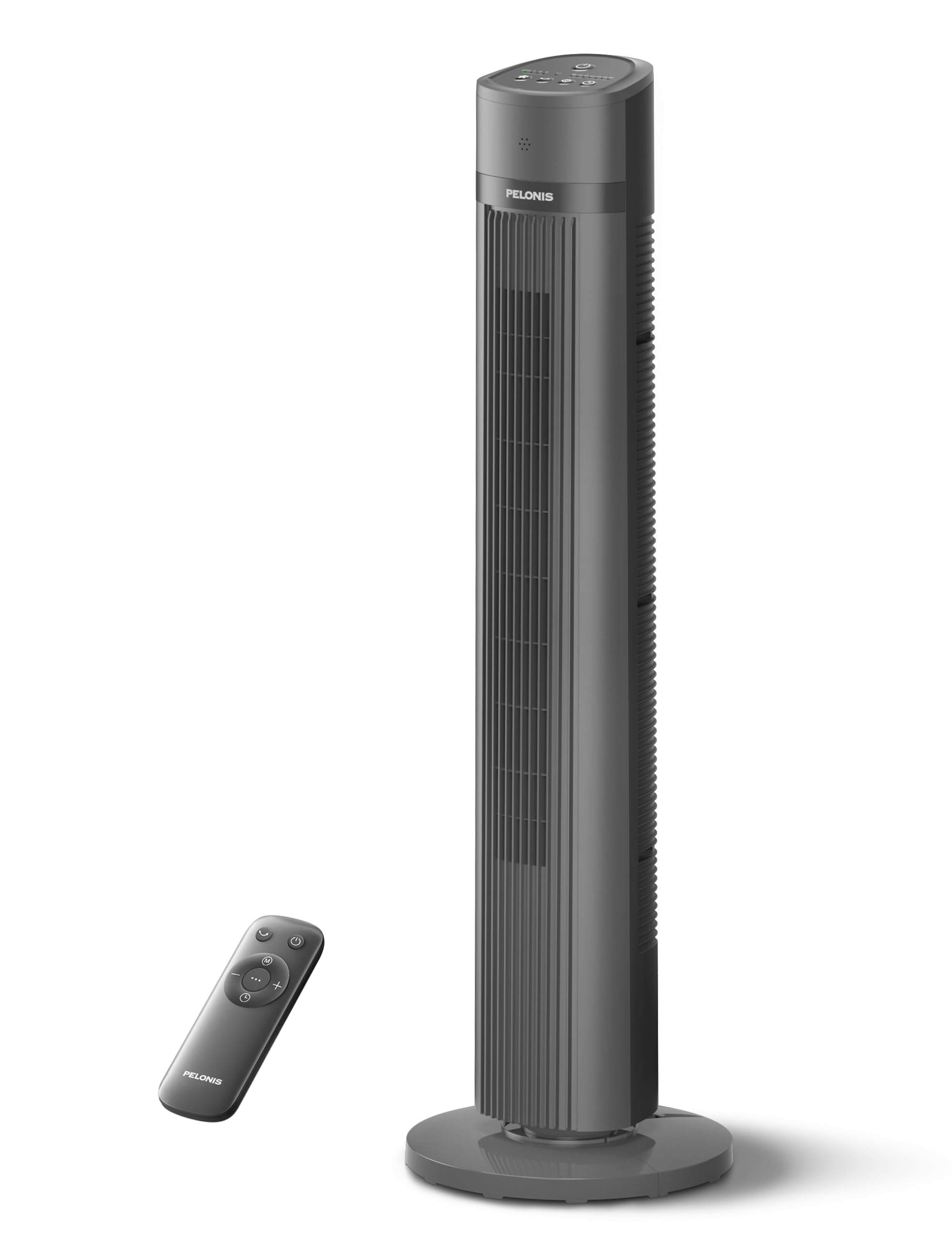
Pelonis 40" Tower Fan
Key Features
- Noise Level: 27dB
- Airflow Power: 26 ft/s
- Height: 40 in
- Speeds & Modes: 3 speeds, 3 modes
- Remote & Smart: Remote
- Price: Budget
The Pelonis 40-inch tower fan prioritizes quiet operation and cost savings over remote convenience and base stability. Its 27dB noise level rivals pricier models, making it a compelling budget pick for light sleepers who want 26ft/s airflow without spending top-tier money. The trade-off: the remote works reliably only when aimed directly at the base, and the tall design can feel tippy on carpets or uneven floors. On a level hard surface and with line-of-sight remote control, it’s a practical bedroom fan — just don’t expect to adjust settings from bed without aiming.
Pros
- Quiet operation at 27dB, comparable to fans costing much more.
- Strong 26ft/s airflow effectively circulates room air.
Cons
- Remote may require precise aiming to register commands.
- Base stability can be an issue on carpets or uneven surfaces.
This fan balances quiet cooling and a tight budget, provided you place it on a hard floor and accept the remote’s aiming quirks.
Best for Guest Rooms
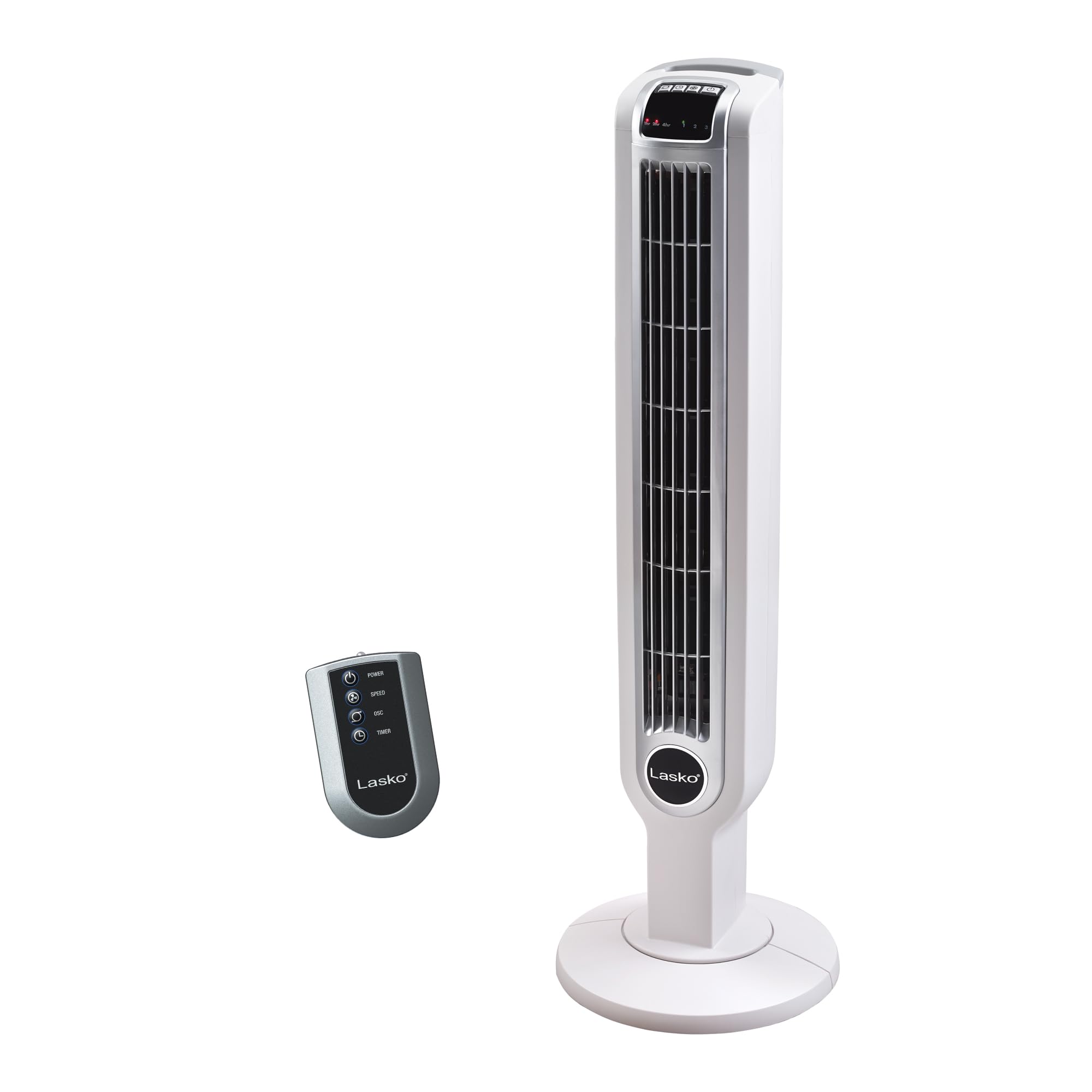
Lasko 36" Tower Fan
Key Features
- Noise Level: 54.5dB
- Airflow Power: 210 CFM
- Height: 36 in
- Speeds & Modes: 3 speeds
- Remote & Smart: Remote
- Price: Budget
The Lasko 2510 has been a go-to basic tower fan for years, thanks to its straightforward operation and handy remote that works from across the room. It cools small to medium spaces adequately on warm days and sets up in minutes with minimal assembly. However, it’s not a quiet bedroom fan: at 54.5dB, the steady hum is clearly audible, ruling it out for light sleepers. If you don’t mind background noise and need a no-frills fan for a dorm, guest room, or workspace, this budget-friendly tower gets the fundamentals right without overspending.
Pros
- Remote control with reliable range, so you don’t have to get up to adjust speed or oscillation
- Moves enough air to cool a small bedroom or office on warmer days
- Simple base assembly and intuitive controls; gets running in minutes
Cons
- Airflow output trails DC-motor tower fans; fine for directed spot cooling, less effective for whole-room circulation
- Runs noticeably louder than modern quiet fans — a steady 54.5dB hum that light sleepers will find intrusive
The Lasko 2510 makes sense for dorms, home offices, or guest rooms where a little background noise is acceptable — a dependable basic fan that won’t drain your wallet.
Best for Speed Customization
Honeywell HYF290B
Key Features
- Noise Level: 45dB
- Height: 40 in
- Speeds & Modes: 8 speeds
- Remote & Smart: Remote
- Price: Budget
With 8 speeds, the HYF290B offers more fine-grained airflow control than most budget tower fans, and the included remote adds everyday convenience. The tall 40-inch tower oscillates to circulate air across a room, but the noise level climbs noticeably on higher settings — fine for an office or kitchen, less so for a sleep-focused bedroom. Airflow, while adjustable, remains moderate rather than room-filling.
This fan is right for budget-conscious buyers who want more speed choices for daytime cooling in kitchens, living rooms, or home offices where some background sound is acceptable. If your goal is near-silent bedroom comfort for light sleep, DREO’s 20dB DC-motor options are a better fit.
Pros
- 8 speeds allow precise airflow adjustments
- Included remote works reliably for adjusting speed and oscillation from across the room
Cons
- Airflow output remains moderate, and may feel inadequate for whole-room circulation in larger spaces
- At medium to high speeds, fan noise becomes prominent, which can disrupt sleep or quiet work
If you prioritize precise speed control on a budget for daytime spaces where a low hum is fine, the HYF290B delivers. For near-silent bedroom cooling, DREO’s DC-motor lineup is the more appropriate choice.
Best for Personal Spot Cooling
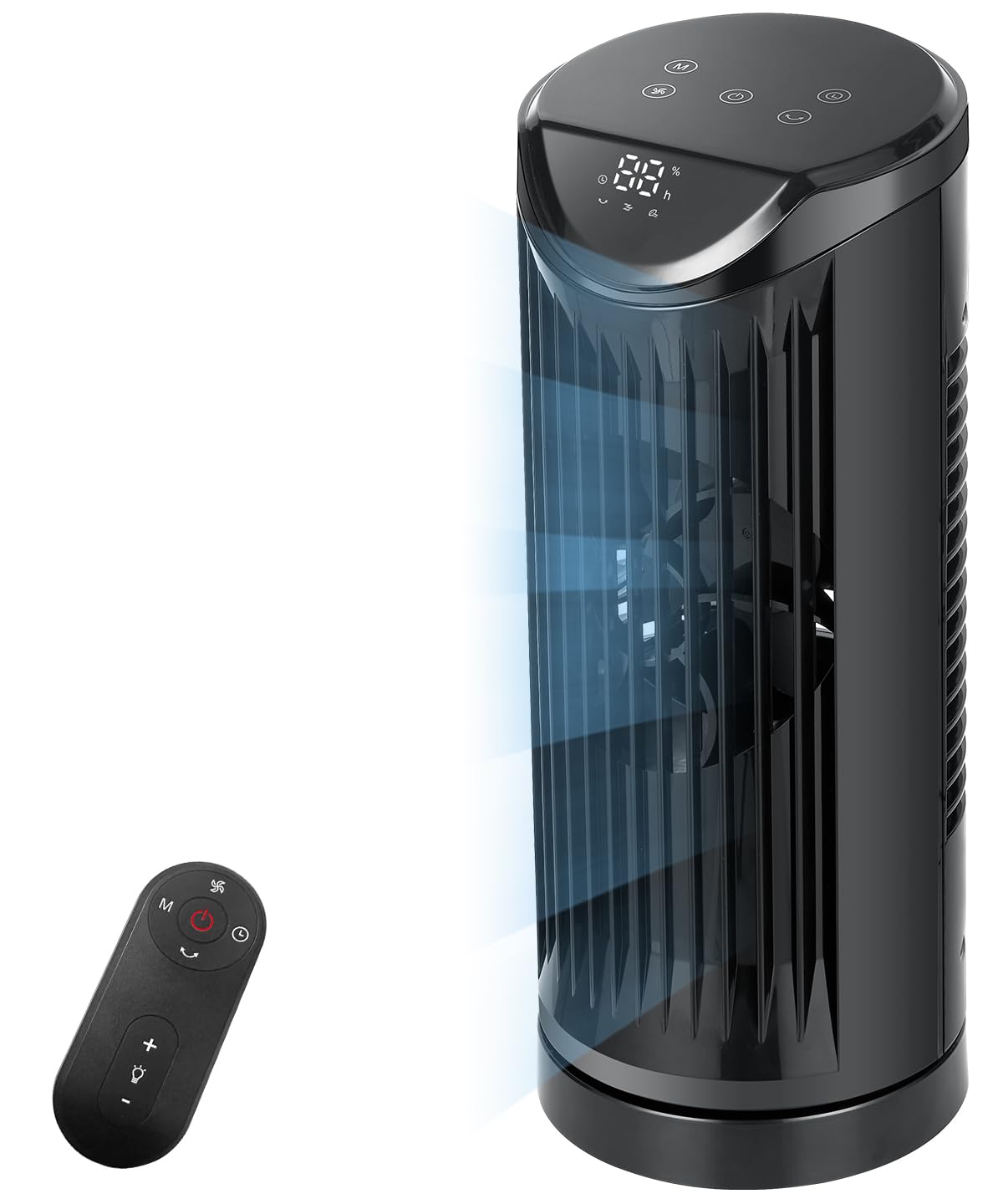
KopBeau Mini Tower Fan
Key Features
- Noise Level: 40dB
- Height: 13 in
- Speeds & Modes: 4 speeds
- Remote & Smart: Remote
- Price: Budget
Quiet operation up close and a responsive remote make this 13-inch fan a capable bedside spot cooler when it’s within arm’s reach. But at just 13 inches tall, it’s a desk fan, not a floor-standing tower for whole-bedroom air circulation, and its airflow can’t cool a full room for comfortable sleep.
Pros
- Quiet operation for its tiny size
- Remote control works well from bed
Cons
- Airflow too weak for whole bedroom cooling — it’s a desktop personal fan.
Right for a single person side-table cooling at night; not for whole-room air circulation.
How to Choose
The most important step in choosing a bedroom tower fan is ignoring decibel ratings on the box and looking for real-user descriptions of the sound character and volume.
Noise Level (dB)
A 20dB fan is nearly inaudible—like the faint hum of a laptop—while a 28dB fan produces a low but noticeable whir that can disturb light sleepers. The decibel scale is logarithmic, so a 28dB fan is perceptibly about twice as loud as a 20dB one.
Beyond the number, sound character matters. Some fans have a smooth white noise that masks other sounds, while others emit a higher-pitched buzz or intermittent hum. If silence is non-negotiable, aim for DC-motor models rated 20dB, then verify through user reviews that the noise is truly unobtrusive.
Airflow Power
Airflow is measured in feet per second (ft/s) or cubic feet per minute (CFM). For a bedroom, 25+ ft/s with oscillation can create a cooling breeze that reaches the far corner. High airflow doesn’t have to mean loud—DC motors can push large volumes of air quietly.
A common hidden trade-off: a fan with weak airflow may need to run at top speed to be felt, which often makes it louder. A fan with strong airflow can operate at a lower speed, staying quieter while still delivering effective cooling.
Height
Taller fans (40–42 inches) direct air over beds and dressers, preventing the breeze from being blocked by furniture. Shorter 36-inch fans work well in smaller bedrooms or when placed at bedside height.
The physical trade-off is stability. Taller towers with narrow bases can wobble on carpet or uneven floors. If you have thick carpet or pets, check for a wide, weighted base and user reports of tipping.
Speeds & Modes
More speeds give you finer control to find the exact airflow that feels comfortable for sleep. A fan with only 3 speeds may jump from too weak to too strong, leaving no ideal nighttime setting.
However, having 8 or 12 speeds doesn’t guarantee a gentle lowest speed. Some fans’ minimum output is still too brisk for very sensitive sleepers. Look for owners confirming that the lowest setting is truly subtle.
Remote & Smart Control
A reliable remote lets you change settings from bed without disrupting your sleep position. Many budget fans use narrow-beam infrared remotes that require precise aiming and may not work beyond 6–8 feet.
Wi-Fi or app-controlled fans let you adjust settings from anywhere in the room—or even via voice—but they can introduce connectivity hiccups. If consistent bedside control is critical, prioritize fans with radio-frequency remotes or highly-rated app stability.
FAQ
Why does my tower fan make a clicking noise after a few months of use?
Clicking often comes from dust buildup on the motor shaft or blades, or from a loose housing. Cleaning the rear grille and ensuring the fan is on a level surface can fix it. If the noise persists, it may indicate motor wear—contact the manufacturer if under warranty. For prevention, choose models with removable, washable grilles.
How much quieter is a 20dB tower fan compared to a 28dB one in a bedroom?
The decibel scale is logarithmic, so a 20dB fan is roughly half as loud perceptibly as a 28dB fan. In a quiet bedroom, the difference is stark: 20dB is nearly inaudible, like a gentle breeze, while 28dB produces a low but noticeable hum that can disturb light sleepers. For absolute silence, 20dB is the target.
Can a tower fan actually cool a whole bedroom, or do I need an air conditioner?
A tower fan doesn’t lower room temperature like an AC, but it creates a powerful breeze that makes you feel cooler by accelerating evaporation on your skin. With oscillation and enough airflow (25+ ft/s), it can circulate air across an entire bedroom, making it comfortable for sleep. It’s ideal for nights when the room isn’t excessively hot.
Why does my fan remote only work when I point it straight at the fan?
Many budget tower fans use narrow-beam infrared remotes that require a direct line of sight and precise aiming, limiting control from bed. Mid-range and premium fans often use radio frequency (RF) or Wi-Fi, allowing control from anywhere in the room. If remote frustration is a dealbreaker, look for models with app or voice control.