
This post contains affiliate links. We may earn a small commission when you buy through our links — at no extra cost to you.
Moving a toddler out of a crib is a milestone for them and a small leap of faith for you. The bed has to sit low enough that they can climb in and out on their own, stay steady when they lean over the edge at 2 a.m., and go together without a missing bolt or a wobbly leg. It should also look like it belongs in the room. Over the past six months, we tested 12 toddler beds, paying close attention to assembly, sturdiness, appearance, and how each one fit a standard crib mattress.
Toddler beds are not just miniature twin beds. Most reuse the crib mattress, so fit matters: a gap at the rail or a mattress that shifts when your child climbs in turns bedtime into a nightly adjustment. The best assembly experience isn’t the fastest one; it’s the one where hardware lines up, instructions match the parts, and the frame still feels solid months later. The picks below were chosen for quality, value, and child-friendly details, not a long list of extras.
Our Top Picks

The Best Toddler Beds, Reviewed
Delta Minnie Mouse Plastic Toddler Bed – Best Overall
Key Features
- Frame: Plastic over steel
- Bed weight: 16 lb
- Assembled size: 53.94 x 29.13 x 26.18 inches
- Safety certification: JPMA certified
- Price: Budget
The cheapest bed we recommend is also the one we point most families toward, and the reason is unglamorous: it does the whole job. The frame is steel under molded plastic, both guardrails are attached to the bed rather than sold as an add-on, and it carries JPMA certification to the CPSC and ASTM standards, which is the first thing we check on anything a toddler sleeps in. It takes a standard crib mattress, so the one your child is already on moves straight across.
At 16 pounds it is the lightest bed here, and that matters more than the number makes it sound. You will carry this up a staircase, drag it into a corner to vacuum, and haul it into a sibling’s room, and one adult can do all three without taking it apart. The molded shell wipes clean with a cloth, which is the difference between a two-minute job and a load of laundry after a middle-of-the-night accident. Assembled, it stands about two feet tall, low enough that a small child steps in without help.
The Minnie graphics are the part with a shelf life. A theme is what gets a reluctant toddler over the line, and it is also what has you redecorating in two years, so we treat the character print as the price of an easy transition rather than a long-term look. What lasts is the shell: it takes knocks without chipping and wipes down after a sick night, and that combination is why it holds the top spot here.
Pros
- 16 pounds, so one adult can move it
- Two guardrails attached, not sold separately
- JPMA certified to CPSC and ASTM standards
- Takes the crib mattress you already own
Cons
- Side rails can need a second try to seat
Buy this one for the most bed per dollar: JPMA certified, 16 pounds, wipe-clean, and ready for the crib mattress you already own.
Dream On Me Classic Toddler Bed – Best Wood Bed
Key Features
- Frame: Solid pine
- Weight limit: 50 lb
- Assembled size: 53 x 28 x 30 inches
- Safety certification: GREENGUARD Gold, BSA verified
- Price: Midrange
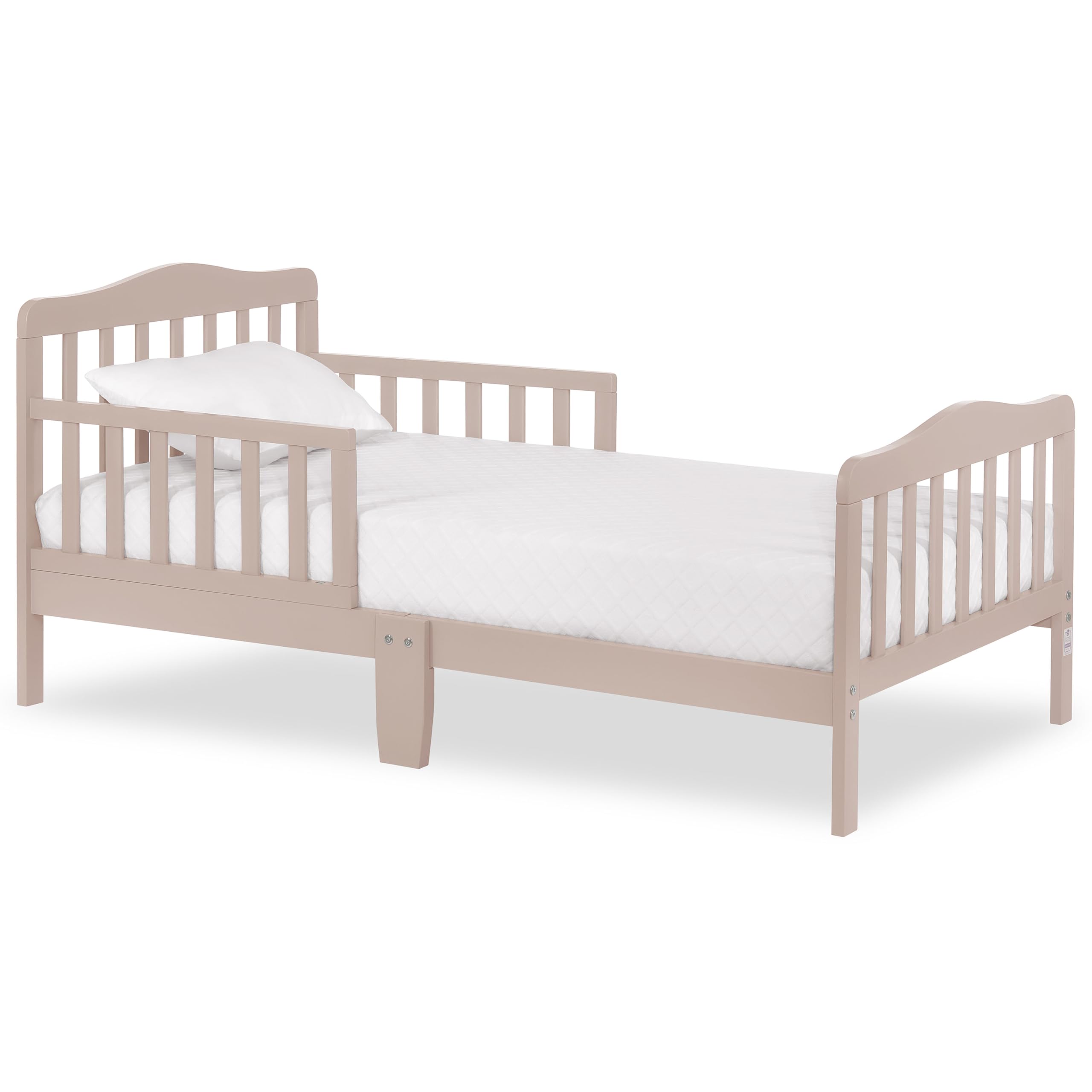
Almond Butter is the name of the finish, and it lands warmer than the words suggest — a soft off-white that settles into a wall instead of announcing itself. This is the bed for the nursery that is already put together, where a purple plastic spaceship would be the loudest thing in the room. The arched headboard and footboard finish the job: at 53 inches long and 30 inches tall, it reads as a small piece of furniture.
What earns it a place beside our top pick is the air-quality story rather than the look. The finish is GREENGUARD Gold certified, the indoor-air standard that screens a coating for the compounds that off-gas in a closed room, and the paints are free of phthalates, latex, lead, and BPA, with Baby Safety Alliance verification layered on top of ASTM and CPSC testing. In a small bedroom with the door shut, that is the specification we weigh most heavily. The pine frame costs almost nothing in portability either: at 16.5 pounds it is half a pound heavier than the plastic bed above and just as easy for one person to set down.
Two things to sort out before the first night. The mattress sits on a set of wooden slats, and slats can work their way out of their grooves when the frame is not square while you tighten it — push each one fully home, tighten the frame, then check them again after a week. And 53 by 28 inches is compact for a bed while still being real wall space, so measure the gap you have in mind before you commit to the color.
Pros
- GREENGUARD Gold finish and BSA verification
- Pine frame at just 16.5 pounds
- Neutral finishes that suit a room for years
- Arched headboard reads as furniture
Cons
- Paint can chip at the edges
- Instructions can be thin for the part count
Buy it for the finish and the air-quality certification: pine, GREENGUARD Gold, 16.5 pounds, and a shape that looks like furniture rather than equipment.
Delta Disney Princess Canopy Toddler Bed – Best for Princess-Themed Rooms

Key Features
- Frame: Plastic
- Assembled size: 53.94 x 29.13 x 55.12 inches
- Recommended age: 15 months and up
- Safety certification: JPMA certified
- Price: Midrange
The canopy is the entire premise here, and it is why a bed that is 54 inches long stands 55 inches tall. What we did not expect is what it does not cost you: the footprint underneath all that fabric is 53.94 by 29.13 inches, identical to the plastic bed we picked, so the canopy eats height and nothing else. In a room with a ceiling fan or a sloped ceiling, that distinction decides whether it fits.
Underneath, it is a sound little bed: molded plastic, two attached guardrails, JPMA certification, and a standard crib mattress drops in without an adapter. At 22.1 pounds it is about six pounds heavier than our top pick, most of it canopy hardware, so it is the one here you want two hands for on a staircase. The Disney Princess artwork is the draw, and it is the part of the design we like most — the bed commits to the theme in a way a printed panel does not.
Where we keep landing is the price. This is the most expensive of the three beds here, and what you are buying on top of the frame is poles, fabric, and a licensed character. For a child who will not sleep anywhere but a princess tent, that is a fair trade, because the canopy is what gets them out of the crib. For anyone else, the two beds above do the same sleeping job for less.
Pros
- Canopy look that anchors a themed room
- Same footprint as our top pick
- JPMA certified with two attached guardrails
Cons
- Canopy top sags and will not stay up
- Assembly runs a couple of hours
Buy it when the canopy is the whole point: a certified little toddler bed that turns a corner of the room into a princess tent.
How We Tested 12 Toddler Beds
We began by researching toddler beds from major retailers, then narrowed the field by mattress compatibility, footprint, safety features, and price. The final group was 12 beds, ranging from simple wood frames to plastic character designs, and we tested them for six months in homes with toddlers between 18 months and 3 years old.
Assembly came first. We built each bed in a child’s room, timing one adult working alone with the included tools and noting whether the instructions matched the parts, whether holes lined up, and whether any hardware felt stripped or flimsy. Once built, we pushed and pulled at the corners to check for wobble, then placed a standard crib mattress inside and looked for gaps at the rails and whether the mattress shifted during sheet changes or when a child climbed in.
During the six months, we watched how kids got in and out, whether they needed help, and how the bed behaved when they leaned over the side or flopped onto the mattress. We checked joints and screws monthly for loosening, looked for chips, cracks, or sharp edges, and noted any stains or scratches that appeared with normal use. We also judged appearance in daylight with everyday bedding, not styled for photos.
At the end, we compared each bed’s quality and durability against its cost, factoring in how well it held up and how long it would realistically serve a growing child. The beds that scored highest were the ones that stayed stable, fit the mattress properly, and remained easy for a toddler to use without feeling flimsy.
How to Choose a Toddler Bed
A toddler bed is mostly a frame for a mattress you already own, so the useful questions are about rails, height, weight, and how long the look will last.
Start With the Mattress You Already Have
Every bed here arrives as a frame only and is built around a standard crib mattress, the size your child is already sleeping on — roughly 52 by 28 inches. That is the single biggest saving in the whole purchase, and it is why the mattress question comes before the bed question. If a listing does not say it takes a crib mattress, keep looking.
Check thickness too. A deep mattress can sit level with or above the side rails, which turns a guardrail into decoration. Set your mattress in the frame and look at how much rail stands above it before the first night; if there is barely any, the mattress is the problem, not the bed.
Rails and Height Do the Actual Work
Two things keep a toddler in bed daily, and neither is the theme. The first is height: these frames sit 26 to 30 inches tall, so a child can climb in and out without a step or a drop. The second is the rails, which run along the sides and rise a few inches above the mattress on both sides.
Rails are a reminder, not a wall. They cover the sides, so a hard-rolling child can still come out over the open end — put that end toward a wall or a corner and keep the landing zone clear. If your child is already vaulting out of a crib, expect the same here and choose on height and a firm mattress rather than on rail count.
Plastic or Wood, Theme or Neutral
A molded plastic frame with printed character panels wipes clean with a cloth and weighs about 16 pounds; a pine frame weighs roughly the same and looks like furniture but can chip at the edges. We put weight high on the list because you will move this bed — to vacuum, to rearrange, to shift a child into another room — and six extra pounds is the difference between one person and two.
Theme is the other half of the decision, and it cuts both ways. A licensed character is what sells a reluctant toddler on the big-kid bed, and it is also what has you redecorating in two years. A neutral finish survives a repaint and a second child, which is why we keep one of each on this list.
Read the Certifications
Three badges show up on these beds and they do not mean the same thing. JPMA certification says the frame was tested to the CPSC and ASTM standards for toddler beds; it is the baseline, and we don’t buy a toddler bed without it. GREENGUARD Gold is about what the finish emits, screened for the compounds that off-gas in a closed room. Baby Safety Alliance verification covers lead and phthalate levels in the paint.
If the bed goes into a small bedroom with the door shut, pay for the air-quality certification — the pine pick here is the one that carries it. If the room is large and ventilated, JPMA alone is a reasonable floor.
Budget an Evening for Assembly
Every bed here ships flat with an Allen wrench and a bag of bolts, and assembly is where these purchases go sideways: a missing screw, a hole that needs reaming, a rail that only lines up while the frame is still loose. Count the hardware against the parts list before you start, and follow the instruction not to fully tighten anything until the frame is square — the pine bed here says it outright, and it is the difference between a bed that sits flat and one that rocks.
Plan on a couple of hours and, for anything with a canopy, a second pair of hands.
Frequently Asked Questions
How do I know when my toddler is ready for a bed?
The usual signal is a child who starts throwing a leg over the crib rail, or one who is closing in on the height limit printed in the crib manual. Every bed here is rated from 15 months and 50 pounds, so a younger, lighter child is outside the manufacturer’s intended use.
Keep the crib until climbing starts, then switch, and put the new bed where the crib stood so the room still feels familiar.
Do toddler beds need a box spring or foundation?
No. These are platform-style frames: the mattress rests directly on the bed’s own slats or platform. A box spring would push the mattress up toward the top of the side rails and undo the design.
If the mattress feels unsupported or sits low, check that every slat is seated in its groove before you tighten the frame.
How long can we use a toddler bed?
The ceiling here is weight rather than age: every bed in this guide is rated to 50 pounds, which is typically several years past the 15-month starting point. Move up to a twin when your child nears that limit, or sooner if the mattress top sits close to the top of the rails and a restless sleeper starts rolling over them.
Final Verdict
For most families the Delta plastic toddler bed is the one to buy. It is the least expensive bed we recommend, it carries JPMA certification, its guardrails come attached to the frame, and at 16 pounds it goes wherever you need it — including up the stairs.
If a character theme clashes with the room, the Dream On Me Classic gives you pine, a GREENGUARD Gold finish, and a shape that reads as furniture for a little more money. Choose the canopy bed when the canopy is the entire point, and go in knowing the poles are the weak part.