This post contains affiliate links. We may earn a small commission when you buy through our links — at no extra cost to you.
The 2 a.m. diaper change is where a sleep sack earns its keep—or becomes the reason everyone is awake for another hour. You’re trying not to jostle a baby who has finally settled, and the zipper tab is tiny, the fabric has bunched, and the whole thing feels like a puzzle. A good sleep sack fixes that: it keeps a baby warm without loose blankets, opens wide enough for a groggy change, and goes back on without a wrestling match. I’ve used these with my own kids, and over the past six months my team and I have tested 14 sleep sacks to see which ones make that routine easier.
But a sleep sack only helps if it fits and holds up. The neck opening shouldn’t gap, the armholes shouldn’t bind, and the fabric should still feel soft after a dozen washes. Warmth matters, though more isn’t always better—the right level depends on the nursery and what your baby wears underneath. The picks below were chosen for comfort, easy zippers, accurate sizing, durability, and value that holds up wash after wash.


Best for Year-Round Base Layer
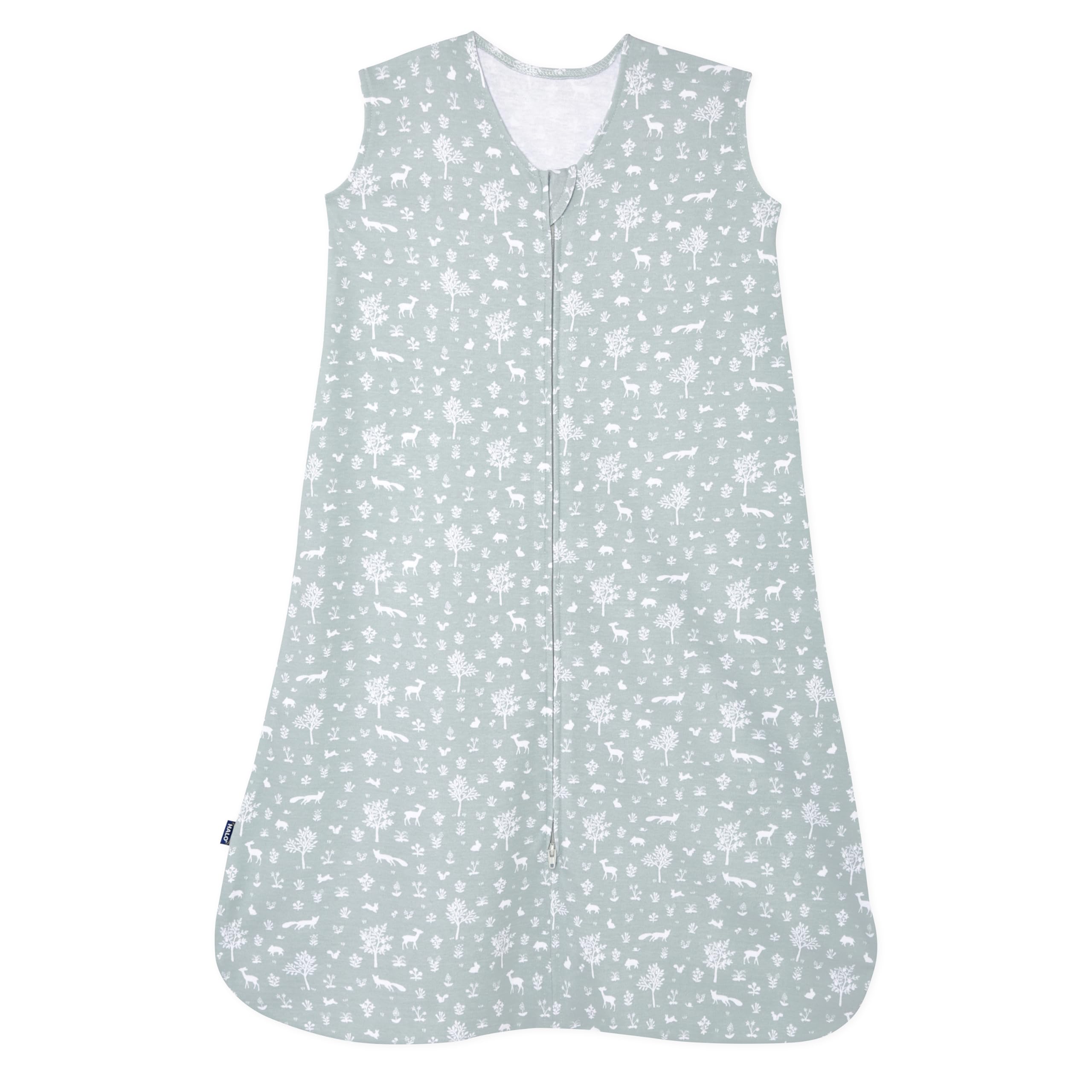
HALO SleepSack Cotton 0.5 TOG
Key Features
- Design: Swaddle-transition wearable blanket
- Fabric: 100% cotton
- TOG Rating: 0.5
- Price: Midrange
Half a TOG is the least exciting number in this guide and the one that matters most. A 0.5 TOG sack is a single layer of cotton that assumes you’ll put a sleeper underneath, which is why we recommend it first: it covers the widest spread of nursery temperatures, fits over whatever your baby already wears, and lets you adjust warmth by changing the layer below instead of buying another sack.
In use it’s plain in the way that works. The cotton is thin and breezy with free arms and roomy legs, so a baby can pull their knees up without the fabric going tight, and it comes out of the wash ready to go again — which counts for a lot on a night when a leak means changing the sack as well as the sheets.
The zipper is the part we watch. On this sack it can stiffen after a few months of washing, and a stuck zipper over a half-asleep baby is its own small crisis. Zip it shut before it goes in the machine and don’t tug if it catches, and you’ll get far more out of it.
Where it sits against the rest of the list: mid-priced, easy to find in stores, and not tied to a season the way the fleece, wool, and bamboo sacks here are. A nursery that runs 66 degrees in January and 78 in July is exactly the case for it, with a different sleeper underneath in each.
Pros
- 0.5 TOG layers over any sleeper
- Thin, breathable cotton for warm rooms
- Roomy legs without extra bulk
Cons
- Neck opening runs wide on smaller babies
Our default recommendation for a first sleep sack: 0.5 TOG cotton that layers over any sleeper, so it works in most nurseries without a second thought about overheating.
Best for Buy-Once Families
Woolino 4 Season Sleep Sack
Key Features
- Fabric: Merino wool lining, organic cotton outer
- Closure: Side zippers with shoulder snap
- Size Range: 2 months to 2 years
- Price: Premium
One sack, from 2 months to 2 years, and no TOG to think about. Woolino builds this from a 100% merino wool lining and an organic cotton outer and lets the wool do the temperature work, so the sack you put on in October is the sack you’re still using in July.
After using it, the size span is the product. A baby wears the same sack through the whole first year and a half, which means one purchase instead of four, nothing new to learn at bedtime, and no bin of outgrown sacks in the closet. Two side zippers and a shoulder snap open the bag flat for changes, and the sleeveless cut keeps it from tipping into too warm.
The trade-off is the price, and it’s the steepest here. The way to think about it: you’re buying the next four sizes at once, and the merino keeps its softness through wash after wash in a way cotton doesn’t. If you plan to have more children, it’s the sack on this list most likely to be handed down.
Pros
- One size covers 2 months to 2 years
- Merino lining regulates temperature year-round
- Side zippers and a shoulder snap open it flat
Cons
- One universal size swamps a small newborn
We call it the buy-once pick: one merino-lined sack that fits from 2 months to 2 years, so you skip the size ladder entirely and pay once instead of four times.
Best for Budget Organic Cotton
Burt’s Bees Baby Wearable Blanket
Key Features
- Fabric: Organic cotton
- Closure: Zipper
- TOG Rating: 0.5 TOG or 1.5 TOG
- Price: Budget
The first thing you notice is the fabric. It’s organic cotton with a brushed, almost jersey hand, and it comes out of the wash soft rather than stiff — the kind of thing you appreciate when you’re the one folding it at ten at night.
It’s also the lowest price of any single sack here, which changes how you buy it: two or three instead of one. The listing carries both weights, 0.5 TOG light and 1.5 TOG medium, so the print isn’t the decision, the TOG is. Pick the light one for a warm nursery and the 1.5 for a cool one, and don’t assume they feel the same because they photograph the same.
We put this in the rotation without hesitating. The cut is generous — real room in the legs, room to grow through the body — so one size lasts, and the fabric stays soft when it’s washed twice a week. Of the cotton sacks here, it’s the one to buy in multiples.
Pros
- Organic cotton stays soft after washing
- Lowest price of any single sack here
- Light and medium weights in one listing
- Generous leg room for kicking and crawling
Cons
- Zipper is stiff to start and can fail
We keep coming back to this one for the entry price: organic cotton that stays soft through a wash cycle, in a light or medium weight, so you can buy two without wincing.
Best for Cold Winter Rooms
Simple Joys Microfleece Sleepbag
Key Features
- Fabric: Microfleece
- Sleeves: Long sleeve
- Pack Size: 2-pack
- Price: Midrange
Almost every sack here is sleeveless, on the theory that free arms sleep cooler. This one isn’t: it has long microfleece sleeves and a fleece body, which is a different job. In a house that runs cold, it replaces a sleeper plus a sack with a single layer.
We reach for it in January. The fleece is light and soft rather than heavy and sweaty, the sleeves mean no cold arms at four in the morning, and two sacks in the pack means one is always clean. It’s the wrong purchase for a warm apartment or a summer nursery, though — fleece holds heat in a way cotton doesn’t, and at 74 degrees it’s simply too much.
As a winter pair, it’s the best value in this guide: two sacks for about what one costs elsewhere, both built to survive a season of nightly washing. If your nursery sits in the sixties, this is the one we hand you. If it sits in the seventies, take the cotton.
Pros
- Long fleece sleeves for cold rooms
- Light fleece that isn’t bulky
- Two sacks per pack
Cons
- Sleeves are narrow to pull on
- Runs small against the size chart
For a cold house, this is the sack we reach for: long fleece sleeves, two per pack, so winter nights don’t depend on how the laundry is going.
Best for Laundry-Day Backups
Yoofoss Cotton Sleep Sack 3-Pack
Key Features
- Size: 0–6 months
- Fabric: GOTS certified organic cotton
- Pack Size: 3-pack
- TOG Rating: 0.5
- Price: Budget
Three sacks in one order solves a problem one sack can’t: the 2 a.m. spit-up, the diaper leak, the morning when last night’s sack is still damp. We buy this one for the arithmetic as much as the fabric — three 0.5 TOG cotton sacks, GOTS certified, for less than a single premium sack here.
The details beat the price. The two-way zipper opens from the bottom, so a diaper change doesn’t have to go all the way to the chin, and there’s an interior guard plus a cover at the top so the pull never sits against skin. The cotton has enough stretch to move with a baby without feeling stiff.
It’s a summer-weight sack, and worth being clear about that: 0.5 TOG over a short-sleeve bodysuit for a warm room, a long-sleeve sleeper and something heavier for January. Where it wins is the middle of the year, and the fact that a clean one is always in the drawer.
Pros
- Three sacks for the price of one
- Two-way zipper with a chin cover
- GOTS certified organic cotton
- Holds up to frequent washing
Cons
- Runs very large against the size chart
Three soft, GOTS-certified cotton sacks with real two-way zippers, so a middle-of-the-night change never waits on laundry — the value pick we recommend first.
Best for Night-Time Changes
baby deedee Sleep Nest Fleece
Key Features
- Fabric: Fleece
- Closure: Zipper with shoulder snaps
- TOG Rating: 1.2
- Price: Midrange
The shoulder snaps are the whole idea. Two snaps at the top let you open the sack wide and lift a sleeping baby in or out from above rather than pulling a neck opening over their head — the difference between a transfer that works and one that ends with everyone awake.
The rest of it is built for winter. The fleece is 1.2 TOG, soft in the hand and closer to a blanket than to outerwear, and it washes and comes out feeling the same, which is what you ask of something that touches a baby’s skin every night for months.
Length is the sizing story. The sack runs long and roomy, so a small baby swims in the size their weight suggests while a tall toddler stays in it well past the age band. On the lighter side, size down; on the long side, buy your usual.
In a cold room with a baby who fights being dressed, it’s the sack we pick first: the snaps shorten the fight and the fleece does the warming. It’s not the one for a warm apartment — 1.2 TOG fleece is a winter tool, and there are cotton sacks here for the rest of the year.
Pros
- Shoulder snaps make night changes easier
- 1.2 TOG fleece for cold rooms
- Soft fleece that washes well
Cons
- Zipper can fail early
The shoulder snaps sold us: this is the sack to reach for when a sleeping baby hates being undressed, and the 1.2 TOG fleece handles a cold room.
Best for Softness-First Buyers
KYTE BABY Sleep Bag 1.0 TOG

Key Features
- Fabric: Rayon made from bamboo
- Closure: Dual zipper
- TOG Rating: 1.0
- Price: Premium
This is the most expensive sack in this guide, and the money goes into the fabric. Rayon made from bamboo has a cool, drapey hand that cotton can’t match — heavier than it looks and soft in a way that survives washing — and at 1.0 TOG it’s a mid-weight sack for a nursery in the high sixties or low seventies.
The cut is more fitted than the cotton sacks here, particularly around the neck and chest, and that’s the detail we appreciated most: no fabric to bunch under a chin, and just enough gentle pressure that a baby who likes being held close settles the same way in the bag. The dual zipper opens from either end for changes.
Buy it because you want that fabric against your baby’s skin every night, not because it’s the last sack you’ll own. It’s the one here that a baby seems to notice, and for a parent who flinches at scratchy cotton, that’s worth something real.
Pros
- Bamboo rayon feels cool and soft
- Snug neckline with no loose fabric
- Dual zipper opens from either end
Cons
- Seams and zipper wear before the fabric does
Softness is the whole case, and we think it’s worth the premium: the bamboo feels cool and substantial, and the snugger neckline is what we noticed most at bedtime.
Best for Swaddle Transition
Love to Dream Transition Bag

Key Features
- Size: Medium (13–19 lbs)
- Design: Zip-off swaddle wings
- Fabric: 93% cotton
- TOG Rating: 1.0
- Price: Premium
This is a swaddle that unsnaps into a sleep sack. The zip-off wings come away one at a time, so a baby who has been sleeping with arms in can move to one arm out and then both without changing bags — it exists for a specific two- or three-month window, and it handles that window better than anything else here.
The design is clever where it counts. There’s no Velcro to rip open at three in the morning, the double zipper opens from either end, and the stretchy 93% cotton holds a snug torso — the swaddled feeling — while the arms stay free once the wings are off. For a baby who startles awake the moment their arms are loose, one wing at a time is gentler than going cold turkey.
What it isn’t: the sack to buy for a baby who already sleeps arms-free. You’re paying for wings you never zip on, and the weight bands are narrow — this Medium is built for 13 to 19 pounds — so it’s outgrown faster than the roomy, one-size options on this list.
For the transition itself, we buy it: it’s the tool that gets a swaddle-dependent baby to free arms with fewer wrecked nights, and it earns its price as a bridge rather than as the sack you’ll still be using in a year.
Pros
- Zip-off wings transition one arm at a time
- No Velcro noise at night
- Two-way zipper for changes
Cons
- Snug chest can feel tight as babies grow
We recommend it for the swaddling-to-arms-free window: zip off one wing at a time and keep the routine — it isn’t the sack for a baby already sleeping with arms out.
How We Chose and Tested the Best Baby Sleep Sacks
We started with a list of sleep sacks from brands parents actually mention—TOG ratings from 0.5 to 2.5, zip-from-bottom and zip-from-top designs, cotton, muslin, and fleece—then narrowed it to 14 that covered different sizes, price points, and closure styles. We spent six months with the final 14, rotating them through naps and overnight sleep rather than judging them straight out of the package. A sleep sack that feels lovely on day one but stiffens after three washes did not make the cut.
Testing happened in real nurseries, not a lab. Two babies—a 4-month-old and a 10-month-old—wore each sack for naps and overnight sleep, and we logged how quickly they settled, how often they woke, and whether they felt too warm or too cool at the back of the neck. We did every diaper change in dim light and noted whether the zipper snagged, stuck, or could be managed one-handed, and whether the zipper garage stayed closed against a baby’s chin.
Fit and sizing got the same attention: we checked the neck opening for gaps, the armholes for rubbing, and the length against each baby’s height, then compared what we saw to the size chart. Each sack went through repeated wash-and-dry cycles, and we felt the fabric afterward for stiffness, pilling, and shrinkage; we also checked seams, zipper pulls, and snaps for wear. Value came down to price per night of actual use—how many washes and wears it survived before looking tired.
How to Choose a Baby Sleep Sack
A sleep sack is a temperature decision first and a fabric decision second — get the warmth rating right for your nursery and the rest of the choice gets much smaller.
Match the TOG to the room, not the season
TOG is a warmth rating, not a quality score. A 0.5 TOG sack is essentially one cotton layer, 1.0 to 1.5 adds insulation, and anything higher is built for genuinely cold rooms. The sacks here run from 0.5 to 1.5, which covers most American nurseries across the year.
The trap is buying the heaviest sack you can find in November and then finding a flushed, sweaty baby at midnight. A sleeveless 0.5 TOG over a long-sleeve sleeper is warmer than it looks. Check the back of your baby’s neck or their chest rather than their hands, which run cool for reasons that have nothing to do with the sack.
Pick the fabric second
Cotton is the default for good reasons: breathable, cheap to replace, and happy with a hot wash every few days. Bamboo rayon feels cooler and softer against skin and usually costs more. Merino regulates temperature better than either, at a premium. Fleece, like the microfleece in the Simple Joys two-pack, is for cold rooms only, because it holds heat in a way the others don’t.
If your baby runs hot, or the nursery is small and warm, stay with cotton and add a warmer sack later rather than buying one heavy sack for the whole winter.
Check the neck and armholes, not the length
Parents measure length because it’s the number on the size chart, but the neckline decides whether a sack actually works. A neck opening loose enough to slide toward the chin, or armholes wide enough to let an arm out, defeats the point of a wearable blanket. Size by weight rather than age, and resist sizing up for longevity — a sack two sizes too big is a sack with fabric bunched near a baby’s face.
Room in the legs is different, and mostly useful: it lets a baby kick, crawl, and eventually stand in the crib without the fabric pulling tight.
Treat the zipper as the part that wears out
Zippers are the shared weak point in this category. They stiffen, split, or lose a pull long before the fabric gives out, and a stuck zipper over a half-asleep baby is a genuinely bad moment at two in the morning.
A two-way zipper with an interior guard and a cover at the top is worth seeking out: it opens from the bottom for a diaper change without exposing a chest, and it keeps the pull off skin. Zip the sack closed before it goes in the wash, and don’t force a pull that catches.
Work out how many you need before you spend
One sack means every leak and every spit-up is a middle-of-the-night laundry cycle. Two is the practical minimum and three is comfortable, which is where the multipacks earn their place — a three-pack of 0.5 TOG cotton or a two-pack of fleece costs less than buying singles and keeps a clean sack in the drawer.
The alternative is one sack that spans sizes. The merino option here covers 2 months to 2 years, costs more up front, and removes the size ladder entirely. Either approach works; what doesn’t is buying one sack and hoping.
Frequently Asked Questions
When can a baby start sleeping in a sleep sack?
From the first weeks, as long as the sack’s weight range covers your baby — that’s what newborn sizes are for. If your baby still startles awake with free arms, swaddle first and move to the sack when they start showing signs of rolling, since rolling is when swaddling has to stop.
Check the weight band on the label rather than the age on the front of the package; a big newborn can be out of a newborn size in a matter of weeks.
Is a sleep sack still safe once my baby can roll, sit, or stand?
Yes — that’s when a sleep sack earns its keep, because it can’t be kicked off or tangled the way a blanket can. Keep the neckline snug and the arms free, and expect the roomy leg panels to let a standing baby pull themselves up in the crib.
The end point isn’t the sack, it’s the crib: once your baby can climb out, it’s time for a toddler bed, not a different sleep sack.
Can my baby wear a sleep sack in the car seat?
Not a bulky one. Extra sleep-sack fabric stops a car-seat harness from sitting snug against the body, and a loose harness is the thing that matters in a crash.
Buckle the baby in normal clothes, do the pinch test at the shoulder strap — you shouldn’t be able to pinch slack — and put the sack on when you arrive.
Final Verdict
Start with the HALO SleepSack in 0.5 TOG cotton. It works in the most rooms, layers over whatever your baby already sleeps in, and doesn’t commit you to one season — the closest thing here to a purchase you won’t second-guess.
Go elsewhere for a specific job: the Simple Joys fleece two-pack for a cold house, the baby deedee when a sleeping baby fights being undressed, and the Woolino if you want one sack to carry you from 2 months to 2 years and would rather pay once than shop four times.