This post contains affiliate links. We may earn a small commission when you buy through our links — at no extra cost to you.
The first night my daughter woke up because a car door slammed outside, I ordered a white noise machine before breakfast. A good one smooths over the sharp sounds that jolt a baby out of deep sleep and gives the same cue every night that bedtime is coming. What I didn’t expect was how much the machines differ — volume dials that jump from barely there to too loud in one notch, fan settings that loop with an audible click. Get it right and the whole house sleeps through the garbage truck.
I’ve since lived with 16 of them over four months of naps and 3 a.m. wake-ups. The good ones share a loop you can’t hear, a volume range that starts quiet and stops short of unsafe, and a build that survives being grabbed through crib slats. We ran each through bedtime, naps, and the 3 a.m. fumble. What separated them was less about features than how the sound sat in a small room; the ones that made sleep easier are below.


Best for All-In-One Nursery
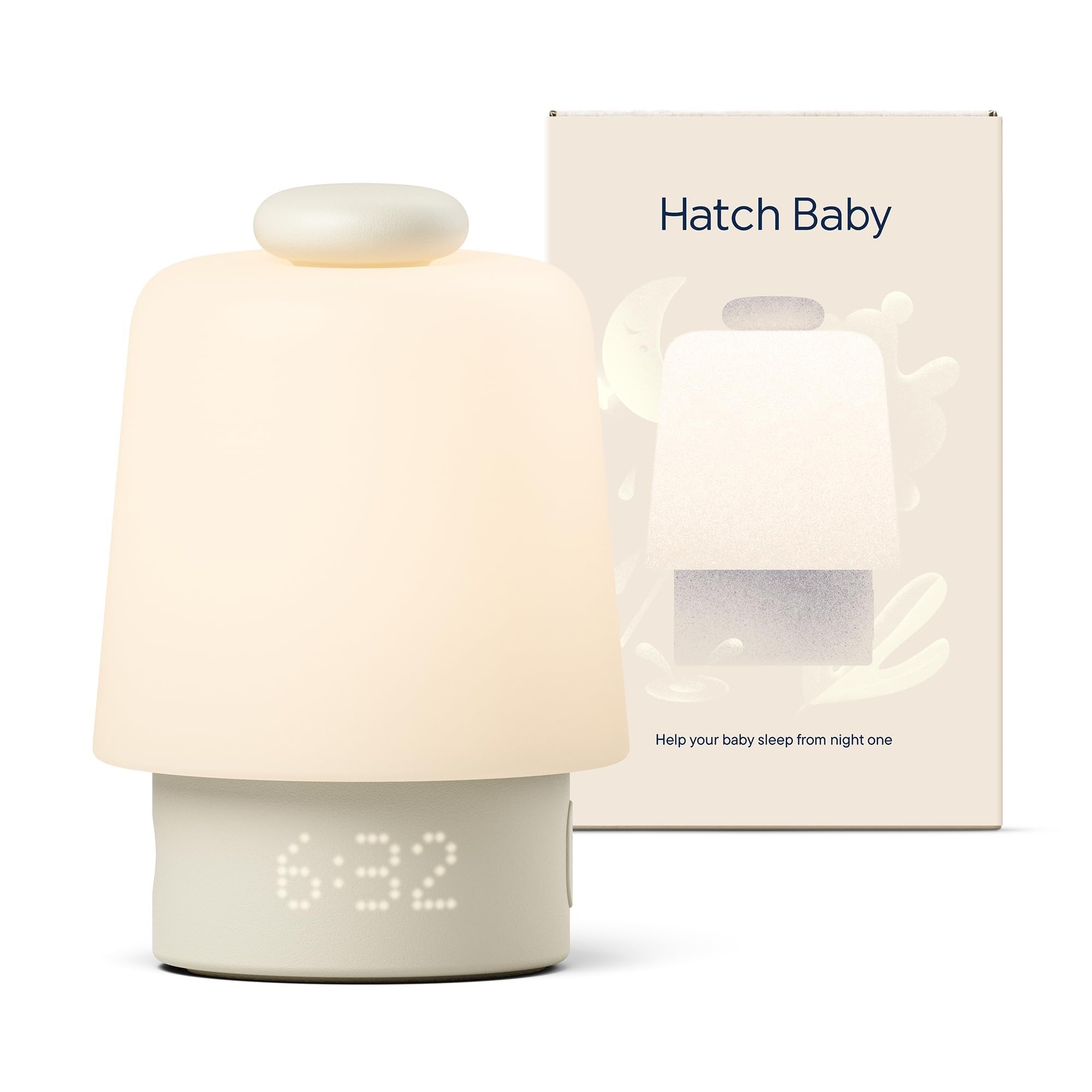
Hatch Baby Sound Machine
Key Features
- Power: Corded electric
- Controls: Wi-Fi app plus touch ring
- Footprint: 6"D x 4"W x 5"H
- Night Light: Adjustable brightness, multiple colors
- Price: Premium
Every other machine in this guide asks you to walk over and press something. The Hatch puts sound, brightness, and saved routines in an app, so you can take the volume down a notch from the hallway without opening the door and restarting the whole settling process. The touch ring on top covers the basics when your phone is charging in the kitchen.
That remote control is why we make it the default, but the light is what earns its keep. It dims low enough to change a diaper by without waking anyone, and the color options let you set a warm amber for the middle of the night and something brighter for the bedtime story. Build a routine that turns the sound and the light on together at the same time every evening, and the machine starts carrying part of bedtime for you.
The sound is better than the price of the budget machines suggests. White and pink noise come out smooth rather than tinny, and there are enough variations that you can find one that does not grate by the fourth hour. The matte putty finish helps too: it reads as a small lamp on a shelf rather than a piece of baby equipment.
The parent we steer elsewhere is the one who wants a switch and nothing more. This machine rewards someone who will build a routine and keep the app installed, and it is the premium spend of the group — worth it only if you will use the light and the scheduling, not just the noise.
Pros
- Sound and light controlled from your phone
- Dims low enough for middle-of-the-night feeds
- Saved routines run sound and light together
- Smooth white and pink noise, not tinny
Cons
- Can power off or fail on its own
- App control depends on Wi-Fi
We make it the default nursery machine: app control, a light that genuinely dims, and saved routines do more at 3 a.m. than any other single feature here.
Best for Simple Fan Sound
Yogasleep Dohm Classic
Key Features
- Size: 5.75 x 5.75 x 3.25 in
- Power: Corded, 7-foot cable
- Speeds: Two
- Sound Source: Real fan
- Price: Midrange
The Dohm makes its noise with a fan, not a speaker, and you hear the difference in about a minute. Air pushed through the housing gives you a steady rush with no short clip repeating underneath it, and none of the digital edge that gives cheaper machines away as a recording. If you are the kind of person who notices the loop, this is the one that does not have one.
The controls are a switch and two speeds, which is the entire point. Nothing to pair, nothing to program, and nothing to rebuild after the house loses power at midnight. In a nursery where you want the same sound from bedtime until morning, that is not a stripped-down feature list — it is the feature. It is the machine we suggest to people who want nothing else to think about.
It does one job, so the light and the library of rain tracks live on other picks here. What you get instead is a footprint small enough for a crowded dresser and a cord long enough to reach most outlets, which counts for more than it sounds like when every surface near the crib is already taken.
Pros
- Real fan noise with no repeating loop
- One switch, two speeds, nothing to program
- Seven-foot cord reaches most outlets
Cons
- Top speed may be too quiet for a loud room
- Some units stop working within months
For parents who want one unchanging fan sound and no app to babysit, we think the Dohm is the simplest machine here that still does the job all night.
Best for Travel and Strollers
Hatch Go Portable Sound Machine
Key Features
- Sounds: 10
- Battery: Up to 15 hours
- Charging: USB-C
- Controls: Three buttons, no app
- Price: Midrange
What the Hatch Go leaves out is the best thing about it: no app, no Wi-Fi, no account, no pairing. Three buttons on the front and a ring you can clip to a stroller bar or a diaper bag. In a hotel room at eleven at night with an overtired baby, that is the difference between a soother and a troubleshooting session.
The rechargeable battery is rated for up to 15 hours and keeps playing while it charges over USB-C, so a night in a strange house does not end at 3 a.m. with a dead machine. Ten sounds cover white noise, a shush, a heartbeat, and ocean — the ones that do the actual work.
It is not as loud as the plug-in machines here. In a quiet nursery that never comes up; in a car with the windows down or a busy restaurant, the top of its range gets swallowed by everything else. Treat it as a portable nursery rather than a noise-cancelling device.
Where it earns its spot is continuity: the same handful of sounds, on the same three buttons, wherever your baby ends up sleeping. The clip ring is the detail we appreciated most — it hangs off a stroller handle or a car seat and stays where you put it instead of sliding around inside a bag.
Pros
- No app, Wi-Fi, or pairing to fight with
- Up to 15 hours, plays while charging
- Clip ring hangs on strollers and car seats
- Ten sounds including hush and heartbeat
Cons
- Some units stop powering on
If the nursery has to travel, we think this is the one worth buying: 15 hours of battery, no app to pair, and buttons you can work one-handed in the dark.
Best for Budget Night Light
Easysleep White Noise Machine
Key Features
- Sounds: 25
- Timers: 5, including continuous
- Night Light: 4 warm-white levels
- Volume Levels: 32
- Price: Budget
If you want a night light and a full sound library without paying Hatch prices, this is the one we hand to anyone on a budget. Twenty-five sounds, thirty-two volume steps, five timers, and a warm light with four levels, in a box small enough to move from the dresser to the nightstand when someone has a cold.
The controls are what matter at 2 a.m. The volume steps are fine enough that you can drop it a notch instead of jumping from too quiet straight to too loud, and the timer runs 60, 120, 180, or 240 minutes or straight through until morning. The memory function picks up where you left off after the power flickers, which sounds minor until the alternative is resetting everything one-handed with a baby on your shoulder.
The sound list runs from white noise and fan settings through rain, brook, birds, train, piano, and lullaby tracks. Expect to settle on two or three and never touch the rest — that is the price of getting twenty-five options at the budget end, and it is true of every cheap machine here. The build does not have the heft of the Hatch, but it does not ask for Hatch money either.
Pros
- Warm light with four brightness levels
- 32 volume steps fine enough for overnight
- Timers plus continuous play, with memory
- 25 sounds including piano and lullabies
Cons
- Warm-white light only, no color options
A warm night light, fine volume steps, and a big sound library for budget money — we think it is the sensible first machine for a second room.
Best for Light-Color Variety
Soother Sleep Sound Machine

Key Features
- Sounds: 30
- Timers: 5, including continuous
- Light Colors: 12
- Brightness Levels: 10
- Price: Budget
Twelve light colors and ten brightness levels is the widest light range in this group, and the bottom of that range is dim enough to check a diaper without turning the room into a nightclub. On a budget machine, that is the feature doing the most work.
Thirty sounds cover three noise colors — white, pink, and brown — plus soft and loud fan settings and eighteen nature tracks. The detail that sold us is the fade: as the timer runs out, the sound eases down instead of cutting dead, which is the difference between a baby who stirs and one who does not. Light control plus a gentle shutdown is why it is our pick among the cheap machines.
The keys are large and clearly labeled, so a half-asleep adult can find them, and a three-year-old can be trusted with the light. This is a nursery machine that grows into a toddler’s room rather than getting outgrown, and the twelve colors are a large part of why. It is also small and light enough to move between rooms when naps happen in the living room.
Pros
- Twelve colors and ten brightness steps
- Sound fades down before the timer cuts it
- 30 sounds including white, pink, and brown noise
- Large, simple keys adults can work in the dark
Cons
- Some nature tracks sound synthetic
The light is what sells it: twelve colors, ten brightness steps, and a sound that fades instead of stopping, all at a budget price.
Best for Noisy Houses
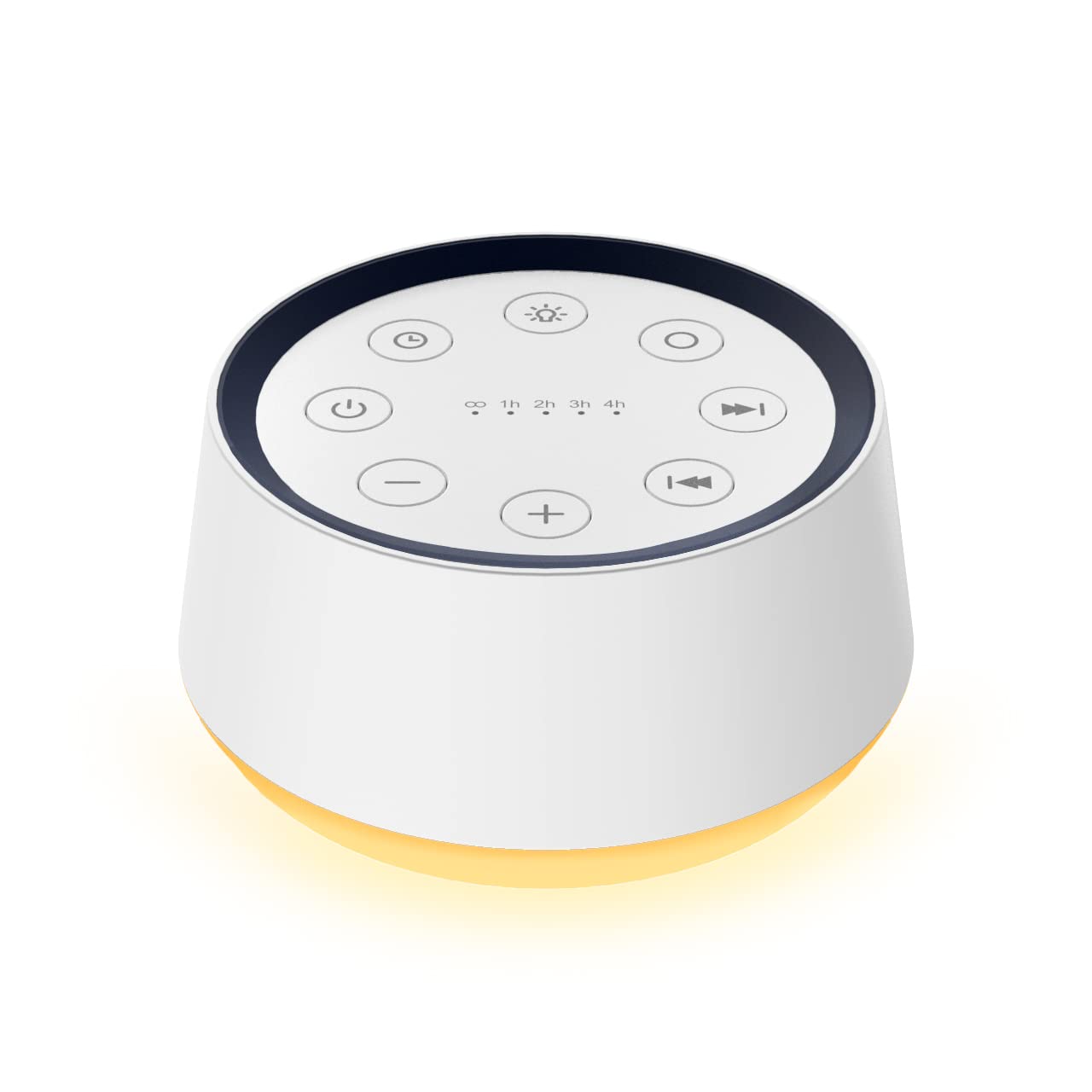
Brown Noise Sound Machine
Key Features
- Size: 4.25 x 4.25 x 2.16 in
- Sounds: 30
- Light Colors: 12
- Volume Levels: 36
- Price: Budget
Brown noise is what people reach for when white noise sounds too bright and hissy. It is weighted toward the low end — closer to heavy rain on a roof than to a radio tuned between stations — and this machine gives you three brown tracks alongside white, pink, and two fan settings, so you can hear the difference before you commit to one.
Thirty-six volume steps is the finest control in this group, and it matters more than the sound count. A short volume ladder leaves you choosing the lesser evil at bedtime, because the notch below too loud is often too quiet. With this many steps you can find the level that blurs the hallway without becoming the loudest thing in the room, and that is exactly the level you want in a nursery.
Twelve light colors ride along, the footprint is small enough for a narrow shelf, and the whole thing is built around a sound that does not call attention to itself. If the nursery shares a wall with a television or a busy street, this is the machine we reach for first.
Pros
- Three brown noise tracks plus white, pink, and fans
- 36 volume steps, the finest control here
- Twelve-color night light with ten levels
Cons
- Night light shines from the base only
For a light sleeper or a noisy house, the three brown noise tracks and 36 volume steps make this the most adjustable machine here for the money.
Best for Second Nursery
Color Noise Sound Machine

Key Features
- Sounds: 25
- Timers: 5, including continuous
- Light Colors: 10
- Volume Levels: 32
- Price: Budget
Twenty-five sounds, ten colors, thirty-two volume steps, five timers: on paper this is the Soother with two fewer colors, and in use it behaves the same way. Four kinds of white noise, four fan sounds, three sea waves, and three rain tracks fill out most of the list, with train, star dust, and meditation along for the ride.
We put it beside the Soother and the differences stayed small. The buttons are large and the layout is simple enough to work without looking, which is the whole game at 3 a.m., and the light steps down through its ten colors and adjusts brightness rather than jumping straight from bright to off.
It does not win on any single dimension here — the Soother has more light control, the Brown Noise machine has finer volume steps — but nothing about it will surprise you, and if the color you want is among its ten you will be perfectly happy. That is a fair description of a good second nursery machine.
Pros
- 25 sounds across noise, fans, water, and rain
- Large, easy-to-find buttons
- Ten colors with adjustable brightness
Cons
A solid, simple budget machine: 25 sounds, ten colors, and buttons you can find in the dark, as long as you do not need the extra light control of the picks above it.
How We Tested: 16 Machines, Four Months of Bedtime
We started by pulling every machine sold by the major retailers and narrowing by what actually matters in a nursery: a volume floor low enough for a small room, a true continuous loop rather than a repeating clip, and a cord or battery setup that works with where the crib sits. We cut anything whose light couldn’t be switched off, anything that needed an app to run a basic function, and anything that added features nobody asked for at 2 a.m. We also sorted by price band and asked what each step up actually bought — most of the time, it was a nightlight and a projector we never turned on. That left 16 machines.
Each one spent four months in rotation in a real nursery and on weekend trips, running at nap time, bedtime, and overnight. We measured output with a decibel meter at crib distance on both the lowest and highest settings, then sat in the room and listened for the seam where a loop restarts — a surprising number of machines give themselves away every 30 seconds. We noted what each sound masked: a doorbell, a dog, an older sibling in the hallway, the washing machine through the wall. We also asked whether we’d willingly sit in that room for 20 minutes, which is where the harsh, hissy machines fell away.
Overnight, we logged every wake-up and whether the machine was still running in the morning. For ease of use, we timed how fast we could dim the display or set a timer in the dark, one-handed, without waking the baby. Durability got tested less gracefully: we dropped each machine from crib height, wiped it down after a leaky diaper, stuffed it into a diaper bag for a weekend away, and checked whether the buttons still worked and the battery still held a full night. Reliability meant it did the same thing on night 100 that it did on night one — no reconnecting, no drift, no slow volume creep.
How to Choose a Baby White Noise Machine
The machine that wins is the one you can forget about between bedtime and morning, so start with how it plays rather than how many sounds it lists.
Continuous Play Comes First
Almost every machine here offers a timer — an hour, two, three, or four — alongside a continuous setting. Continuous is the one that matters, because a nursery that goes silent at eleven often wakes at five past. Check two things before you buy: that continuous play is genuinely available, and that the machine remembers your sound, volume, and timer after the power flickers. The Easysleep and the Brown Noise machine both restore your last settings on their own, and that small piece of automation is worth more than an extra ten sounds.
A Real Fan or a Digital Recording
A mechanical machine like the Yogasleep Dohm generates noise with moving air, so there is nothing to repeat and nothing that wears thin across an eight-hour night; the trade is that you get one family of sound and no library. Digital machines give you rain, ocean, and fan recordings plus a night light, but a short recording can develop an audible rhythm once you have heard it for an hour. If repetition bothers you, listen for it on the tracks you would actually use — bird and brook effects wear out faster than steady noise.
A Light You Can Dim to Almost Nothing
Brightness range matters more than the number of colors. You want a light that goes low enough to check a diaper without waking a drowsy baby, and warm reds and ambers are easier on everyone at three in the morning than blue or green. We care far more about that bottom end of the range than about a sixteenth color. Also look at where the light comes out: a base glow lights the dresser it sits on, while a diffused panel lights enough of the room to work by.
Cords, Outlets, and Placement
Most machines here run from a wall adapter, which means the outlet decides where yours lives — usually across the room from the crib, which is where you want it anyway. Route the cord well out of reach and never run it along a crib rail. If the same machine has to travel, a rechargeable unit like the Hatch Go is the sensible answer; a corded box and a hope for an outlet near the bassinet gets old by the second trip.
Frequently Asked Questions
How loud should a baby white noise machine be?
About as loud as a shower running in the next room is the usual rule of thumb: loud enough to blur the hallway, not loud enough to make you raise your voice. Set it to the level you’d use overnight, then stand where your baby sleeps. If the sound feels sharp or you can hear the loop from there, drop it two steps.
Will my baby become dependent on white noise?
Often, yes, and that is usually fine — the sound becomes a sleep cue the same way a bath and a book do. The practical consequence is that you will want the same sound away from home, which is why a small rechargeable unit earns a place in the diaper bag. Use it for naps as well as nights; a cue that only appears after dark is harder to carry into travel and daycare.
Can I use a phone app or a box fan instead?
A fan works, since it produces real non-looping noise, but you get one volume and one tone, plus a floor fan with a cord next to a crib. A phone app covers a night or two, yet notifications cut through the sound and the screen lights the room. If you go the phone route, put it across the room on do-not-disturb rather than beside the crib.
What is the difference between white, pink, and brown noise?
The three describe how the sound energy is spread. White noise is bright and hissy, pink is softer with less top end, and brown is deeper again — closer to heavy rain on a roof. Parents who find white noise too sharp often settle on brown, which is why the Brown Noise Sound Machine here gives you three brown tracks to compare before you commit.
Final Verdict
The Hatch Baby is the machine we recommend to most parents: sound, light, and a saved routine inside one app-controlled box does more at 3 a.m. than any single feature on this page. If you want the opposite of an app — a switch, a fan, and nothing to pair — the Yogasleep Dohm Classic is the simpler buy and the one that never needs a password.
And if the nursery has to travel, the Hatch Go is the pick that fits in a diaper bag.