
This post contains affiliate links. We may earn a small commission when you buy through our links — at no extra cost to you.
The step beside your bed has one job, and it has to do it half-asleep. A wobbly bed step turns a quick trip to the bathroom into a balance test, especially in socks on a slick floor or when the top step sits too far from the mattress. The right one closes that gap: it makes climbing into a tall bed feel ordinary, gives kids and older knees a surer route, and stays planted when you shift your weight. Over the past eight months, we’ve lived with 10 bed steps to see which ones actually earn their spot.
Height matching matters more than step count. A two-step model that lines up with your mattress height beats a three-step model that leaves you reaching. The best ones felt stable underfoot, went together without a fight, and still felt tight at the joints after months of nightly use. Value showed up in labeled hardware, grippy treads, and a footprint that tucks out of the way; the picks below are the ones we kept beside the bed.
Our Top Picks


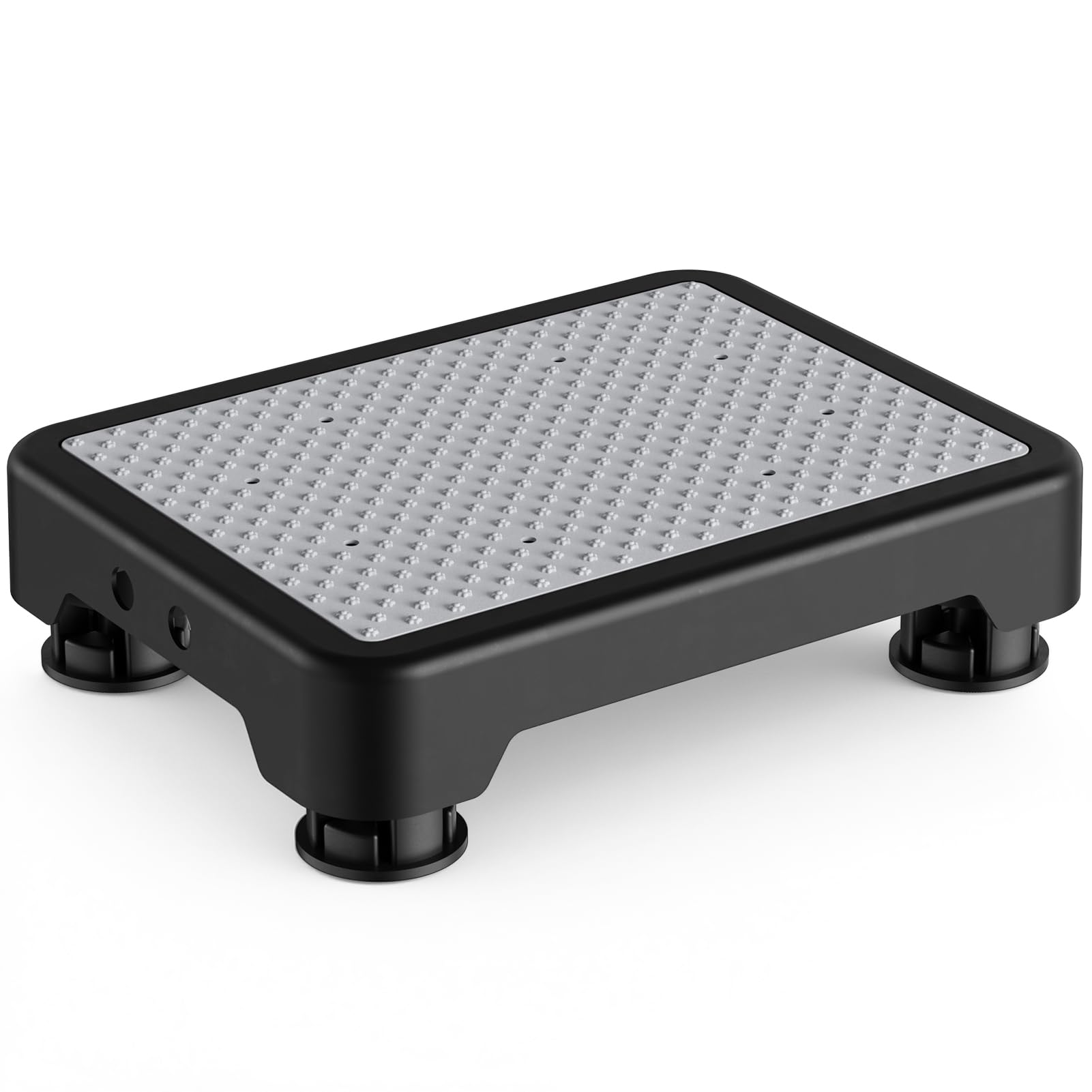


The Best Bed Steps, Reviewed
DMI Step Stool with Handle – Best Overall
Key Features
- Item weight: 8.5 lb
- Step height: 9 inches
- Handle height: 34 inches
- Weight capacity: 300 lb
- Price: Midrange
The 34-inch handle is the first thing we check on a bed step, because it gives you something to hold before your weight shifts. On the DMI it rises well above the 9-inch platform and lands at a natural hand height, so you can plant a foot, take the rail, and turn toward the mattress without reaching down. The platform underneath is a generous 10 by 14.5 inches, with a textured mat rather than a slick chrome surface.
We came back to this one because the handle and platform work as a pair. The rail is tall enough to steady a full step up, and the mat gives you room for a whole foot, even in socks. The steel frame is heavier than the plastic platforms here at 8.5 pounds, which is exactly why it feels planted beside the bed instead of skittering away when you nudge it.
The 300-pound capacity is lower than several platforms in this group, but it is still a sensible rating for a bedside step. More important is the way the rubber-tipped legs and textured top hold the stool in place when you shift your weight from the step to the mattress. The chrome frame also wipes clean easily, which matters in a bedroom.
Assembly is the weak spot. The frame arrives in pieces, and the included wrench is not much help; use a proper screwdriver and a second pair of hands, and check the bolts after the first week. Once together, the DMI feels like a piece of equipment rather than a decorative stool, and that is what we want beside a high bed.
Pros
- Handle gives steady support at hand height
- Wide, textured platform
- Steel frame feels planted
- Rubber feet resist sliding
Cons
- 9-inch step can feel tall beside a low bed
For most high-bed transfers, we choose this handled step because the 34-inch rail gives you something real to hold.
Vaunn Medical Step Stool – Best No-Handle Step
Key Features
- Platform: 14 x 17 inches
- Item weight: 5 lb
- Step height: 8.5 inches
- Weight capacity: 350 lb
- Price: Midrange
No handle is the point of this Vaunn. It is a low, wide platform that can slide under a high bed when you are not using it, and the fully welded steel frame has no joints to work loose. We kept it in the no-handle slot because the 8.5-inch step height is tall enough to matter beside a high mattress, yet the stool stays compact enough to tuck away.
The 14 by 17-inch top is broad enough to sit on while you pull on socks, and the ribbed rubber surface gives you a clear place to put your foot. At 5 pounds, it is easy to pull out and push back, but the welded frame has enough heft that it does not feel like a toy. The 350-pound capacity is higher than the DMI’s and among the stronger ratings in this group.
What it does not give you is a rail. If you need to hold something while you step, this is the wrong pick; the DMI is the better answer. On a high bed where you already have a wall, a nightstand, or a caregiver’s hand nearby, the Vaunn’s low profile and stable platform make more sense than a taller handled stool that crowds the bedside. It asks you to be steady on your own, and that is the line between this one and a handled step.
Pros
- Fully welded steel frame
- 8.5-inch lift for high beds
- Wide ribbed rubber platform
- Light enough to slide under the bed
Cons
If your bed sits high and you want a step that disappears underneath it, the Vaunn’s welded steel platform is the no-handle pick we trust.
SOYO Mobility Step Stool – Best Low Adjustable Step
Key Features
- Platform: 16.5 x 12.6 inches
- Item weight: 4.1 lb
- Step height: 2.8 inches
- Weight capacity: 550 lb
- Price: Budget
Some high beds only need an inch or two of help, and a full step stool can feel like overkill. The SOYO is a low platform with five individually adjustable feet, so you can level it on a slightly uneven floor and set a modest boost in front of the bed. The 16.5 by 12.6-inch top is wide enough for both feet, and the rubber mat has drainage holes that make it useful in a bathroom as well as a bedroom.
At 2.8 inches, it is not trying to be a staircase. That low height is the reason it works for someone who can still balance but finds the floor-to-mattress gap awkward, and the 550-pound capacity is the highest in this group. The platform is light enough to move with a foot, and the rubber feet hold it steady on hard floors.
We liked it best as a bedside half-step, not as a replacement for a handled step beside a tall mattress. If your bed is genuinely high, the DMI’s rail and 9-inch rise make more sense; the SOYO’s advantage is that it stays out of the way and gives you a flatter landing than the floor. The wide footprint is the trade-off in a tight gap between bed and wall.
Pros
- Five feet adjust for uneven floors
- 550-pound capacity
- Wide non-slip platform
- Low enough to move with a foot
Cons
For a bed that is only a little too high, this adjustable platform adds a firm half-step without crowding the floor.
HBTower Mobility Step Stool – Best Lightweight Step
Key Features
- Material: Polypropylene
- Item weight: 2.87 lb
- Step height: 4.29 inches
- Weight capacity: 420 lb
- Price: Budget
At 2.87 pounds, the HBTower is light enough to carry by its edge with one hand, which is the whole reason it earns a place here. It is a half-step rather than a full stool: the platform sits 4.29 inches off the floor, with a textured top and silicone pads underneath to keep it from skating.
What sold us was how little space it takes up between uses. The 420-pound capacity is more than most users need, and the polypropylene body is easy to wipe down after a bathroom or kitchen job. The low height makes it a good match for a bed that is only a few inches above the floor, or for a car seat that needs one extra beat before you climb in.
It is not adjustable, so the height you buy is the height you live with. If your mattress is tall, this is not the step; the DMI or Vaunn makes more sense. What it does well is disappear: it is thin enough to tuck beside a nightstand or under a low shelf, and light enough that you can move it with a foot when your hands are full.
Pros
- Very light at 2.87 pounds
- 420-pound capacity
- Non-slip top and silicone base
- Easy to tuck away
Cons
When the step has to move between bed, bath, and car, this light platform is the one we reach for.
Leekpai Step Stool with Handle – Best Budget Step with Handle
Key Features
- Handle: Yes
- Item weight: 8 lb
- Assembly tools: Included
- Weight capacity: 350 lb
- Price: Midrange
The case for the Leekpai is straightforward: it gives you a handle, a non-slip step, and the tools needed for assembly for less than the DMI. We like that it does not make you hunt for an Allen key, and the 350-pound capacity is enough for most bedside use. The steel frame has a similar institutional look to the handled stools used in clinics.
The handle is the feature that matters most. It gives you something to grab while you step up, and the rubber tread keeps the platform from feeling slick under a sock. The stool is lighter than the DMI at 3.63 kilograms, so it is easier to move from room to room, but that lighter frame is also why the assembly needs care.
Stability is the caveat. Some units can arrive with bolts that need re-tightening, and a stool that wobbles is not one to trust beside a bed. Check every fastener after assembly, put the stool on a level floor, and tighten the legs again after the first week. If you want the most solid handled step in this group, the DMI is the safer buy; if you want the basic setup for less, the Leekpai is worth a look.
Pros
- Includes assembly tools
- Handle supports stepping
- Non-slip rubber tread
- 350-pound capacity
Cons
A handled steel step for a tighter budget, as long as you tighten the legs and check for wobble before relying on it.
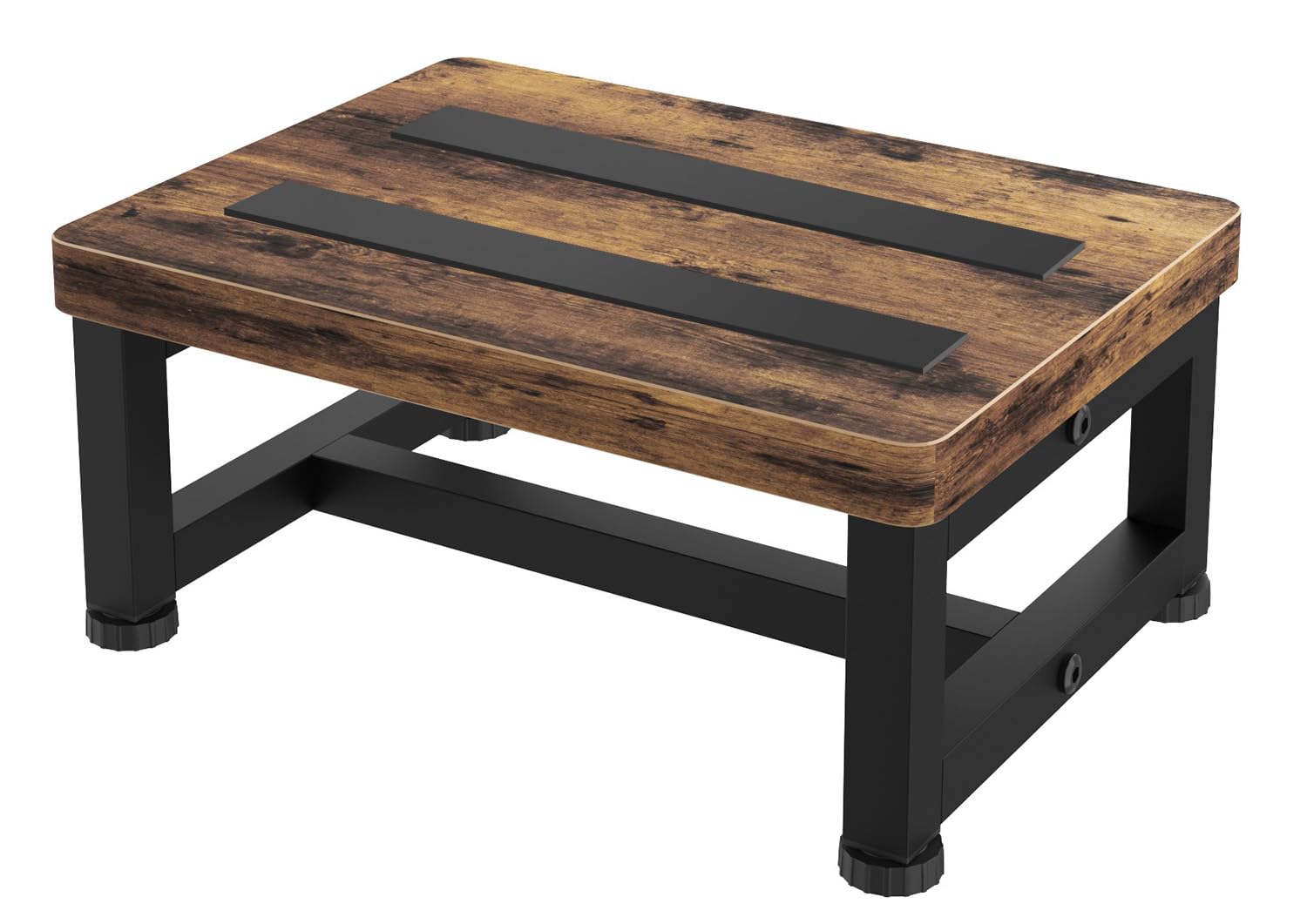
FYGUES Wooden Step Stool – Low Wooden Step
Key Features
- Material: Engineered wood and steel
- Platform: 15.4 x 11.8 inches
- Step height: 5.9 inches
- Weight capacity: 500 lb
- Price: Budget
The FYGUES looks more like a small piece of bedroom furniture than a medical aid, which is why it caught our eye. The rustic brown finish and rounded corners soften a piece that sits in view, and the 5.9-inch platform is low enough to feel like a gentle boost rather than a stair. It is a good match for a low bed, a guest room, or a spot where a chrome stool would look out of place.
Underneath the wood, there is an alloy steel frame and adjustable rubber feet. The 15.4 by 11.8-inch top is wide enough for a full foot, and the 500-pound capacity is generous for a step this compact. The feet can be tweaked to stop a rock on an uneven floor, and the non-slip strips give you a visible landing zone.
We see it as a furniture-grade step for a low bed, not a daily climbing tool for a tall mattress. At 5.9 inches it gives a modest lift, and the steel frame gives it more structure than the wood alone suggests. For a guest room or a bedside where the step is on show, that is a fair trade.
Pros
- Furniture-like wood finish
- 500-pound capacity
- Adjustable non-slip feet
- Low 5.9-inch profile
Cons
- Engineered-wood edges can peel with heavy use
For a low bed where looks matter, this wood step is a good-looking choice if you accept its engineered-wood build.
How We Tested Bed Steps at Home
We began by researching bed steps in a range of heights, step counts, and materials, then narrowed the field by listed weight capacity, footprint, assembly requirements, and price. We ordered 10 models and placed each one beside a real bed: a low platform bed, a tall pillow-top, and an adjustable bed that changed height through the night. Testers used them barefoot and in socks, on carpet, hardwood, and a rug, and during middle-of-the-night bathroom trips, morning routines, and the occasional laundry-carrying climb.
Stability and sturdiness came first. We pushed each step sideways while standing on it, stepped off the edge on purpose, and noted whether it slid, tipped, or creaked; we also watched whether the top step lined up with the mattress or forced a reach. For ease of use, we timed assembly alone, checked whether the hardware was labeled and the instructions were clear, and noted whether the step was light enough to reposition without dragging. We judged value by comparing the materials, fit, and finish against what the step cost—not simply by the lowest price.
Over eight months, we kept notes on durability and quality: loose screws, wobble at the joints, chipped finish, worn tread, and any squeaks that developed after repeated use. We also checked functionality in daily life—whether the step tucked out of the way when not in use, whether the tread was easy to wipe clean, and whether it stayed put on different floor surfaces. The steps that rose to the top were the ones we stopped thinking about.
How to Choose a Bed Step
The right bed step is the one that matches the height of your mattress and the amount of balance support you actually need, not the one with the highest weight rating.
Start With the Height Gap
Measure from the floor to the top of the mattress, then subtract the height of any frame or rail you step onto. A step that is too tall turns a small lift into a stair; one that is too low leaves you reaching for the mattress. A 9-inch step like the DMI suits a genuinely high bed, while a 2.8-inch platform like the SOYO is for a bed that is only slightly raised. The trap is assuming taller is safer. It is not.
Decide Whether You Need a Handle
Handles are not decoration. They give you a fixed point to hold while your weight moves, and for anyone with balance or knee trouble, that can be the difference between a confident step and a hesitation. The DMI puts its rail at 34 inches, close to where your hand falls naturally. If you have a wall or a sturdy nightstand within reach and want the step to slide under the bed, a no-handle design like the Vaunn can work. Do not use a handle as a substitute for a caregiver’s help if balance is seriously limited.
Check Stability, Not Just Capacity
Capacity tells you how much weight the frame is rated to hold; it does not tell you whether the step will rock when you shift from one foot to the other. Look for a wide platform, a textured or rubber top, and feet that sit flat on your floor. A heavier steel frame like the Vaunn’s tends to stay put, while a light plastic platform like the HBTower relies on silicone pads and a broad base. On hardwood, clean the feet regularly; grit under rubber is what turns a stable step into a slider.
Plan for the Footprint and Assembly
A bedside step has to live in the gap between the bed and the wall, so check the footprint before you buy. A fixed handle adds height and can keep the stool from tucking fully out of the way; a low platform is easier to slide under a bed but may not give you the rise you need. Assembly is the other practical cost. Handled steel stools often arrive in pieces, and the included wrench may not be enough. Use real tools, tighten the bolts, and recheck them after the first week.
Match the Material to the Room
Steel and polypropylene are the easy choices for bathrooms and kitchens because they wipe clean and shrug off splashes. Wood or wood-topped steps look warmer in a bedroom but need more care; the FYGUES uses engineered wood over a steel frame, so keep it out of standing water and check the edges. If the step will move between a wet bathroom and a dry bedroom, a plastic platform like the SOYO or HBTower is the more practical finish.
Frequently Asked Questions
Can I use a bed step on carpet?
Low-pile carpet usually helps a heavy stool stay put; thick pile can let a light platform rock because the legs sink at different depths. Set the step down, weight one corner, and check for rocking before you trust it. A wide steel frame like the Vaunn is more forgiving; a light plastic platform is better on a hard, level floor.
Can I use the same step for my bed and my car?
Only if the step height works for both. A low platform like the HBTower is light enough to carry out to a car, but a handled step is bulky and may not clear the door sill. Measure the car sill and the bed height before you choose one step for both, or buy a second low step for the car.
Can I use a bed step after hip or knee surgery?
A low, stable step with a handle is often easier to manage after surgery, but the right height depends on your bed and your care team’s guidance. Practice with someone nearby, keep the path clear, and choose a step you can reach without twisting. The DMI’s handle and the SOYO’s low platform are the two shapes to compare.
Final Verdict
For most high beds, the DMI is the step we recommend: the 34-inch handle gives you something real to hold, the 9-inch platform matches a tall mattress, and the steel frame stays planted.
If you want the step to slide under the bed, choose the Vaunn’s no-handle platform; if the bed is only slightly high, the SOYO’s low adjustable step is the better fit.