
This post contains affiliate links. We may earn a small commission when you buy through our links — at no extra cost to you.
A buckwheat pillow does something no foam pillow can: it stays exactly where you push it. Mold a well under your neck at midnight and it’s still there at six, which is why people with cranky necks tend to become lifers. The tradeoff is honest and up front — hulls shift and crunch when you roll over, and a brand-new pillow smells faintly of the field it grew in.
What a good one fixes is the thing most of us ignore until our shoulders ache: a neck that’s been slowly sinking because the fill gave out months ago. My team and I have slept on 13 buckwheat pillows over the past six months, and the differences came down to how clean and how coarse the hulls are and how much control you get over the fill. Here’s the shortcut first-timers miss: buy one with a zipper, because you will almost certainly want to scoop some hulls out. The picks below are the ones worth the scooping.


Best for Standard-Size Sleeping
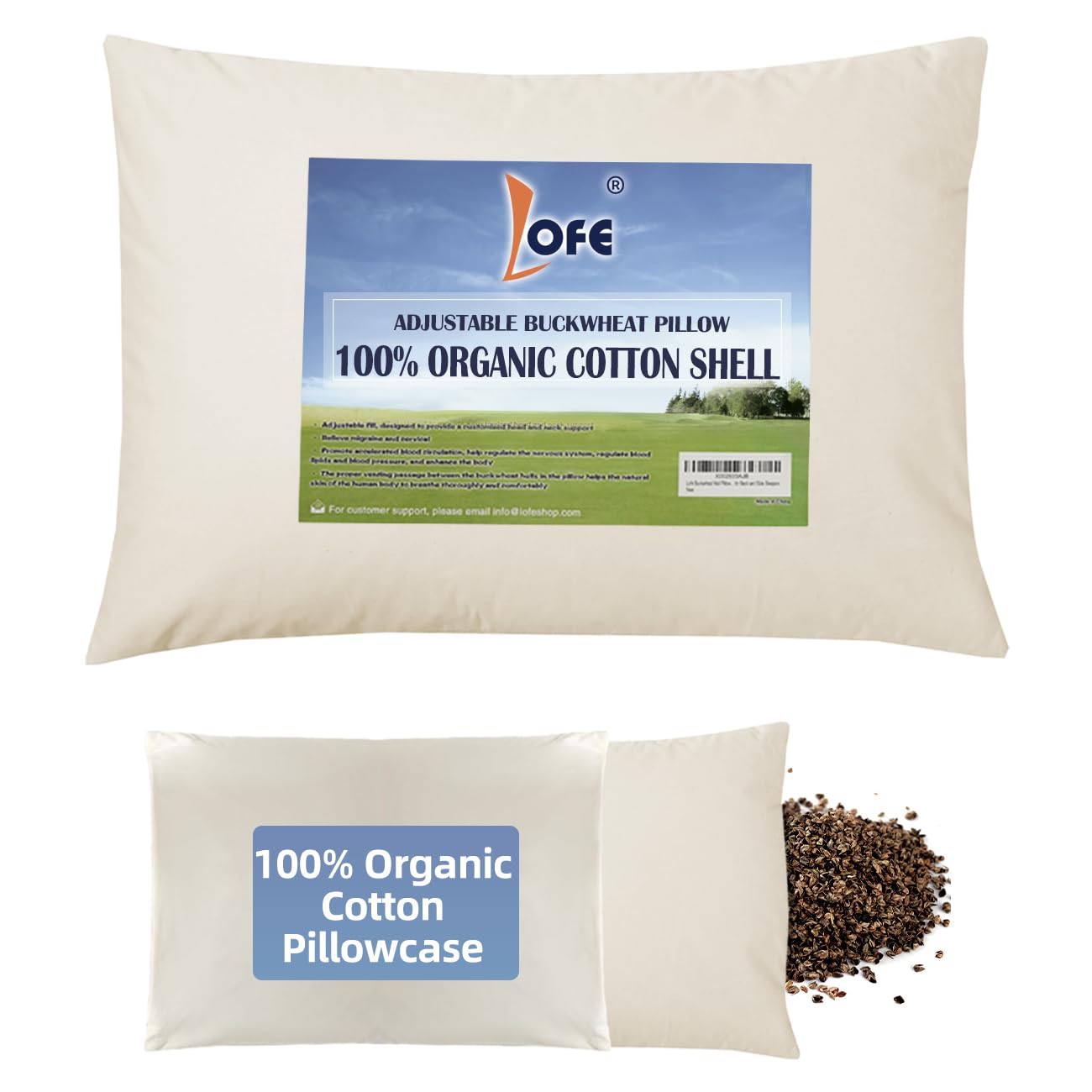
LOFE Organic Buckwheat Pillow 20 x 26
Key Features
- Fill: Tartary buckwheat hulls
- Loft: 5 inches
- Size: 26"L x 20"W
- Weight: 7.9 lb
- Price: Midrange
If you have never slept on buckwheat, this is the one to start with. The LOFE is a full 20 x 26 inches, so it fits a standard case and covers the same ground as the pillow you’re replacing — which we can’t say for the Japanese-size options further down. Organic cotton shell, tartary buckwheat fill, and a second organic cotton pillowcase included. The part we care about most is the side zipper: it lets you take hulls out until the pillow sits level with your neck instead of propping your head up.
It arrives overfilled and genuinely tall — 5 inches of loft, which is a lot even for a side sleeper. Empty a couple of cupfuls out and it settles into a shallow well for the head with a ridge under the neck, and the density of the hulls keeps it that way. Ours didn’t slide off the bed the way a down pillow does when you turn over, and it never warmed up under the head.
One thing to plan for: the smell of fresh hulls. It’s noticeable the first night and faint within a week, and a case over the top covers most of it. That’s the trade for fill that hasn’t been sealed in plastic for a year, and it’s the only adjustment period we minded.
The second case earns its place more than a spare usually does. Buckwheat hulls never go in the washing machine, so having one case on the pillow while the other is in the laundry is what keeps the thing clean without emptying it onto a sheet.
Pros
- Full 20 x 26 size fits standard cases
- Side zipper lets you tune the loft
- Extra organic cotton pillowcase included
- Dense hulls hold their shape overnight
Cons
- Heavy at 7.9 pounds to lift and re-case
Our default pick: a full 20 x 26 sleeping surface, a side zip for tuning loft, and a second organic cotton case in the box.
Best for Compact Beds, Travel
Beans72 Japanese Buckwheat Pillow
Key Features
- Fill: US-grown organic hulls
- Size: 20"L x 14"W
- Cover: Cotton pillow ticking
- Firmness: Extra firm
- Price: Midrange
Set it next to our top pick and the Beans72 gives up about a third of its width: 14 x 20 inches against 20 x 26. That’s the whole proposition. It’s the traditional Japanese size, small enough to scoot around under your head at night and to leave the rest of the bed to whoever you share it with, and there’s less of it to fight when you change position.
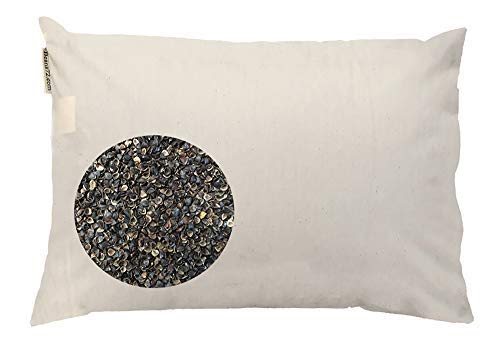
The fill is why it stays in the guide. US-grown organic hulls in a pillow-ticking cotton case, packed extra firm and shipped well overfilled, with a zip at one end. Plan on emptying some out before the first night rather than after a bad one: this is a pillow that pushes back, and at full fill it’s closer to a sandbag than a cushion. Take some out and it holds a head shape in any position without needing a fluff — side, back, stomach, it doesn’t argue.
Where it doesn’t work is scale. A broad-shouldered side sleeper runs out of pillow on a 14 x 20 surface — there’s nothing to hug, and the hulls under the neck have nowhere to spread. If that’s you, go full size. For everyone else it’s the least fussy pillow here: no fluffing, no drifting off the bed, nothing to rearrange at three in the morning.
Pros
- Compact 14 x 20 footprint frees the bed
- US-grown organic hulls in ticking cotton
- Zippered end makes the fill adjustable
- Holds a shape in back, side or stomach positions
Cons
- No pillowcase included
- Hulls crunch audibly when you move
Pick it for the footprint: a compact 14 x 20 Japanese-size pillow, extra firm, filled with US-grown organic hulls, and at its best in a small bed.
Best for Side Sleepers
USlixury Organic Buckwheat Pillow
Key Features
- Fill: Organic buckwheat hulls
- Loft: 4.2 inches
- Size: 26"L x 20"W
- Extras: Spare hulls and pillowcase
- Price: Midrange
A pouch of extra hulls ships with this pillow, and that’s more useful than it sounds. Nearly every buckwheat pillow arrives overfilled, so the first job is taking fill out; the spare pouch means you can put some back when you overshoot, or top it up in a few months when the hulls settle. What we appreciate is that the design assumes you’ll tune it twice.
Full 20 x 26, 4.2 inches of loft, and a firm fill that presses into a neck contour instead of springing back flat. For side sleeping that’s the useful part — the hulls fill the gap between jaw and shoulder rather than letting the head drop. The shell is unbleached organic cotton with a second case included, and the whole thing has the dense, planted feel of a pillow that isn’t going anywhere.
This is not the pillow for a stomach sleeper. Four inches of firm hull is a lot to lie face-down on, and there’s no softness to sink into. Everyone else — particularly anyone who wakes with a stiff neck — gets a pillow that holds its shape all night without a single fluff.
Pros
- Spare hulls bag for topping up later
- Firm fill holds a neck contour all night
- Second organic cotton pillowcase included
Cons
- Coarse, canvas-like cotton cover
- Natural hull odor needs a few days of airing
A firm full-size pillow with spare hulls in the box, so you can put loft back after you take it out — our pick for side sleepers who want the gap filled.
Best for Budget Back Sleepers
ZEN CHI Organic Buckwheat Pillow
Key Features
- Care: Hand wash only
- Fill: Organic buckwheat hulls
- Loft: 2.83 inches
- Size: 14"L x 20"W
- Price: Budget
It’s the cheapest pillow here, which is the only reason we picked it up — a budget buckwheat pillow that can’t be adjusted is a false economy. This one can. There’s a zip along the edge, the fill is organic grown hulls, and the case is plain cotton that takes a standard 14 x 20 cover.
The 2.83-inch loft is the number that decides it. That’s low and flat — lower than everything else here except the Sobakawa — and it suits back sleepers and smaller frames far better than broad-shouldered side sleepers, who need more fill under the neck. We found it settled into a shallow head well quickly, stayed cool, and asked for no attention after that.
Give it a week before you judge it. Ours smelled strongly of the hulls for the first several days — not chemical, just strong — and a few days by an open window sorted it. If you want to sleep on it the night it arrives and smells bother you, spend more. Otherwise the saving is real, and the pillow underneath is the same idea as the expensive ones.
Pros
- Cheapest pillow in this set
- Working zip for adjusting the fill
- Low 2.83-inch loft suits back sleepers
- Organic hulls at a budget price
Cons
- Crunchy hull noise when you turn over
- Cover is hand-wash only
The least expensive pillow in this group, and still a real one: a 14 x 20 Japanese size with organic hulls and a zip you can actually use.
Best for Guest Rooms
Sobakawa Traditional Buckwheat Pillow
Key Features
- Fill: 100% buckwheat hulls
- Loft: 3.15 inches
- Size: 29"L x 19"W
- Cover: 100% muslin cotton
- Price: Midrange
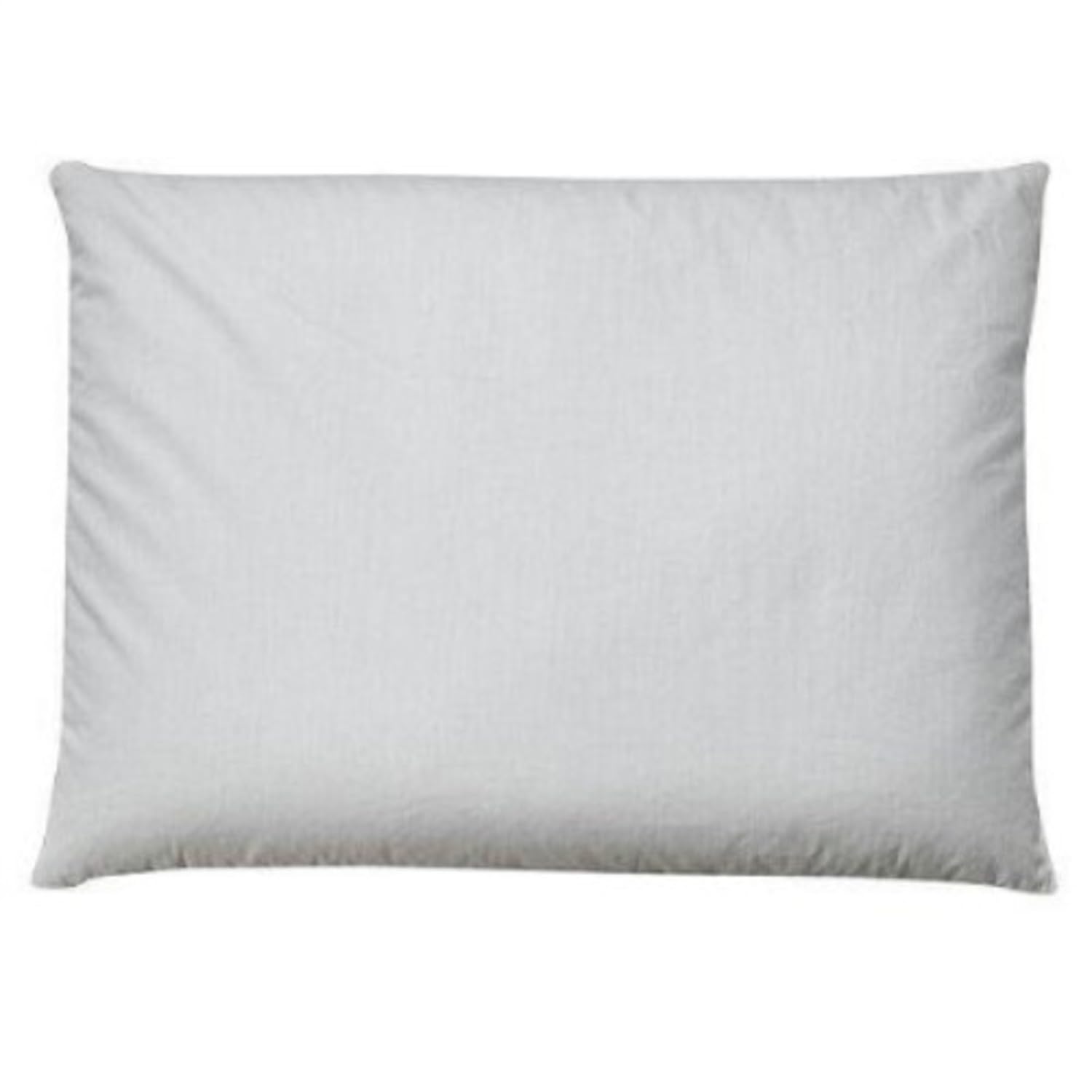
The measurements are where this one gets confusing. It’s sold as a queen at 29 x 19 inches, but the pillowcase on the same listing is given as 12 x 15 inches, and what arrived sat much closer to the smaller figure — nearer a small couch cushion than a queen pillow. If you’re replacing a standard pillow and want the new one to fill the same case, this isn’t the one.
Everything else about it is easy to like. The muslin cotton cover is the softest fabric in this guide and the only one that looks like proper bedding — the cloud weave is a nicer thing to leave on a made bed than the plain ticking elsewhere. At 7.5 pounds with 3.15 inches of loft, the hulls give slightly before they hold, so it lands between plush and firm rather than all-out hard, and the muslin breathes enough that it never turned warm on us.
For a reading chair, a guest room or a small bed, that combination works. It’s the pillow here we’d leave out rather than hide under a case, and the one we point at someone who wants a hull pillow that feels soft before it feels firm.
Pros
- Soft muslin cover that looks like bedding
- Hulls give slightly before they hold
- 7.5 pounds stays put on the bed
- Breathes well for hot sleepers
Cons
- Sealed seam, so fill can’t be added or removed
The nicest cover in this group and a softer hull feel, best bought for a small bed or guest room rather than as a standard queen replacement.
How We Tested the Buckwheat Pillows
We started with more than 40 listings and filtered for the things that actually change how one of these performs: hull grade and how thoroughly they’re cleaned, whether the fill is loose hulls or cut with foam or millet, a zipper that opens the full length of the seam, and a cover you can take off and wash. Price only counted against fill weight, since a few budget pillows arrived roughly half full. That left 13 pillows, and we slept on each for at least three weeks, rotating them among back, side, and stomach sleepers on the team, with two going to a tester who has a bad shoulder.
Every pillow got the same handling. We weighed it out of the box, then unzipped it and scooped hulls into a bowl a cup at a time to see how much shaping control the design really allowed — some zippers only open partway, which ends the conversation. Loft was measured flat and again after six weeks of nightly use, and we shook and re-fluffed each one to see whether it came back. We smelled them on arrival and again after a week of airing, because hull dust is the usual culprit. For noise, we listened for the crunch on turns in a quiet room and noted whether the cover muffled it, and we logged how our necks felt each morning rather than trusting the first night.
By the second month we were checking for flattened spots, dust collecting in the seams, and hulls working their way through the fabric. Value got settled last: what each pillow cost against its fill weight, cover construction, and whether the brand sold replacement hulls so you aren’t buying a whole new pillow when the fill packs down.
How to Choose a Buckwheat Pillow
A buckwheat pillow is a shape you set rather than a feel you choose, so two decisions matter more than the fabric or the brand: how much fill you can take out, and how big the sleeping surface is.
Match the Fill to How You Sleep
Hulls hold whatever shape you press into them, so the pillow’s height should equal the gap between your head and the mattress when you lie on your side. Too much fill and your chin tips up; too little and the neck drops toward the bed. Side sleepers need the most loft, back sleepers noticeably less, and stomach sleepers almost none — a face-down sleeper is usually better served by something else entirely.
If you don’t know where you land, start fuller and empty in stages. Going the other way means buying hulls separately and opening a bag over your bed, which is nobody’s idea of a good evening.
Insist on a Zipper
Most buckwheat pillows arrive packed fuller than anyone wants to sleep on, so the zip isn’t a bonus feature — it’s how you finish the product. A sewn-shut pillow commits you to the factory fill permanently; a zippered one lets you take out two fistfuls, sleep a night, and take out two more. Store what you remove in a lidded container, because you’ll want some of it back once the hulls compact.
Look at the slider and the seam, not just the presence of a zip. A thin plastic slider on a pillow full of hulls is the part that fails, and when it does you have hulls on the floor and no way to close the pillow. Ours held up, but this is the component worth checking before you commit.
Get the Size Right, Then Ignore the Name
Full and queen hull pillows generally run 20 x 26 inches, which fits an ordinary pillowcase. Japanese-size pillows run 14 x 20 and need their own cover, so budget for one. The word on the listing is not a reliable guide to either: a pillow sold as a queen can measure well under a standard pillow on the bed, and the pillowcase dimensions further down the same page are often the more honest number.
Measure the case you intend to use, then choose a size you’d still be happy with if it arrived at the smaller end. If you share a bed, the compact 14 x 20 also takes up much less of it.
Expect Some Smell, Some Noise and Some Upkeep
Fresh hulls carry a natural, faintly grassy smell that fades over a week or so of airing, and they rustle when you move — smaller hulls are quieter, tighter packing is louder. Neither disappears completely, and a fabric case muffles both. If you want to sleep on it the night it arrives, that expectation is the thing to adjust.
Care is simple but not optional: hulls never go in a washer or dryer, the cover comes off and washes, and the fill wants airing and sun-drying every month or two to stay fresh. Treat the pillow as a bag of grain with a washable jacket and you’ll get the upkeep right.
Frequently Asked Questions
How do I take fill out without hulls going everywhere?
Unzip the pillow over a sheet or a large bowl and scoop with a measuring cup rather than pouring. Work in small batches, zip up, sleep a night, then repeat — the first attempt usually removes too much. Keep the hulls you take out in a lidded container somewhere dry, because they go back in once the fill compacts.
How long do buckwheat hulls last before you replace them?
Years, not months, but they do break down. Replace the fill when the hulls crush to dust, when the pillow stops holding the shape you press into it, or when it smells musty even after a day in the sun. The cover usually outlasts two or three fills, and replacement hulls are sold on their own — you’re buying fill, not a new pillow.
Why is a buckwheat pillow so heavy?
Hulls are dense, so a full-size pillow runs well over seven pounds against a pound or two for down or fiberfill. That weight is exactly why it stays where you put it instead of sliding off the bed. It also makes the pillow awkward to move and hopeless in a carry-on; if you want buckwheat for travel, take the 14 x 20 size.
Final Verdict
Buy the LOFE if you want one pillow to replace the one you already sleep on: full size, a zip you can work, and a second case that makes washing practical. If the bed is small or you like the traditional Japanese footprint, the Beans72 is the better buy, and if you want to spend as little as possible without giving up adjustability, the ZEN CHI is the one.
Whatever you choose, make sure you can get inside it. The fill level you want on night one is rarely the one it ships with.