
This post contains affiliate links. We may earn a small commission when you buy through our links — at no extra cost to you.
Waking up with a kink in your neck is a lousy way to start the day, and the pillow under your head is often to blame. A contour memory foam pillow is designed to fix that: the raised edges and center dip cradle your head so your neck stays in line with your spine, whether you sleep on your back or side. The catch is that firmness and fit vary wildly—some are brick-hard, others go flat in a month, and the wrong height can leave side sleepers with a numb arm.
Over the past eight months, I’ve slept on 12 different contour pillows in my own bed, and my team has done the same in theirs, noting how our necks felt each morning, how often we flipped for a cooler side, and whether the covers held up to a wash. The ones that made the cut got the fundamentals right: real neck support without feeling rigid, a height that matched the sleeper, and foam that bounced back night after night. The picks below are the ones we’d put under our own heads again.
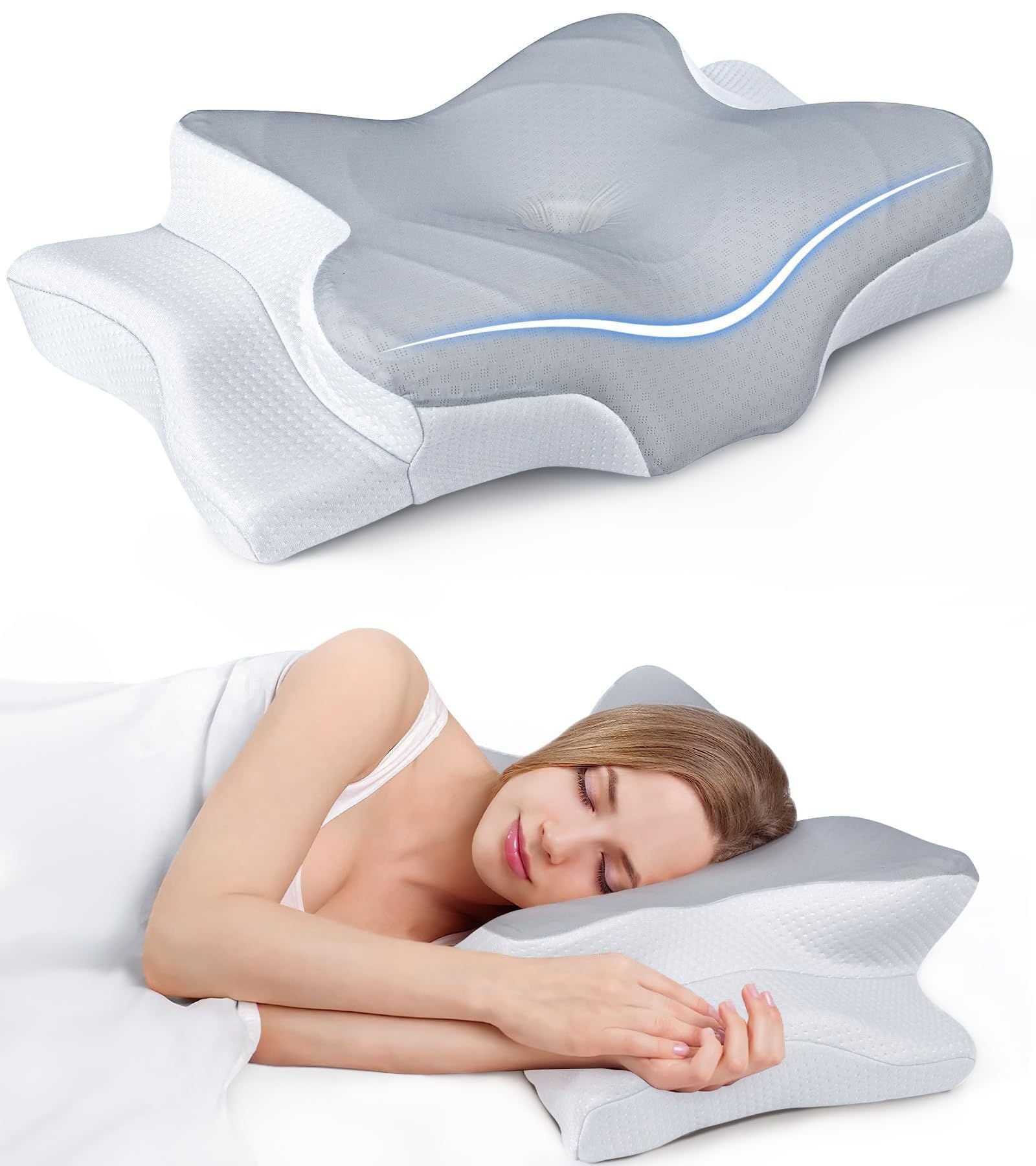


Best for Back and Side
Cozyplayer Adjustable Cervical Pillow
Key Features
- Loft: Adjustable
- Size: Queen
- Cover: Q-Max cooling, washable
- Contour: Six-zone hollow
- Price: Midrange
The cooling cover is the first detail that stands out on the Cozyplayer, but the six-zone contour is what earns it our top spot. The hollow center gives the back of the head a place to settle while the raised sides put support under the neck rather than behind the ears. That is the shape that matters for back and side sleepers: it holds the head in a neutral line without making the face feel buried.
The adjustable height is the part that matters most to us. A contour pillow only works when the neck edge lands at the right height, and this one lets you tune the loft instead of hoping the factory setting is close. The Q-Max cooling cover feels cool at contact and takes the edge off a warm bedroom. The cover is removable and machine washable, and the foam core stays out of the wash.
The six-zone shape is more forgiving than a simple bolster. The center hollow keeps the head from rolling to one side, and the side panels give a side sleeper something to press up against. The pillow is at its best for back and side sleeping; stomach sleepers will likely want a lower profile. The cooling effect is a contact-cool feel, not air conditioning, so do not expect it to stay cold until morning.
What keeps it on top is the combination: a hollow center, a cool cover, and a height you can correct after a bad first night. That combination is harder to find than a single standout feature.
Pros
- Six-zone hollow contour supports head and neck
- Adjustable loft helps correct a bad fit
- Cooling cover is removable and washable
- Good match for back and side sleepers
Cons
- Only one Queen size
The Cozyplayer is our top pick for back and side sleepers who want a cool, adjustable contour that holds the head in a neutral line.
Best for Adjustable Loft
Royal Therapy Memory Foam Pillow
Key Features
- Loft: 3-layer, removable middle
- Size: 24 x 14 x 5 in
- Cover: Bamboo-rayon, washable
- Firmness: Medium
- Price: Premium
The removable middle layer is the reason Royal Therapy belongs here. Pull it out and the pillow drops to a lower contour; leave it in and the neck edge sits higher. That is a more useful adjustment than adding fill to a cover, because it changes the shape of the pillow rather than just the surface.
The medium-firm foam gives a supportive surface without the rigid feel of the Anvo, and the 24 x 14-inch footprint is smaller than a standard bed pillow. We like that for keeping the contour where it belongs, though it leaves a visible gap in a wide sham. The bamboo-rayon blend cover is soft against the skin, and the pillowcase is machine washable.
The three-layer construction is the real selling point for back sleepers who are between heights. The 5-inch profile is sensible for back sleeping, and the removable layer adds lift for side sleeping when the neck needs more support. The foam itself has a dense, slow-rebound feel that keeps the neck edge from collapsing.
The smaller footprint is the trade-off. It fits inside a standard pillowcase, but it will not fill a queen sham. If you want a broad, hotel-pillow look, this is not that pillow; if you want a contour that stays put and lets you change the loft, it is one of the most practical here.
Pros
- Removable middle layer changes loft
- Medium-firm foam supports without rigidity
- Compact footprint stays in place
Cons
- Only the pillowcase is machine washable
We like Royal Therapy for its removable middle layer, which changes the loft without changing the pillow’s medium-firm feel.
Best for Tall Side Support
UTTU Adjustable Cervical Pillow
Key Features
- Loft: 5.2 in / 4.5 in
- Size: 23.6 x 13.8 in
- Cover: Breathable, machine washable
- Adjustment: Removable middle layer
- Price: Midrange
The tall 5.2-inch side is what makes the UTTU a serious side-sleeper pillow. It fills the gap above a broad shoulder, and the 4.5-inch side gives back sleepers a lower option without making them buy a second pillow.
The sandwich construction is the clever part. A middle layer comes out, so you can drop the height without giving up the contoured neck edge. We found that more useful than a pillow with two fixed sides, because the change is in the middle of the pillow rather than only at the edge. The dynamic foam has a slow, supportive rebound, and the breathable cover is machine washable.
We favor it for side sleepers who have struggled with contour pillows that felt too low, especially with a broad shoulder or a preference for a firmer surface. What sold us is the layer system: it turns a one-shot contour purchase into something you can correct after a few nights. That is worth more than a fancy cover.
The 5.2-inch side is real side-sleeper territory, and the 4.5-inch side keeps it usable for back sleeping. The pillow is white and only comes in one size, so it is not the most practical travel companion.
Pros
- Tall side fills a shoulder gap
- Removable middle layer adjusts loft
- Breathable cover is machine washable
Cons
- Tall side is too much for stomach sleepers
We favor the UTTU for side sleepers who need a tall contour they can lower by removing a layer.
Best for Firm Neck Lift
Anvo Contour Memory Foam Pillow
Key Features
- Loft: 4.7 in / 3.5 in
- Size: 24 x 13.4 in
- Cover: Mesh sides, washable
- Firmness: Firm
- Price: Midrange
Anvo is the firmest pillow in this group, and that is either the reason to buy it or the reason to skip it. The 4.7-inch high side and 3.5-inch low side give a pronounced neck lift, and the slow-rebound foam holds its shape instead of letting the head sink through.
The extra lift is the point for side sleepers with broad shoulders, where a softer contour collapses and leaves the head lower than the neck. Back sleepers who like a low pillow may find even the 3.5-inch side substantial. The breathable mesh panels on the cover help with airflow, and the cover is removable and machine washable.
The firm surface is not a compromise; it is the design. The foam gives a clear edge under the neck and keeps the head on top rather than cradling it deeply. If you want a pillow that sinks around your head, the Polovo is the better match. If you wake with a stiff neck because your pillow has gone flat, the Anvo is the one to try.
The two-height shape is simple, and the firmness makes it easy to know whether it is working. We appreciate that kind of honesty in a pillow.
Pros
- Firm foam gives strong neck lift
- Two heights for back and side
- Breathable mesh cover washes
Cons
- No removable layer to fine-tune height
We keep the Anvo as our firmest pick because it gives broad-shouldered side sleepers a high neck edge and little sink.
Best for Combination Sleepers
DONAMA Cervical Pillow
Key Features
- Loft: 5.51 in
- Size: 24.8 x 14.96 in
- Contour: Dual-height with armrest
- Firmness: Medium soft
- Price: Midrange
The armrest cutouts are the first thing we noticed on the DONAMA, and they solve a side-sleeper problem the other pillows here ignore: where to put the arm that ends up under your head. The butterfly shape gives the shoulder a channel and the arm a place to tuck.
At 5.51 inches high, it is the tallest pillow in this group. That suits side sleepers who need a filled gap above the shoulder, and the medium-soft foam gives a softer landing than the Anvo. We favor it for combination sleepers who roll from back to side, especially if an arm ends up under the pillow.
The dual-height design lets you rotate the pillow rather than buy a second one, and the foam is CertiPUR-US certified. That certification is a useful baseline for indoor foam, even if it does not tell you how the pillow will feel. The double-layer cover has a cool-to-touch feel and is machine washable.
The armrest is the detail that makes it feel designed for real side sleeping, not just labeled for it. If you sleep with an arm under your pillow, this is the one that feels built around that habit.
Pros
- Armrest cutouts suit side sleepers
- Dual-height butterfly contour
- Medium-soft foam feels cushioned
- CertiPUR-US foam and washable cover
Cons
- Tall profile overwhelms stomach sleepers and small frames
- Only one size
Our pick for combination sleepers is the DONAMA, whose armrest cutouts and tall butterfly shape suit side sleeping with an arm tucked under.
Best for Budget Back Sleep
Polovo Contour Memory Foam Pillow
Key Features
- Loft: 5.3 in / 3.7 in
- Size: 23.6 x 13.8 in
- Cover: Mesh sides, washable
- Firmness: Soft
- Price: Budget
Polovo sits at the budget end of this group, and it still gives you the two things a contour pillow needs: a raised neck edge and a lower center. The high side is 5.3 inches and the low side is 3.7, so you can flip it rather than commit to one loft.
The foam is soft and rebounds in about five seconds, which makes it conform more than it props. The lower side is the better starting point for back sleeping; the high side gives side sleepers more room. The mesh sides and removable cover help with airflow and washing.
We recommend it for back sleepers and budget-conscious shoppers who want a real two-height contour without a premium price. The lower side is the better starting point for back sleeping, and the high side gives side sleepers more room. The softness is a preference, not a defect.
The two-height shape is what makes it a genuine contour pillow rather than a cheap wedge. That is the detail we keep coming back to.
Pros
- Two contour heights in one pillow
- Soft foam conforms around the head
- Budget-friendly choice
Cons
- Soft foam gives less lift under a heavy head
Polovo is the budget choice we trust for back sleepers who want a soft, two-height contour without firm lift.
Best for Back Sleeping
Osteo Cervical Pillow

Key Features
- Loft: 5.2 in / 4.1 in
- Size: 25.5 x 16.5 in
- Cover: 3D mesh, washable
- Contour: Hollow center
- Price: Midrange
The hollow center is the reason the Osteo makes the list. It gives the back of the head a lower landing zone while the side bolsters keep the neck from rolling forward, a shape that suits back sleepers who hate the feeling of being pushed uphill.
At 25.5 x 16.5 inches, the surface is broad enough for turning over, and the 3D mesh cover is breathable and machine washable. The two heights, 5.2 and 4.1 inches, let you flip the pillow rather than buy a second one.
The foam runs firmer than the soft cover suggests. That suits back sleepers who want a clear neck edge, but side sleepers who want a deep cradle may find it unyielding. The hollow design also takes some getting used to if you are coming from a flat pillow.
We recommend the Osteo for back sleepers who want a broad, hollow-center pillow and do not mind a firmer feel. It is not the softest contour here, but the shape is the most back-friendly in this group.
Pros
- Hollow center supports back sleeping
- Two heights for flexible loft
- Broad surface makes turning easier
- Breathable 3D mesh cover washes
Cons
- Large footprint takes up more bed space
Back sleepers who want a broad hollow center should consider the Osteo; we like its firm support and roomy surface.
Best for Firm Back Support
EPABO Contour Memory Foam Pillow

Key Features
- Loft: 4.8 in
- Size: 24 x 15 in
- Cover: Hypoallergenic blend, washable
- Firmness: Firm
- Price: Budget
EPABO is the most traditional contour here: a firm 4.8-inch foam wedge with a 24 x 15-inch surface. The shape is simple and the foam is dense.
The foam gives a clear, high neck edge and keeps its shape under the head. The cover is a silky hypoallergenic blend and is machine washable, while the foam core is not. The wedge shape is easy to position, and the broad surface gives you room to turn.
The 4.8-inch height is best for back sleepers who want a straight lift rather than a deep cradle. Stomach sleepers and smaller side sleepers may feel pushed up. The firm surface also gives little sink, so it rewards a sleeper who likes a crisp, supported feel.
We recommend the EPABO for back sleepers who want a firm, no-fuss contour and already know their preferred loft. The firm surface is the point, and the simple shape makes it easy to position.
Pros
- Firm surface gives clear neck lift
- Broad 24 x 15-inch surface
- Washable hypoallergenic cover
Cons
- No height adjustment
The EPABO is our simple, firm option for back sleepers who already know their loft and do not need to adjust it.
How We Tested the Best Contour Memory Foam Pillows
We started by pulling together the contour pillows that kept surfacing in reviews and retail best-seller lists, then filtered the field by foam type, loft height, cover material, and price. That left us with 12 pillows to test, a mix of high- and low-profile shapes, softer foams, and denser ones. Each landed in a tester’s bed for eight months—not a hotel room or a lab, but our actual bedrooms, where we slept on them night after night and woke up with whatever neck we’d earned.
Every morning we logged the obvious: whether we woke with a stiff neck, a headache, or numbness in an arm, and how many times we’d shifted or punched the pillow during the night. We also paid attention to fit—side sleepers noted whether the pillow’s height kept their head level with their spine, back sleepers checked if the contour forced their chin down, and stomach sleepers watched for lower-back strain. To judge support and firmness, we pressed a palm into the center and watched how quickly the foam sprang back, then noted whether it felt like a brick or a cloud by the third week.
Quality checks happened away from the bed, too. We washed every removable cover according to its care label and inspected seams, zippers, and fabric pilling afterward; we also aired out fresh pillows to see whether any chemical smell lingered. By the end of eight months, we compared notes on which pillows still held their shape and which had developed a permanent dent. The ones that scored highest kept our necks comfortable, matched our sleep positions, and showed no signs of flattening.
How to Choose a Contour Memory Foam Pillow
The right contour pillow is a height decision before it is a firmness decision.
Start with your sleep position
Side sleepers need the high side of a contour to fill the gap between the neck and the mattress; back sleepers do better with the lower side or a hollow center that lets the head settle. Stomach sleepers usually need the lowest profile, and some are better off with a flat pillow altogether. A contour labeled for every position is making a compromise, so pick the side that matches the way you actually wake up.
If you switch between back and side, a dual-height pillow or a removable layer is worth the extra complexity. The UTTU and Royal Therapy are built around that idea, while the Osteo leans toward back sleeping with its broad hollow center.
Treat loft as fit, firmness as feel
A pillow can be labeled medium-firm and still be too tall. Height decides whether your chin is pushed toward your chest or your head drops below the neck edge; firmness decides how much pressure you feel. The contour pillows here run from about 3.5 to 5.5 inches at the neck, which is a useful range to compare against the pillow you already like.
Get the height right first. If you are between sizes, choose a pillow with a removable layer rather than a softer foam, because softness will not fix a loft that is wrong. A low-profile back sleeper and a broad-shouldered side sleeper should not be shopping for the same pillow.
Check the cover for heat and washing
Memory foam traps body heat, and a cooling cover only changes the surface you touch. That is still worth having if you sleep hot, especially with mesh sides that let air move. More important is whether the cover comes off and machine washes; the foam core should not go in the washer.
Look for a removable cover and a breathable fabric, and treat cooling claims as a comfort bonus rather than a guarantee. A cool-to-touch cover can take the edge off bedtime, but no pillow stays cold until morning.
Match the footprint to your pillowcase
Contour pillows are smaller than standard bed pillows, usually around 24 by 14 inches. That keeps the shape where you put it, but it can leave a gap in a wide sham. A tight pillowcase can also compress the neck edge and undo the contour.
Measure your case before buying. If it is snug, use the pillow’s own cover or a roomy case; if you want a broader bed-pillow look, choose a roomier model like the Osteo.
Frequently Asked Questions
How long should I give a new contour pillow before deciding?
Give it one to two weeks of regular nights, not a single nap. Your neck needs time to adjust to a new height, and the foam needs time to fully expand after shipping. Change one thing at a time: flip to the lower side or remove a layer before deciding it is wrong. If numbness or tingling persists, stop using it.
Can I put a memory foam pillow in the dryer?
No. Heat can break down the foam and leave it stiff or crumbly. Wash the removable cover and air-dry it; spot-clean the core with a damp cloth and let it air dry away from direct heat. A fan or a well-ventilated room speeds drying without cooking the foam.
Why does my contour pillow feel harder in a cold room?
Memory foam can stiffen when it is cold, then soften as it warms to room temperature. Give it a few minutes under your head before judging the feel. If your bedroom runs cold and you want consistent firmness, the UTTU is designed to stay consistent in cold weather.
Final Verdict
Cozyplayer is our default because its hollow six-zone shape and adjustable loft solve the two common contour failures: a neck edge that sits too low and a head that rolls out of the center. If you want a firmer feel, the Anvo is the clear alternative; if you need a removable layer to change height, the Royal Therapy is the easier fit.