
This post contains affiliate links. We may earn a small commission when you buy through our links — at no extra cost to you.
A CPAP battery that claims three nights on paper might struggle to finish one in your bedroom. The missing variable is nearly always the same: humidifier and heated tube power draw. Manufacturers quote runtimes with those comforts turned off — a condition few buyers actually use.
Add airline carry-on limits to the equation, and the choice gets even trickier. The FAA and TSA cap lithium batteries at 100 watt-hours. That rules out most multi-night batteries for air travel, forcing a hard choice between plane-friendly portability and the capacity you need for off-grid camping or power outages.
This guide aligns each battery’s actual capacity and travel credentials with the way you’ll really use it. Pick based on your nightly power draw and your travel profile, and that three-night label stops being a guess.



Bluetti X30 Cpap Battery
BLUETTI X30 CPAP Battery
Key Features
- Battery Capacity (Wh): 297Wh
- TSA/FAA Compliance: Not compliant
- Included CPAP Cable Compatibility: 5 color-labeled DC cables
- Price: Mid-Range
The BLUETTI X30 consistently provides 3-5 nights of CPAP use on a single charge, assuming the humidifier and heated tube are turned off — the baseline for runtime claims in this segment. Its 297Wh battery and pass-through charging work together as an uninterruptible power supply, switching to battery instantly during blackouts without the slightest interruption. The kit includes five color-coded DC cables that cover ResMed AirSense, AirCurve, AirMini, and DreamStation machines directly.
Build quality is sturdy enough for frequent transport. At 3.9 pounds with a built-in handle and a fitted case, it moves easily from bedroom to campsite or hotel. The UPS transition is silent — users wake up only when the lights return, never from a therapy interruption. Its compact footprint sits unobtrusively on a nightstand, and the color-labeled cables remove setup guesswork.
This unit is built for home backup during storms and for multi-night camping or RV trips where shore power is scarce. It is not suitable for airline cabins (297Wh exceeds the 100Wh limit) or weight-conscious backpacking. A small number of shipments have included an incorrect DC cable, so unboxing with your CPAP on hand to confirm compatibility is a sound move — BLUETTI support quickly resolves such mix-ups. For buyers who value a deep, verifiable track record in a medical backup device, the X30 is the most reassuring choice in its class.
Pros
- Consistently delivers 3-5 nights of CPAP use without humidifier
- Pass-through charging acts as a UPS, switching seamlessly during power outages
- Compact, well-built design with a carrying case and color-labeled cables
- 3.9 lbs with built-in handle makes it practical for camping and hotel stays
Cons
The X30 is the most extensively field-tested CPAP battery for multi-night backup, delivering consistent runtime, UPS pass-through, and a full accessory set. For anyone who prioritizes a deep track record over airline compatibility, it’s the logical choice — just verify the cables match your machine before your first night away.
Easylonger Es960 Cpap Battery
EASYLONGER ES960 CPAP Battery
Key Features
- Battery Capacity (Wh): 297.6Wh
- TSA/FAA Compliance: Not compliant
- Price: Mid-Range
The ES960 uses LiFePO4 battery chemistry, rated for more than 3,000 full charge cycles — a lifespan several times longer than the standard lithium-ion cells found in travel-optimized alternatives. That longevity pairs with a 297.6Wh capacity delivering 4+ nights of CPAP use without a humidifier, far exceeding the single-night runtime of slim carry-on packs. The tradeoff is weight and bulk: at 6.6 lbs and well above TSA limits, this battery stays on the ground.
This battery fits buyers who need multi-night off-grid power and prioritize total cost of ownership over upfront price. It is ideal for car camping, home backup, or powering car accessories and laptops through its six output ports. It is not suited for airline carry-on, and ultralight backpackers will find it too heavy.
Pros
- Multi-night runtime: 4+ nights of CPAP use without humidifier on a single charge.
- LiFePO4 battery rated for 3,000+ full charge cycles, far outlasting conventional lithium-ion.
- Six output ports including a 12V car socket and settable voltage, powering CPAP, laptops, and accessories from one pack.
Cons
- Charging percentage indicator can stick at 99% or behave inconsistently — actual runtime stays unaffected.
The ES960 is the long-haul choice for power users who want multi-night runtime and years of heavy cycling — and who never need to fly with it.
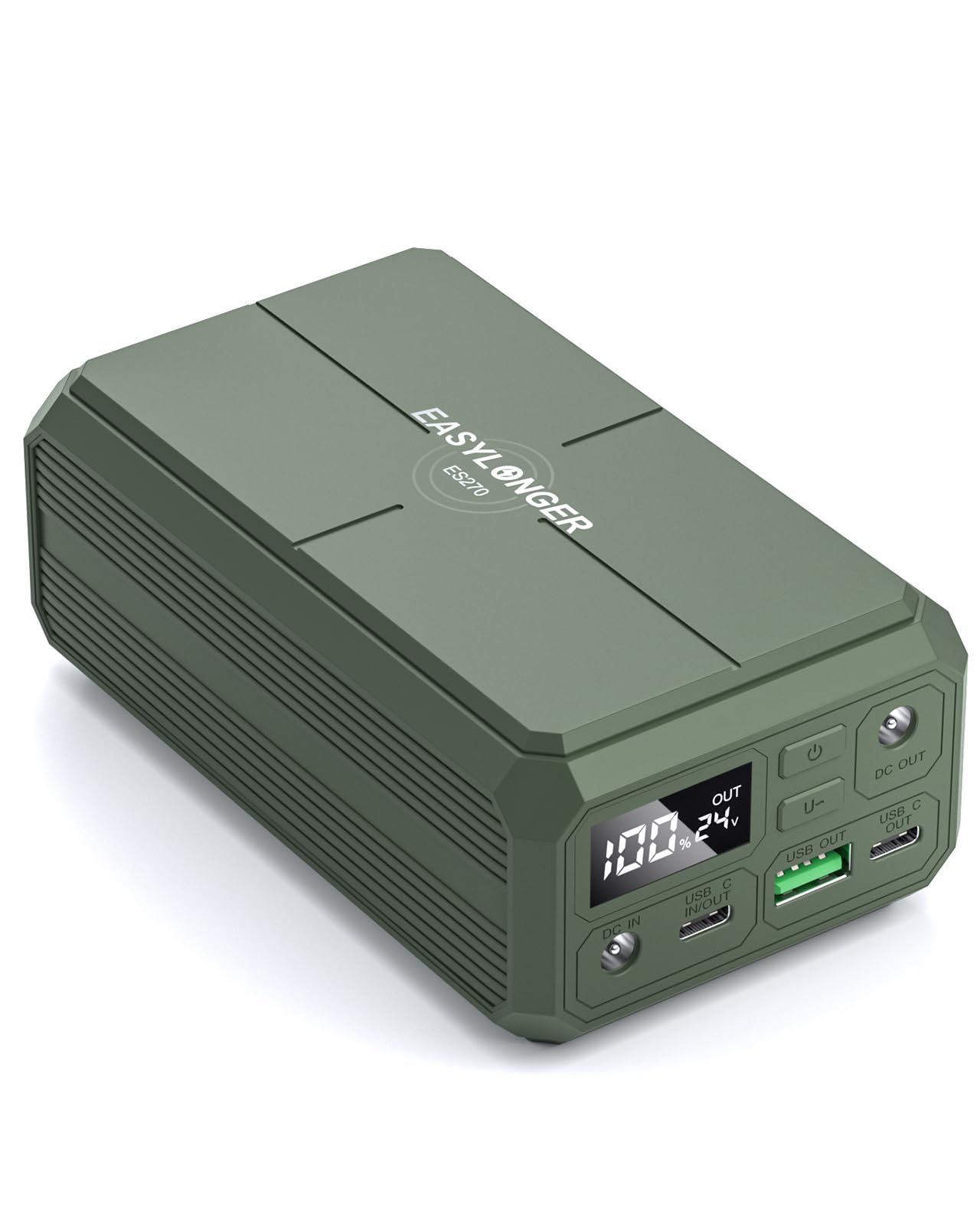
Easylonger Es270 Cpap Battery
EASYLONGER ES270 CPAP Battery
Key Features
- Battery Capacity (Wh): 99.9Wh
- TSA/FAA Compliance: TSA Compliant
- Included CPAP Cable Compatibility: 4 DC cables + 65W charger
- Price: Budget
The ES270 hits the FAA’s carry-on limit of 99.9 watt-hours exactly, then layers on a wireless charging pad and 100-watt USB-C output so it doubles as a travel hub for your phone and tablet. Weighing 1.3 pounds, it slides into a CPAP carrying case and clears TSA checkpoints without question—a clear contrast to heavier LiFePO4 batteries that can’t come on a plane.
This battery is built for the frequent flyer who uses a low-power travel CPAP like the ResMed AirMini or Luna TravelPAP with humidifier off; in that scenario you can expect roughly 8 hours of runtime. If you run a full-size AirSense or DreamStation and keep the humidifier active, runtime may drop to 4–6 hours, enough for one night but not a safety net for delays. The included 65-watt adapter recharges in about 2 hours, so an airport lounge top-up is feasible, but multi-night camping or home backup calls for a larger-capacity battery.
Pros
- TSA and FAA compliant at exactly 99.9Wh — guaranteed to clear airport security
- Weighs 1.3 lbs and fits inside a CPAP carrying case for easy travel
- Includes wireless charging and 100W USB-C PD, adding everyday power bank utility
Cons
- Slow recharge with generic USB-C chargers — the included 65W adapter is necessary for a 2-hour fill
- Full-size CPAPs can drain the battery in 4–6 hours without humidification, limiting travel to one night
For frequent air travelers who run a travel CPAP with humidifier off, this battery hits the sweet spot of weight, compliance, and price.
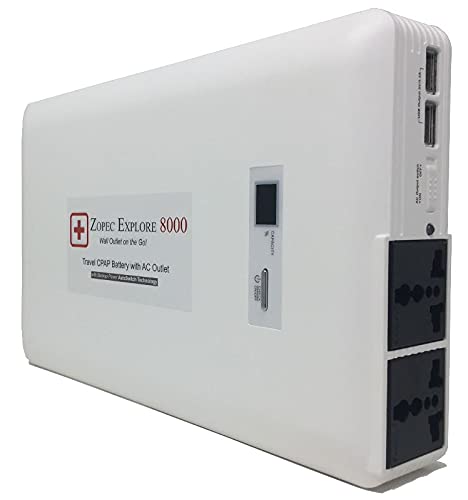
Zopec Explore 8000 Battery
Zopec Explore 8000 Battery
Key Features
- Battery Capacity (Wh): 288Wh
- TSA/FAA Compliance: Not compliant
- Included CPAP Cable Compatibility: No cables needed (AC outlet)
- Price: Luxury
Unlike travel batteries that rely on DC cables and specific voltage settings, the Explore 8000 operates like a standard wall outlet, so it powers any CPAP machine without adapters — including oddball brands many chargers ignore. Its automatic switchover activates the moment a blackout hits, making it a true UPS for CPAP therapy. At 288Wh, it can theoretically deliver 3-4 nights without humidifier, though that depends heavily on machine draw and unit consistency.
For home backup where seamless blackout protection is paramount, the Zopec eliminates adapter guesswork entirely. Its 4.2-lb build suits camping or road trips, but the 288Wh capacity far exceeds TSA limits, so air travel is not an option. However, runtime varies noticeably between units, and some batteries stop accepting a charge after only a handful of cycles. Testing thoroughly on arrival is essential before relying on it for multi-night coverage.
Pros
- Functions as a standard wall outlet, eliminating adapter confusion for any CPAP brand — no DC cables or voltage selection needed.
- Automatically cuts over to battery during power outages, providing true UPS behavior without user intervention.
- Surprisingly portable for a 288Wh pack at 4.2 lbs, making it viable for camping and off-grid use.
Cons
- Claimed 3-4 night runtime can be optimistic — even without humidifier, some users get less than a full night’s operation.
- Occasional units stop charging after a few uses, which undermines confidence in long-term reliability for medical backup.
The Explore 8000’s AC outlet and UPS switchover make it uniquely simple for home CPAP backup, but expect to validate runtime capacity before depending on it for extended outages.
Medistrom Pilot-24 Lite
Medistrom Pilot-24 Lite
Key Features
- Battery Capacity (Wh): 95Wh
- TSA/FAA Compliance: TSA Compliant
- Price: Premium
Where the TSA-optimized 99.9Wh travel battery focuses on squeezing out every last watt-hour and adding wireless charging, the Pilot-24 Lite takes a different path: a full aluminum shell and LG industrial cells built to survive drops and rough handling. Its 95Wh rating stays within airline limits and the dedicated DC output avoids voltage confusion for 24V ResMed machines.
The metal case shrugs off the abuse of overhead bins, but the cells inside have a documented tendency to stop holding a charge within a year of moderate use. This suits the occasional flyer who needs a physically tough, ultralight companion for short trips and campsites — and is willing to trade long-term reliability for that toughness. At this premium price, the value only holds up if the aluminum build and AirMini compatibility are hard requirements, not nice-to-haves.
Pros
- TSA-compliant 95Wh capacity in an aluminum shell that withstands rough luggage handling.
- Delivers consistent 24V power to AirMini and AirSense 10 machines, with some users getting two nights of therapy.
- Recharges in 2-3 hours, enough for a layover to restore another night of use.
Cons
- Adapter cable supplied with some units can be incompatible with the AirSense 10, forcing a call to support.
- Battery may stop holding a charge after limited use cycles, making it unreliable for regular backup duty.
The Pilot-24 Lite fills a narrow gap: travelers who need a drop-resistant metal battery and 24V CPAP support, and can accept that the battery cells may not last beyond a year of occasional use.
Zopec Explore 5700 Battery
Zopec Explore 5700 Battery

Key Features
- TSA/FAA Compliance: TSA Compliant
- Included CPAP Cable Compatibility: No cables needed (AC outlet)
- Price: Premium
The Explore 5700’s AC outlet design plugs directly into any CPAP machine’s power cord, bypassing the DC cable confusion common to other travel batteries. This genuine universal compatibility makes it the simplest option for mixed-brand households. However, the ambitious 3-night runtime claim lacks widespread independent confirmation, making it less certain for those who need verified performance data before committing.
Pros
- Plugs directly into any CPAP machine’s AC power cord — no DC cables, no voltage matching needed.
- TSA/FAA compliant and weighs 2.5 lbs, so it slots into carry-on luggage without hassle.
Cons
If the simplicity of a true AC-outlet CPAP battery appeals to you and you’re comfortable with performance claims that haven’t been independently validated at scale, the Explore 5700 fills a narrow but real need for no-fuss travel backup.
How to Choose
Start by calculating your own CPAP’s nightly power draw — it’s the only way to translate marketing runtimes into real-world expectations.
Battery Capacity (Wh)
Watt-hours determine how many nights you get per charge, but the relationship isn’t linear because your machine’s power draw varies wildly. A ResMed AirSense 10 without humidifier might pull 8-10W, while the same unit with heated tube and max humidity can pull 25-30W — tripling consumption.
A 300Wh battery might deliver four nights without heat, two with humidifier alone, and barely one with everything cranked up. Look up your CPAP’s wattage at your typical settings, multiply by your sleep hours, and add a 20% buffer. That’s your true nightly Wh requirement.
TSA/FAA Compliance
Lithium batteries in carry-on luggage are capped at 100 watt-hours per battery. This limit is non-negotiable at US and international checkpoints — a 297Wh battery will be confiscated. If you fly even once a year, you need a sub-100Wh unit on board, and you’ll likely have to check any larger backup separately if your airline allows it at all.
The workaround is to pick a battery that hits exactly the legal maximum, like the 99.9Wh cells designed specifically for this boundary. For road trips or home backup, capacity limits vanish; size your battery purely on runtime needs.
Included CPAP Cable Compatibility
Most CPAP batteries ship with a set of DC cables that plug directly into your machine’s power port, bypassing the AC adapter. But cable sets vary — some cover only ResMed and Philips DreamStation, others add AirMini or Luna. A few universal designs let you use your CPAP’s own AC power cord, eliminating cable matching entirely.
Before buying, check the battery’s compatibility list against your exact CPAP model. A missing cable means you’ll need a separate adapter or a workaround, adding cost and bulk. If you own a less common brand, prioritize batteries with AC output or comprehensive cable kits.
Pass-Through Charging Support
Pass-through charging lets the battery sit between the wall outlet and your CPAP, acting as an uninterruptible power supply. When grid power fails, the battery instantly takes over without interrupting airflow. This turns a portable power bank into a blackout-proof backup that requires no nightly setup changes.
Not all batteries support this — some require you to unplug the CPAP and swap cables manually during an outage. If seamless protection matters, look for ‘pass-through charging’ or ‘UPS mode’ in the specs, then confirm it works with your CPAP’s voltage.
Battery Chemistry
Standard lithium-ion cells degrade to 80% capacity in 500-1,000 full cycles, which means a battery used nightly for backup may need replacement in 2-3 years. Lithium iron phosphate (LiFePO4) cells last 3,000+ cycles before noticeable degradation — effectively a decade of nightly use.
LiFePO4 adds weight (the chemistry is less energy-dense), so these batteries are heavier for the same capacity. If you cycle the battery daily, that upfront heft buys dramatically lower long-term cost; if you only use it on a few trips a year, standard Li-Ion’s lighter weight and lower price make more sense.
FAQ
Why does my CPAP battery only last one night when it claims three?
Runtime claims assume the humidifier and heated tube are turned off. With those features running, power consumption triples in many machines, slashing claimed runtime by 50-70%. Always calculate your CPAP’s real power draw at your usual settings to set expectations.
Can I bring a 300Wh CPAP battery on a plane?
No. TSA and FAA rules cap lithium batteries at 100 watt-hours for carry-on. A 300Wh battery will be confiscated at security. For air travel, choose a battery explicitly labeled as TSA-compliant and under 100Wh, such as a unit built to the 99.9Wh ceiling.
Will my CPAP battery work with the humidifier turned on?
Yes, but runtime drops substantially. Running a heated humidifier and tube can consume 2-3 times more power than a bare CPAP. If you need humidity, either size up to a larger capacity battery or plan to recharge during the day.
How do I know which DC cable works with my specific CPAP machine?
Check the battery’s included cable list against your CPAP model before purchase. Most kits cover ResMed AirSense 10/11 and Philips DreamStation, but smaller brands may be absent. If your machine isn’t listed, universal AC-output batteries that use your CPAP’s own power cord avoid this problem entirely.