
This post contains affiliate links. We may earn a small commission when you buy through our links — at no extra cost to you.
Leg positioner pillows promise better alignment and pain relief, but a pillow that looks perfect online often turns out too small, too firm, or slides across the sheets at 2 a.m. The category is full of one-size-fits-all claims that ignore body dimensions, sleep style, and recovery needs.
That’s why we’ve focused not on which pillow is ‘best’ in an abstract sense, but on which specific design matches your body and sleep position. Whether you’re a side sleeper needing a knee spacer or recovering from knee surgery and requiring adjustable elevation, the right choice depends on details like width, height, and firmness — not star ratings alone.
Before you commit, measure the gap between your knees when lying on your side, and check the pillow’s height against your leg length if you’re elevating. These simple checks avoid the most common return reasons, and we’ve made them the backbone of every recommendation ahead.


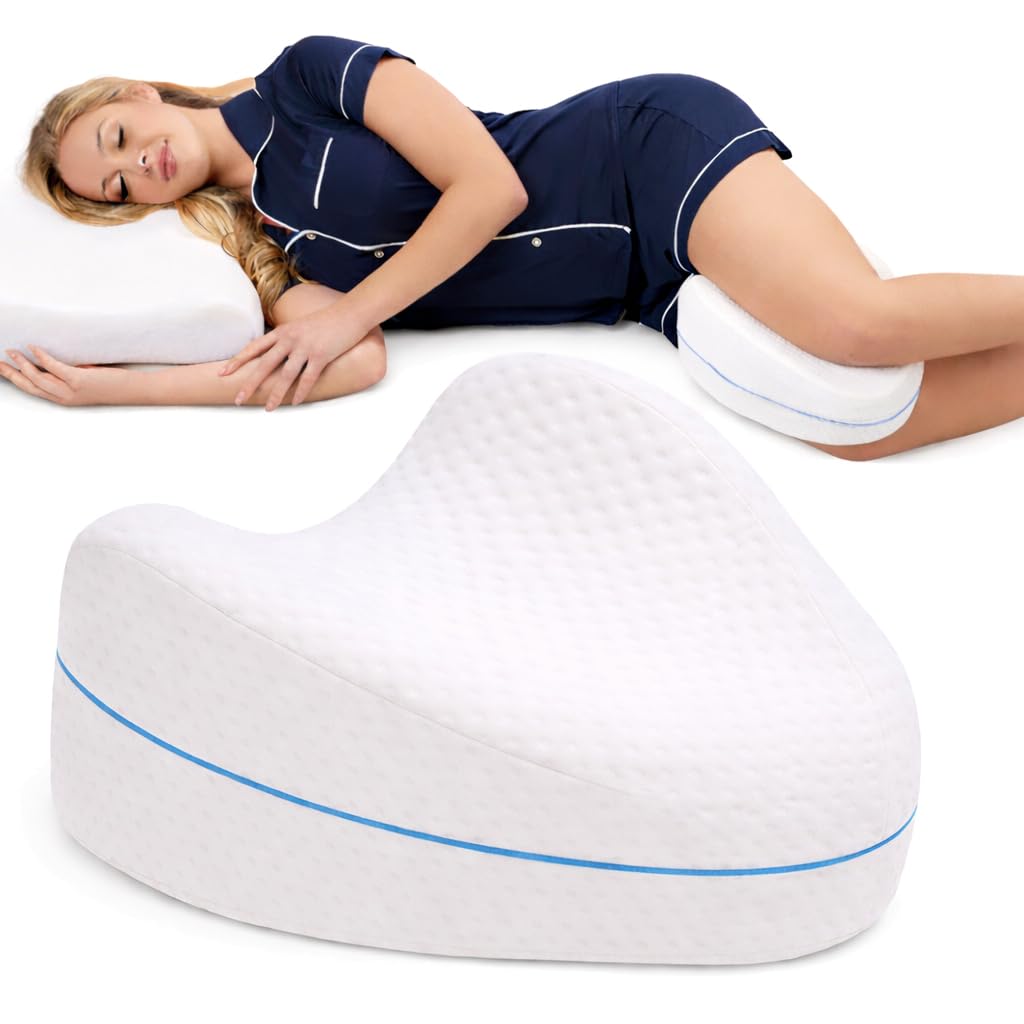

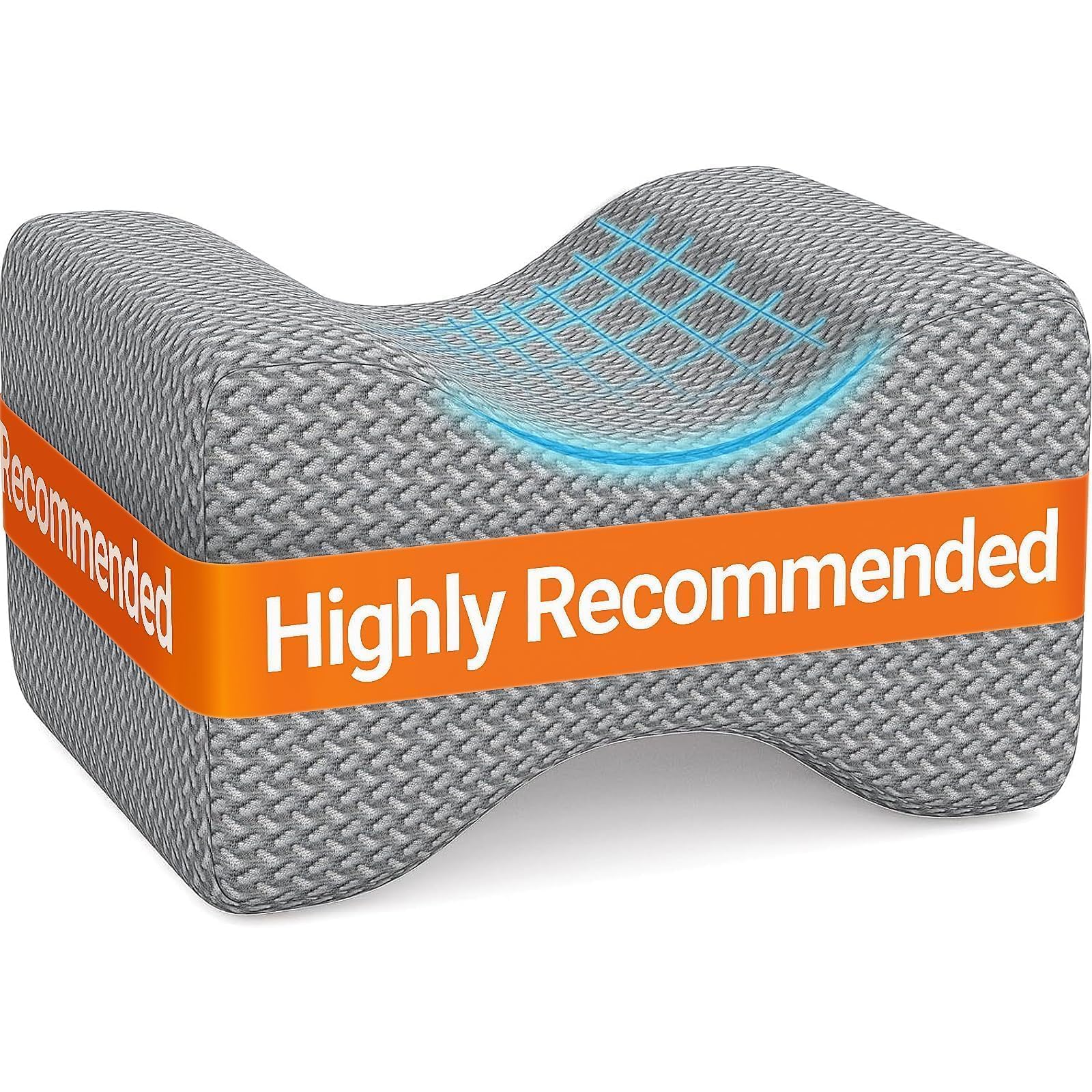

Best for Post-Surgery Recovery
KingPavonini Adj Leg Pillow
Key Features
- Pillow Type: Leg elevation wedge
- Dimensions: 29 x 13 x 9.1 in
- Material & Firmness: Gel memory foam, high-density foam
- Price: Mid-Range
The four-position height adjustment from 3.5 to 10.2 inches lets you fine-tune leg elevation for post-surgery recovery or swelling relief — no other pillow in this set offers that granularity without swapping wedges. A gel memory foam top layer conforms to the leg without pressure buildup, while the high-density base keeps the shape stable under weight.
The crystal velvet cover feels plush and breathable, and three integrated handles make shifting it between couch and bed effortless. The non-slip silicone bottom grips most surfaces securely. On satin or very smooth sheets, it can drift slightly, but a cheap gripper pad underneath stops any movement. Its 29-inch length works for taller users, and the U-shaped groove cradles the leg so it stays centered without rolling off.
This pillow is designed for single-leg elevation — recovery from knee surgery, reducing ankle swelling, or simply propping up a leg while working at a desk. If you need to elevate both legs simultaneously or want a cooling gel layer, the wider gel option in this set fits that need. Side sleepers looking for a knee separation pillow should look elsewhere, as this isn’t built for that body position.
Pros
- Soft memory foam top layer keeps legs comfortable for hours without pressure buildup.
- Four-height adjustability quickly adapts to sitting or lying positions.
- Helps reduce swelling and aids post-surgery recovery effectively.
- Plush crystal velvet cover with non-slip bottom and thoughtful triple handles.
Cons
- On very smooth sheets, it can slide despite the silicone bottom — a thin gripper mat fixes it.
For recovery demands that shift between reclined and seated elevation, this adjustable design provides tailored support that fixed wedges can’t match, and the plush velvet cover keeps it comfortable day and night.
Best for Single-Leg Elevation
LightEase Leg Elevation
Key Features
- Pillow Type: Leg elevation wedge
- Dimensions: 29 x 13 x 9.5 in
- Material & Firmness: Memory foam
- Price: Mid-Range
The LightEase leg elevation wedge uses a deep, contoured memory foam groove paired with two front handles to simplify single-leg support. While the adjustable top pick allows variable height, this fixed-angle wedge offers a simpler, no-fuss design that cradles the leg securely after surgery or injury. Handles let you tug it into place without bending forward, a detail that’s especially helpful when mobility is limited.
It’s built for recovery-focused elevation after hip, knee, or femur procedures where keeping the leg elevated and stable matters most. The soft plush cover and memory foam provide a comfortable, shaping cradle that holds form well over time. The main tradeoff: the wedge can slide on silky sheets, which some users solve with a non-slip mat. It’s not a knee pillow for side sleepers, and the fixed height may not suit those needing graduated elevation.
Pros
- Contoured foam cradles the leg deeply for post-surgery comfort and elevation.
- Stable support prevents leg rolling, keeping it centered without constant adjustment.
- Dual front handles let you reposition the wedge easily without straining or disturbing the leg.
Cons
- May slide on silky sheets without extra grip; a non-slip mat resolves it.
For post-surgery leg elevation where easy repositioning and stable cradling outweigh height flexibility, this wedge delivers — just pair it with a non-slip mat on smooth bedding.
Best for Side-Sleeper Alignment
Contour Legacy Knee Pillow
Key Features
- Pillow Type: Knee pillow
- Dimensions: 10 x 9.5 in
- Material & Firmness: Ventilated memory foam
- Price: Mid-Range
The Contour Legacy’s hourglass shape and firm ventilated memory foam yield noticeable spinal alignment improvements for side sleepers dealing with back, hip, or knee discomfort. Unlike pillows that offer multiple sleep positions or plush cushioning, this design takes a rigid approach: its fixed crescent profile holds your legs at a specific distance, which can reduce strain but leaves no adjustment for personal comfort.
The pillow works best for those with a petite to average build who don’t mind a firm surface between their knees. If your thigh gap is wider or you prefer a softer, forgiving feel, the size and firmness may feel restrictive rather than supportive. Checking the dimensions against your leg spacing is a practical step before buying.
Pros
- Eases back, hip, and knee discomfort for many side sleepers
- Contributes to more restful, uninterrupted sleep
- Durable construction with breathable, washable cover
Cons
- Firm, unyielding texture can create pressure on knees and ankles instead of cushioning them
- Pillow dimensions may be too narrow for those with larger frames, limiting knee separation effectiveness
If you’re a smaller-framed side sleeper who prefers firm alignment over soft cushioning, the Contour Legacy delivers the targeted spinal support you’re looking for—just be sure the dimensions match your anatomy.
Best for Under-Knee Support
Everlasting Comfort Bolster
Key Features
- Pillow Type: Under-knee bolster
- Dimensions: 21 x 7.9 x 4.5 in
- Material & Firmness: Memory foam, OEKO-TEX
- Price: Mid-Range
OEKO-TEX certification is the standout here — this bolster’s memory foam meets stringent chemical safety standards, setting it apart from many uncertified knee bolsters. The half-moon profile provides a consistent 4.5-inch lift under the knees, which helps decompress the lower spine when you sleep on your back. Its dense foam resists flattening through the night, maintaining pressure relief without gradual sinking.
Back sleepers dealing with sciatica or persistent lower back pain stand to gain the most. The bolster encourages a neutral pelvic tilt that can ease tension in the lumbar muscles. Lighter sleepers, however, may find the density too rigid for all-night comfort, and at 21 inches long, it might not fully support both knees of individuals over 6 feet tall. This is a focused tool for a specific build, not a one-cushion-fits-all solution.
Pros
- Reduces lower back pressure by elevating knees during back sleeping
- Memory foam retains shape and firmness all night without sinking
- Cover is breathable, removable, and machine washable
Cons
- Firmness may feel too hard for lighter individuals, causing potential numbness or discomfort
- At 21 inches, the bolster may be too short for users over 6 feet to support both legs comfortably
If you’re a back sleeper under 6 feet who needs firm knee elevation and values certified materials, this bolster delivers consistent, all-night support — just confirm your tolerance for density before buying.
Best for Budget Side-Sleeper
BlissTrends Knee Pillow
Key Features
- Pillow Type: Knee pillow
- Dimensions: 10 x 7.9 x 5.7 in
- Material & Firmness: Memory foam
- Price: Budget
The BlissTrends Knee Pillow stands apart from pricier, firmer knee pillows by including a quick-start video guide, making it especially welcoming for first-time users. Where some budget pillows rely on dense polyurethane that can feel overly rigid, this one uses memory foam that softens just enough to cushion without bottoming out — a deliberate tradeoff for side sleepers who prioritize pliability over unyielding support.
It’s best matched with smaller-framed side sleepers who need affordable relief from sciatica, hip, or lower back discomfort. The compact 10-inch length stays put on narrower beds, but anyone with a larger thigh gap or heavier build may find it shifts or feels undersized. Firmness can also be hit-or-miss, with some units arriving softer and others firmer than expected — a variability that matters less if you’re seeking gentle separation rather than rigid alignment.
Pros
- Helps relieve sciatica and lower back discomfort during side sleeping
- Memory foam cushioning stays pliable without excessive sink, suiting budget-conscious users
- Competitive value for an entry-level knee pillow with pain-relief credentials
Cons
- Firmness can vary from one unit to another, leaving some users with a feel that’s too soft or too hard
- Compact size may not stay in place for users with wider thighs or a larger frame
A low-risk introduction to knee pillows that pairs a helpful video guide with adequate relief — best for smaller side sleepers who confirm the dimensions fit their build and aren’t put off by possible firmness shifts.
Best for Dual-Leg Elevation
KingPavonini Cooling Leg Wedge
Key Features
- Pillow Type: Dual-leg elevation wedge
- Dimensions: 24 x 21 x 8 in
- Material & Firmness: Cooling gel memory foam
- Price: Premium
The KingPavonini Cooling Leg Wedge sets itself apart by supporting both legs simultaneously on a cooling gel memory foam surface, with a Velcro-stacked system that adjusts height for sitting or lying down. Unlike single-leg elevation wedges, this wide platform cradles both limbs, making it a natural choice after bilateral procedures or for full-leg swelling.
The generous width and cooling top layer particularly benefit hot sleepers needing symmetrical leg elevation. However, the two-piece construction can slide apart on smooth bedding, and the Velcro layers require patience to re-stack. This wedge suits users who stay relatively still overnight and don’t mind occasional repositioning, but active sleepers or anyone wanting a grab-and-go single-piece wedge will find the top pick’s one-piece design more stable.
Pros
- Cradles both legs with cooling gel for comfortable, pain-relieving elevation.
- Solid foam construction provides consistent support for swelling reduction.
- Washable jacquard cover and non-slip bottom add practical durability.
Cons
- Velcro height adjustment can be fussy to reassemble after changing configuration.
- Two-piece design can slide apart on smooth sheets, requiring occasional readjustment.
The only dual-leg wedge with cooling gel and adjustable height, best suited for stationary recovery where elevation consistency matters more than avoiding the occasional realignment of its two-piece structure.
Best for Side-Sleeper Support
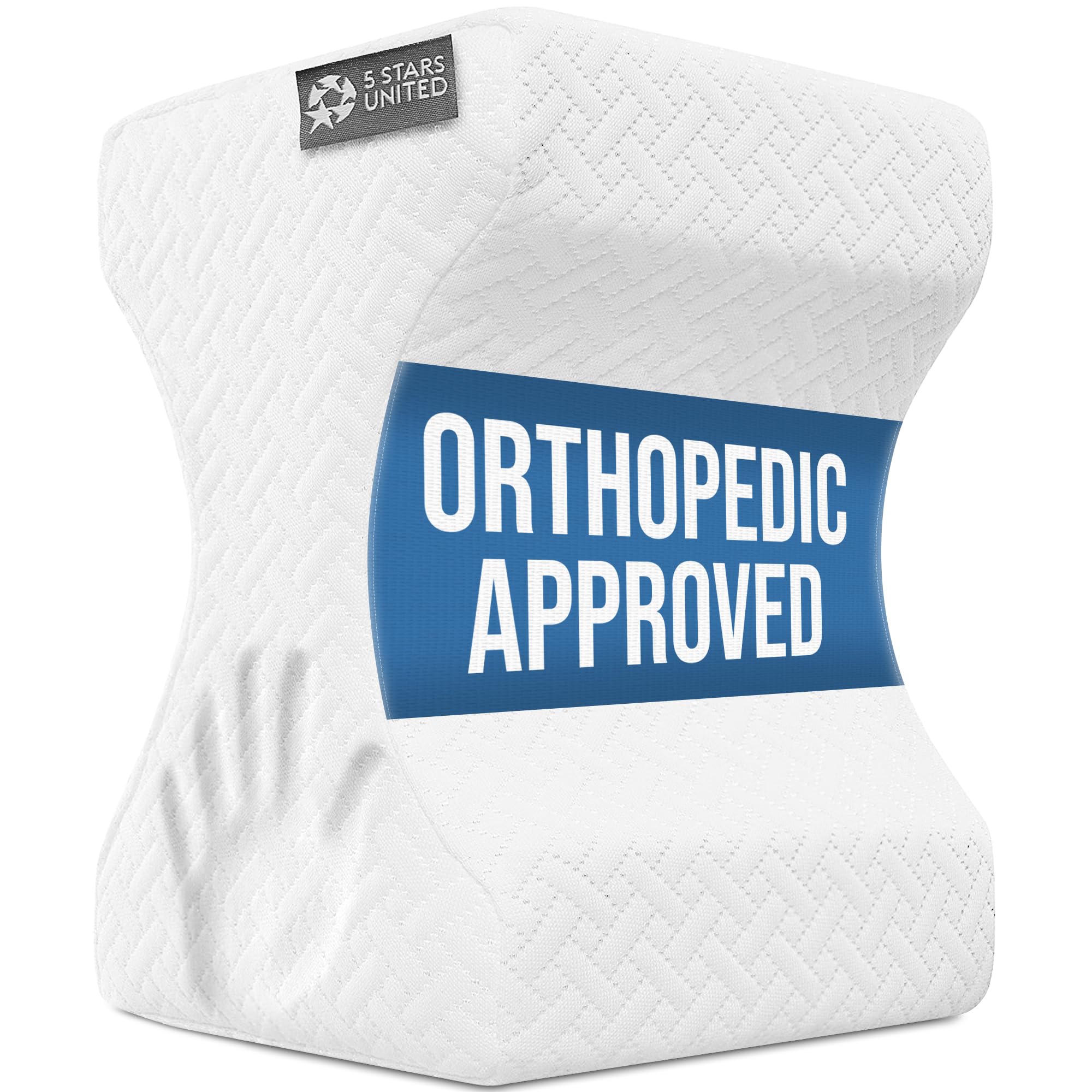
5 Stars Knee Pillow
Key Features
- Pillow Type: Knee pillow
- Dimensions: 9.8 x 7.8 x 6 in
- Material & Firmness: Memory foam, CertiPUR
- Price: Mid-Range
OEKO-TEX and CertiPUR certified foam and a breathable cover make this a safe choice for side sleepers. The hourglass design rotates into four orientations, letting you fine-tune knee separation or leg support to your preference. The fixed 7.8-inch width can struggle to create adequate separation for thicker legs, and the memory foam firmness proves polarizing—too rigid for some, too yielding for others. It ends up a usable alternative when the more established Contour Legacy knee pillow doesn’t fit right, though the same size uncertainty applies.
Pros
- Reduces back and hip discomfort by keeping knees aligned during side sleeping
- Certified materials and dense memory foam hold up well over time
Cons
- Firmness may not match personal preference—can feel too hard or too soft
- Width may be insufficient for larger thighs, limiting knee separation
Worth a look as a Contour Legacy alternative for side sleepers who want certified materials and multi-position use. Measure your thigh gap—the 7.8-inch width is non-negotiable.
Best for Back-Sleeper Relief
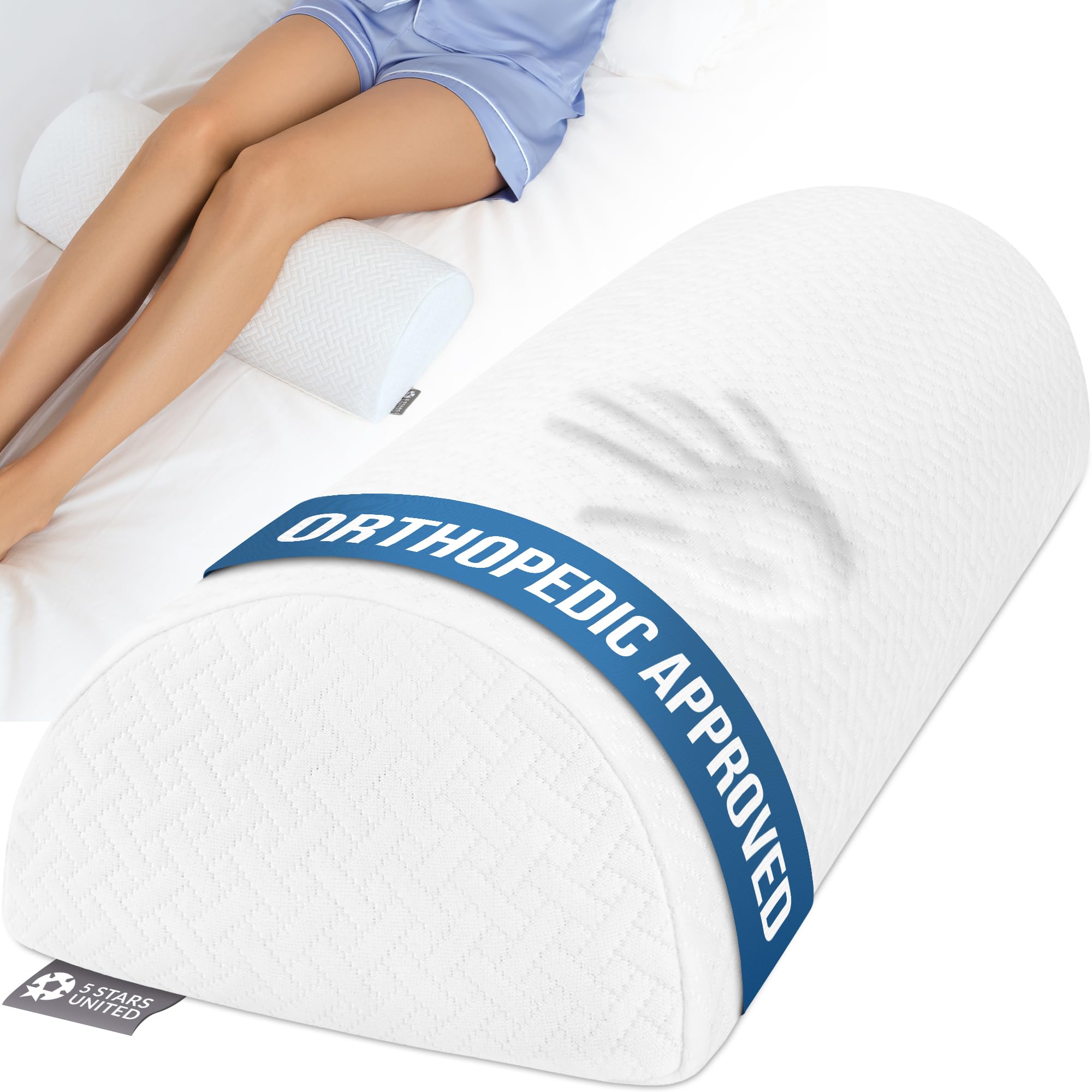
5 Stars Bolster
Key Features
- Pillow Type: Under-knee bolster
- Dimensions: 20.4 x 7.8 x 4.8 in
- Material & Firmness: Memory foam, OEKO-TEX
- Price: Mid-Range
The high-density memory foam in this half-moon bolster provides firm knee elevation that can reduce lower back pressure during back sleeping. Its dense foam also supports quality and durability, and the shape works under the neck or lumbar as well. The foam’s unyielding firmness, however, can cause leg numbness for lighter users, and the 20-inch length may feel too short to support both knees evenly. A softer bolster in this set offers similar relief with a more plush feel.
Pros
- Reduces lower back pain when sleeping on back
- Provides firm knee and lower back support
- High-density memory foam retains shape over time
Cons
- Size may feel too short to support both knees evenly
- Firmness can be unyielding, leading to leg numbness for some users
If you need a firm, durable bolster exclusively for back sleeping and low-back relief, and find too-soft pillows ineffective, this one works — provided you verify the 20-inch length fits your frame.
Best for Restless Side Sleepers
NATUMAX Knee Pillow w/ Strap

Key Features
- Pillow Type: Knee pillow
- Dimensions: 9.45 x 6.5 in
- Material & Firmness: Memory foam
- Price: Mid-Range
The NATUMAX knee pillow sets itself apart with an elastic leg strap that keeps it in place for restless side sleepers. Memory foam, a sleep mask, and ear plugs round out the package. Back and hip pain relief is evident when the fit works. But the strap can dig in or feel restrictive if the pillow is too small for your frame, and the soft foam may compress under weight, limiting deep knee separation. For active sleepers who want a secure, all-in-one solution, it’s a niche pick; those who stay still will find standard pillows more comfortable.
Pros
- Relieves back and hip pain by keeping legs aligned, especially with the strap secured
- Strap holds the pillow in place through tossing and turning, reducing nighttime adjustments
Cons
- Strap can dig into the leg or feel too tight if the pillow size doesn’t match your thigh gap
- Soft memory foam may flatten under heavier weight, reducing knee separation for deeper support needs
For side sleepers who shift frequently and want a pillow that stays put without repositioning, the bundled sleep accessories make this a convenient pick — but verify the dimensions against your frame to avoid strap discomfort.
Best for Swelling Reduction
MEGCXIT Leg Elev. Pillow

Key Features
- Pillow Type: Leg elevation wedge
- Dimensions: 23.6 x 16.8 x 8 in
- Material & Firmness: Memory foam
- Price: Mid-Range
The MEGCXIT wedge’s broad 23.6-inch platform comfortably accommodates both legs, using supportive memory foam to relieve pressure and promote circulation during back sleeping. Swelling reduction is notably effective thanks to the consistent 8-inch elevation. Its sheer size, however, makes it a poor fit for smaller beds or anyone who shifts to side sleeping. The top pick offers comparable support in a far more compact, height-adjustable design — a better match when bed real estate is tight.
Pros
- Plush memory foam cradles legs securely for hours, with no hard pressure points.
- Stable 8-inch elevation effectively reduces edema and promotes circulation.
Cons
- Its large footprint (23.6 x 16.8 inches) can dominate smaller beds, making placement awkward.
If bed space isn’t a constraint and you primarily sleep on your back, this wedge delivers broad, no-fuss leg elevation. For tighter setups, the compact adjustable top pick is a smarter fit.
Best for Budget Sciatica Relief
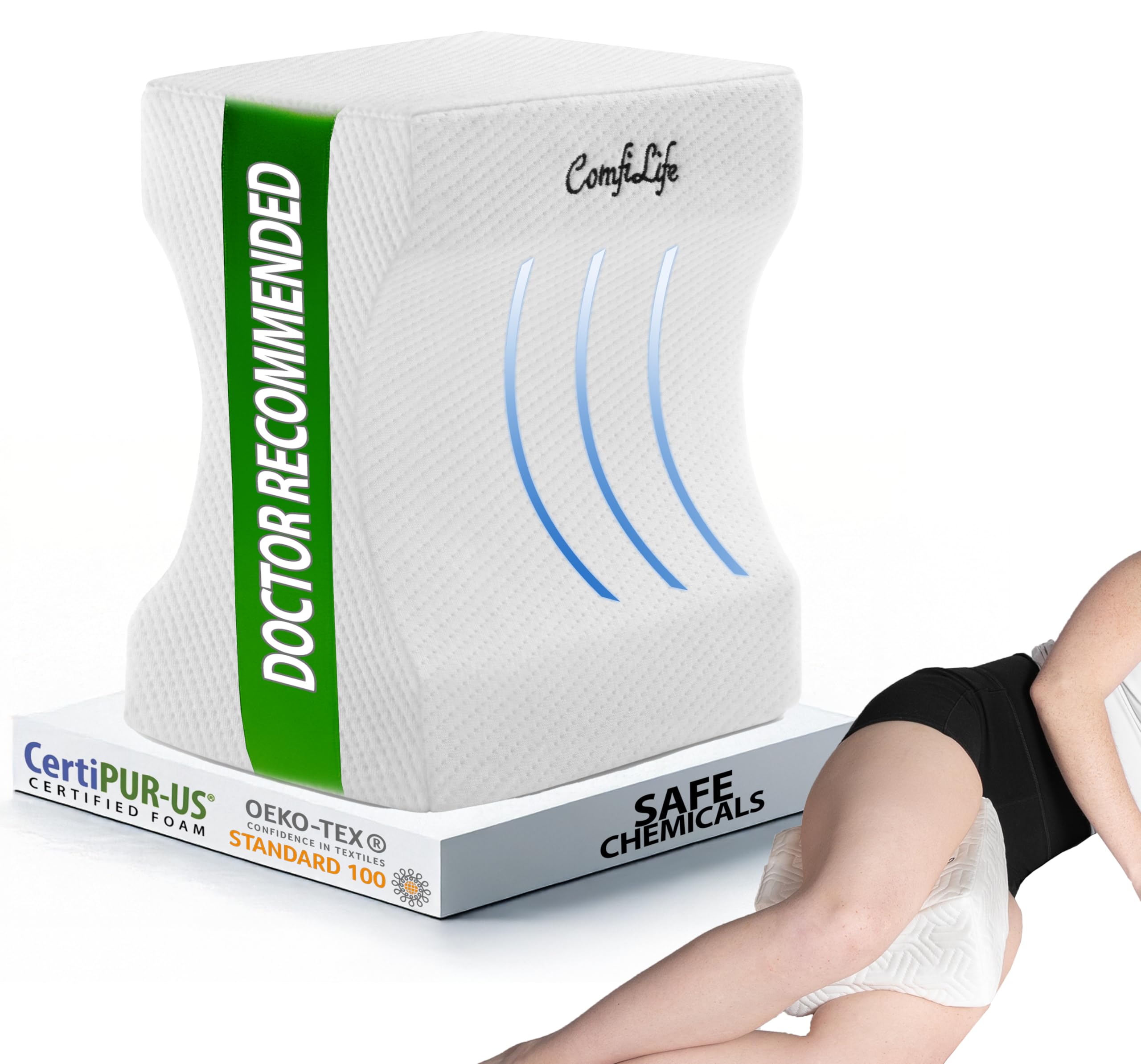
ComfiLife Knee Pillow
Key Features
- Pillow Type: Knee pillow
- Dimensions: 9.8 x 7.9 x 6.3 in
- Material & Firmness: Polyurethane foam
- Price: Budget
This knee pillow uses firm polyurethane foam to align hips and relieve lower back and sciatica pain during side sleeping. The dense core maintains consistent separation, and the breathable cover helps with airflow. However, the 9.8-inch length and rigid foam create a narrow comfort window — larger thighs may not get adequate separation, and the hardness can cause pressure points for those accustomed to softer support. For sleepers who match its compact dimensions and want unyielding alignment, it’s a budget-friendly option, but a slightly softer, even less expensive alternative in this set may suit more body types.
Pros
- Provides effective pain relief for lower back and sciatica
- Promotes better sleep quality and hip alignment
Cons
- Size may be insufficient for larger thighs, resulting in inadequate knee separation
If you’re a side sleeper with average thighs who wants a firm, compact knee pillow for back pain, this budget-friendly option delivers — but if you need more space or a softer feel, the slightly softer alternative in this set is a better fit.
Best for Travel Knee Pillow
Vaunn Knee Pillow

Key Features
- Pillow Type: Knee pillow
- Dimensions: 10 x 8 x 10 in
- Material & Firmness: High-density memory foam
- Price: Mid-Range
The Vaunn knee pillow effectively relieves back and hip pain for petite side sleepers who need a lightweight, travel-friendly spacer. Its memory foam cradles the knees comfortably, but the pillow’s small dimensions limit knee separation for average and larger adults. The foam can also compress under heavier weight, reducing support through the night. This makes it a travel- or petite-only solution.
Pros
- Relieves back and hip pain as a knee spacer for side sleeping
- Comfortable memory foam cradles knees without pressure points
Cons
- The memory foam can compress under body weight, reducing support overnight
- Compact dimensions may not provide adequate knee separation for average or larger adults
A travel-friendly knee pillow for petite side sleepers who need just enough spacing to alleviate hip and back pressure; average and larger adults will need a larger, firmer alternative.
How to Choose
The two measurements that determine whether a leg positioner pillow helps or causes discomfort are the gap between your knees when side-lying and the elevation height required for your leg condition.
Pillow Type: Wedge, Knee, or Bolster?
Leg elevation wedges raise the entire leg to reduce swelling and are meant for back sleeping; using one as a knee separator on your side can rotate your hips awkwardly. Knee pillows are shaped to fit between the legs when side sleeping, keeping the spine neutral, but they offer almost no lift for post-surgical swelling.
Choose based on your primary position and recovery goal: a wedge for elevation, a knee pillow for side sleeping, or an under-knee bolster for back-pain relief when lying on your back.
Dimensions and Fit for Your Body
The width and height of a knee pillow must match the distance between your knees. If the pillow is too narrow, your knees may touch or it will slide out; a wedge that’s too short won’t support the full leg, creating pressure points. A tall wedge can overextend the knee joint, especially for shorter individuals.
Always measure your knee gap and compare leg length to pillow dimensions. A pillow that looks ‘standard’ online may be far too small for average-to-larger frames.
Adjustable vs. Fixed Height
Fixed-height pillows are straightforward, but if you need to vary elevation between sitting and lying down, an adjustable model with multiple height levels adapts better. Adjustable designs rely on removable layers or Velcro systems, which can shift apart during restless sleep.
For post-surgery recovery, adjustable height is worth the extra complexity because swelling changes and using a single fixed angle often leaves you too high or too low later in recovery.
Memory Foam Firmness and Material
Firmness is the most subjective factor. Heavier users need denser foam to avoid bottoming out, while lighter sleepers may find the same foam painfully hard. Many budget pillows use standard polyurethane foam, which can feel unyielding; memory foam with moderate softness or gel infusion balances support with contouring.
A pillow that’s too soft compresses and loses its lift, while one that’s too firm can cause numbness and pressure points. If you’re unsure, look for medium-firm memory foam that supports without feeling like a brick.
Non-Slip Grips and Handles
Handles on the front or side let you reposition the pillow without twisting, and non-slip silicone dots or backing reduce nighttime sliding. However, on high-thread-count or silk sheets, even non-slip bottoms can glide — plan to add a separate gripper mat if your bedding is silky.
A pillow that constantly shifts disrupts recovery and sleep. If you toss a lot, a knee pillow with an elastic leg strap may be the most practical solution.
FAQ
Why does my knee pillow keep falling off at night even with a strap?
The strap may be too loose, or the pillow itself is too small for your thighs, letting it slip out. Tighten the strap so it sits above the knee without digging in, and place the pillow against bare skin or on a non-slip surface. If it still migrates, a wider, firmer knee pillow without a strap often stays put better for restless sleepers.
How high should a leg elevation pillow be to reduce swelling after knee surgery?
The leg should be elevated 6 to 10 inches above heart level while lying flat; a wedge with a 7–9 inch rise typically achieves this. An adjustable-height pillow lets you fine-tune the angle as swelling decreases, while a fixed-height wedge may be too high or too low at different recovery stages. Follow your surgeon’s specific protocol.
Is a cooling gel leg pillow actually cooler, or does it still trap heat?
Gel-infused memory foam feels cool to the touch initially and dissipates body heat faster than standard memory foam, so it stays noticeably less warm over hours. It won’t actively cool like a fan, but for most hot sleepers it prevents that stifling heat buildup common with plain foam. For maximum coolness, pair it with a breathable cover.
Why does my lower back still hurt when using an under-knee bolster?
The bolster may not lift your knees high enough to flatten your lower back, especially on a soft mattress. Try adding a thin towel underneath for extra height or switch to a taller half-moon bolster. Back pain can also persist if you’re a stomach sleeper — under-knee bolsters only work for back sleeping.