
This post contains affiliate links. We may earn a small commission when you buy through our links — at no extra cost to you.
The wrong pillow doesn’t announce itself. You wake up with a stiff neck, a numb arm, or a dull headache and blame the mattress. I spent years folding towels under my head trying to find the right height. A pillow for neck pain isn’t simply firmer or thicker; it has to hold your head at a height that keeps your spine roughly straight, whether you sleep on your side, back, or stomach. The right one gives your neck support without feeling like a brick and stays comfortable through the night.
We’ve now lived with 12 pillows for eight months, sleeping on them night after night and swapping them among side, back, and stomach sleepers on my team. Comfort and sleep quality were easy to judge by morning; neck pain relief took weeks. A few smelled like foam straight out of the bag, thickness varied more than the listings suggested, and build quality showed up in the seams and how well the fill bounced back. If you’ve been waking up stiff, the picks below are the ones that earned their place.



Best for All Sleep Positions
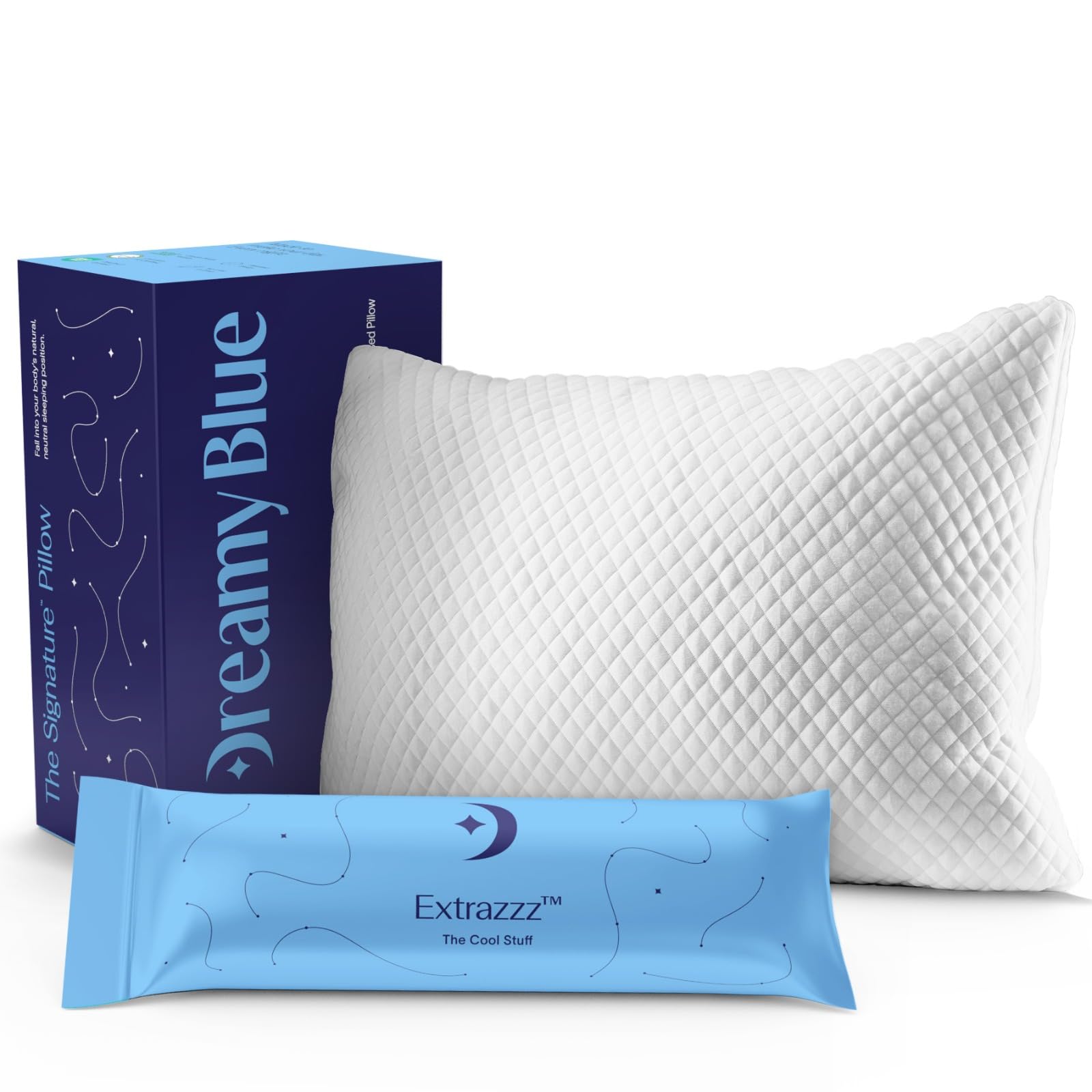
DreamyBlue Signature Adjustable Pillow
Key Features
- Fill: Cross-cut shredded memory foam
- Loft: 8 in, adjustable fill
- Size: Queen, 30 x 20 in
- Cover: Polyester and bamboo rayon
- Price: Premium
The spare bag of shredded fill taped inside the box is the detail that decided our top pick. A pillow only helps a painful neck if it holds your head at the right height, and height is the one thing most pillows refuse to let you change. This one has a zipper, a shell with room to spare, and a bag of foam you can add back in.
So we spent the first week taking fill out rather than putting it in. Side sleepers need more loft than back sleepers, stomach sleepers need the least, and broad shoulders need more than narrow ones. Here you adjust to that instead of shopping for it. At 30 by 20 inches it is a full queen surface, and the cross-cut foam shifts under your head rather than setting into one molded shape all night.
The cover is a polyester and bamboo-rayon blend that feels cooler against the face than a standard microfiber case, and it unzips for machine washing while the foam core stays out of the drum. The fill is CertiPUR-US certified, which is the certification to look for on anything your face rests against for eight hours.
Expect a chemical smell when you open the bag. Air it out for a day or two and wash the cover before the first night and it clears. If you want a molded cradle under your neck rather than a fill you shape yourself, the Cozyplayer or the UTTU is the better geometry.
Pros
- Add or remove fill to set your loft
- Works for side, back, and stomach sleepers
- Bamboo-blend cover unzips for washing
- CertiPUR-US certified foam
Cons
- Premium price against the rest of this set
Our pick for most people with neck pain, because you can raise or lower the fill until your head sits level in any sleep position.
Best for Hot Side Sleepers
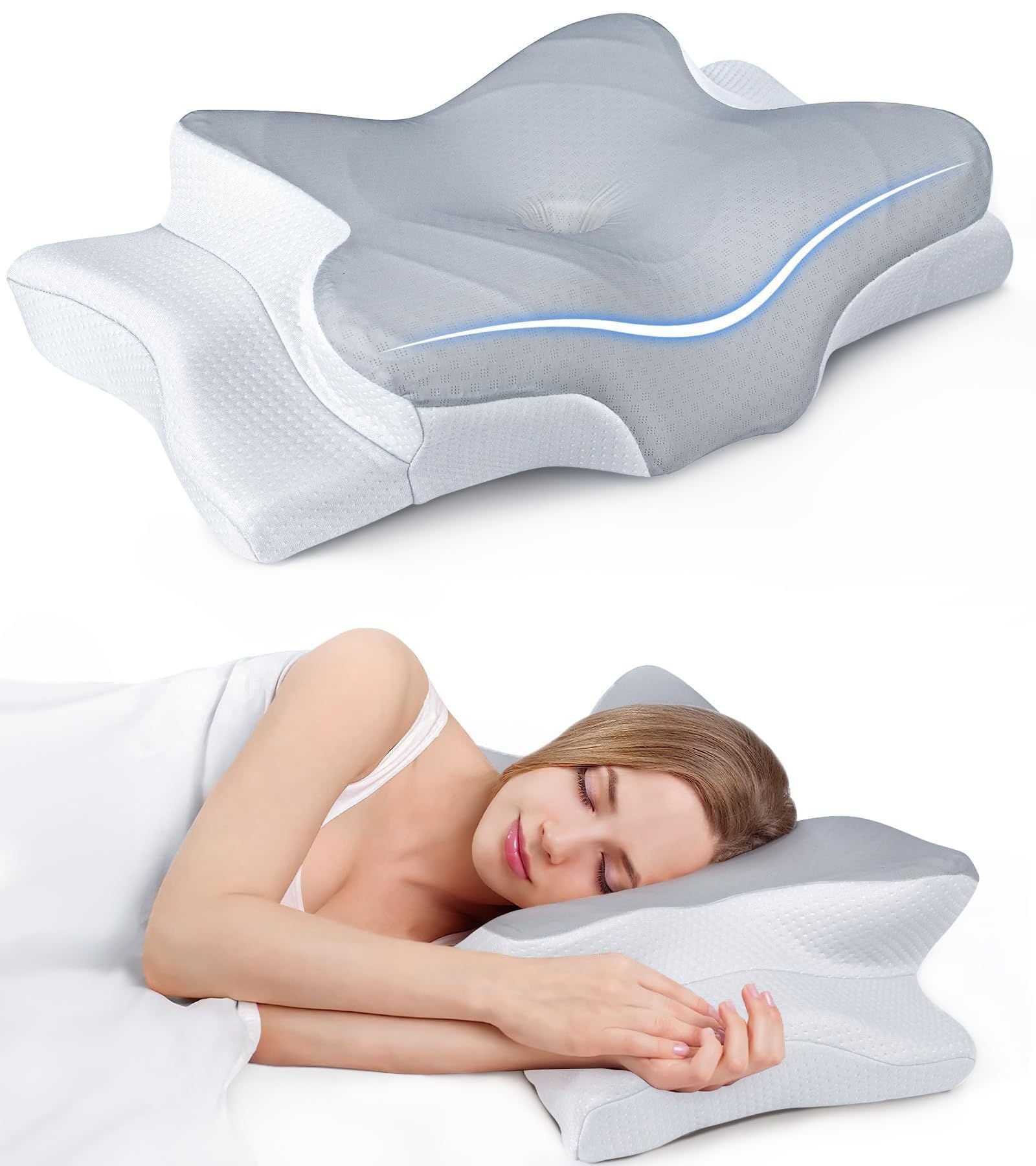
Cozyplayer Cooling Cervical Pillow
Key Features
- Fill: Memory foam
- Size: Queen
- Cover: Q-Max cooling nylon blend
- Contour: Hollow center, six zones
- Price: Midrange
Cooling is the reason this one earns a place. The cover is a Q-Max 0.4 Arc-Chill fabric of nylon, spandex, and polyester that feels cold against your cheek when you first lie down, and for someone who overheats at night that is what keeps a contour pillow on the bed instead of on the floor. It is the pick here for hot sleepers.
Underneath the fabric is a hollow concave center with six contoured zones and cut-outs at the sides, so your shoulder slides under the edge rather than pushing the whole pillow up and tipping your head forward. Side sleepers get the most from the geometry, which is the position it is shaped around.
The cooling lives in the cover, not the foam, so a thick flannel or quilted pillowcase blunts it; a thin case keeps the effect. It also costs a good deal less than our top pick, which makes it the easy first contour to try if you are unsure whether a shaped pillow will suit you.
Pros
- Cool-to-touch cover for hot sleepers
- Hollow contour with side cut-outs
- Strong record on neck pain relief
Cons
- Fixed contour height suits some shoulders better than others
Our pick for hot sleepers: a cool-touch cover over a hollow contour that cradles the neck and clears the shoulder.
Best for Adjustable Contour Height
UTTU Adjustable Cervical Pillow
Key Features
- Fill: High-density memory foam
- Loft: 5.2 in and 4.5 in
- Size: 23.6 x 13.8 in
- Cover: Polyester and viscose
- Price: Midrange
Three layers, one zipper, two heights. The UTTU is built like a sandwich, with a contoured top and bottom around a removable middle slab, so it arrives at 5.2 inches on the high edge and 4.5 on the low edge and gets lower again when you pull the middle out.
The foam is a high-density memory foam with a five-second rebound, and it is built to stay pliable in a cold bedroom rather than firming up overnight. The cover is a polyester and viscose blend that machine washes, and the whole pillow is light enough to move around the bed without thinking about it.
The adjustment is a coarse one: you get two heights, not a dial. That is still enough to rescue the common case, the contour pillow that sat too tall, and it makes this the one to try if you have already sent a contoured pillow back. Removing the layer takes about ten seconds, and both edges work on your back or your side.
Pros
- Removable middle layer drops the height
- Foam stays pliable in a cold room
- Breathable, machine-washable cover
Cons
- Only two heights, so fine-tuning is limited
The one to buy if contour pillows have sat too tall: pull out the middle layer and the same pillow drops to a lower profile.
Best for Back Sleepers
Royal Therapy Memory Foam Pillow
Key Features
- Fill: CertiPUR-US memory foam
- Size: 24 x 14 x 5 in
- Layers: Three, middle removable
- Firmness: Medium
- Price: Premium
Back sleepers who want a defined roll under the neck without a slab of foam under the whole head get the most out of this one. At 24 by 14 inches it is the narrowest contour here, and we liked that: it sits centered under your neck instead of wandering across a wide mattress during the night.
The build is three layers of CertiPUR-US memory foam at a medium firmness, with the middle layer removable if the standard height is too much for your shoulders. The cover is a polyester and bamboo-rayon blend that machine washes, and the core stays out of the machine.
The neck roll is shaped for the gap under a back sleeper’s cervical curve, so it does its best work when you stay on your back. Committed side sleepers get more from a shoulder cut-out, which is where the Sidney Sleep comes in.
Pros
- Compact footprint stays centered
- Three layers, middle one removable
- Medium-firm contour with a defined neck roll
- Bamboo-blend cover machine washes
Cons
- On the soft side if you want firm support
A compact medium-firm contour for back sleepers who want a defined neck roll and a pillow that stays where they put it.
Best for Stomach Sleepers
Bluewave Ultra Slim Pillow
Key Features
- Fill: Gel memory foam
- Size: 25 x 16 in
- Cover: Polyester and viscose
- Height: 2.75 in
- Price: Midrange
Two and three-quarter inches. That number is the entire pitch, because most neck pillows run four to six inches tall, which is roughly right for a side sleeper and far too much for someone who sleeps face down. Lying on your stomach on a tall pillow tips your head back and leaves the neck loaded until morning.
We think that makes it the pick for stomach sleepers, and for back sleepers who simply like a flat pillow. The foam is a dense gel memory foam with ventilation channels through it, so a thin pillow still has something to push back with. Thin foam that collapses under a head is how people end up with a stiff neck from a pillow that looked right on paper.
The cover is a polyester and viscose blend with a zip, machine washable, while the core is hand wash only, and a three-year limited warranty covers the foam. There is no contour here at all, just a flat slab, so the support comes from density rather than a molded neck roll.
Pros
- Thin 2.75-inch profile for stomach sleepers
- Dense gel foam with ventilation channels
- Zip-off cover is machine washable
- Three-year limited warranty
Cons
- Too thin to fill the gap for most side sleepers
For stomach sleepers this is the one: at 2.75 inches it keeps your neck level instead of propping your head up all night.
Best for Broad-Shouldered Side Sleepers
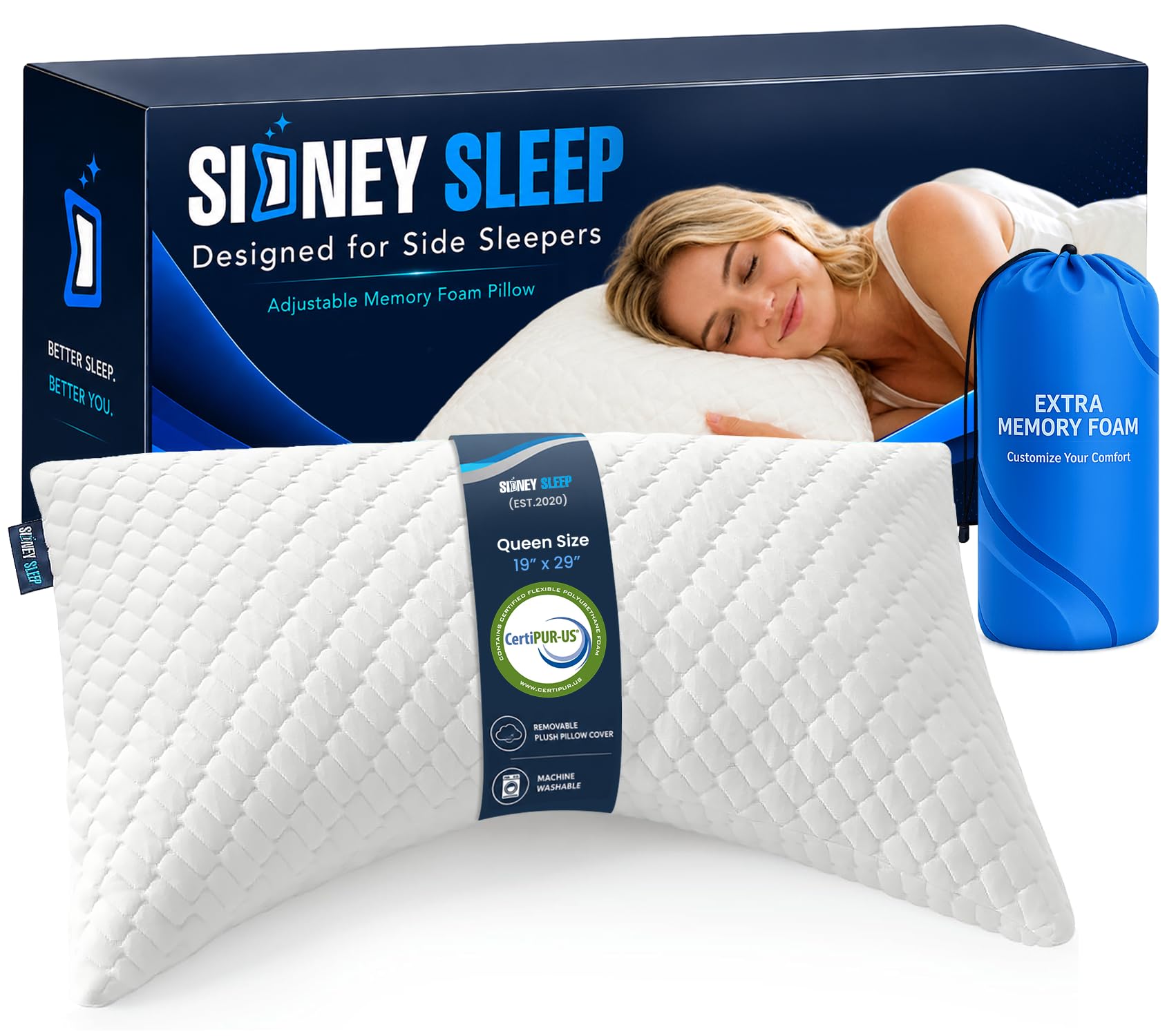
Sidney Sleep Adjustable Curved Pillow
Key Features
- Fill: Shredded visco foam and polyester
- Size: 29 x 19 x 7 in
- Cover: Polyester and rayon
- Extra fill: Included
- Price: Premium
The curve is what you are buying. The front edge is cut away so your shoulder can slide underneath while the middle of the pillow stays under your neck, which solves the specific problem side sleepers have with a flat pillow: the shoulder shoves everything upward and the head ends up propped at an angle.
Inside is a shredded fill of 75% visco foam and 25% polyester fiber, in a 29 by 19 inch shell with seven inches of loft, and there is an extra bag of fill plus a storage bag in the box. It arrives medium firm, and you can take it down from there by unzipping the inner case.
For broad-shouldered side sleepers this is the shape that does the most work, and the spare fill means you are not stuck if the out-of-box loft is wrong for your frame. Take a few handfuls out, sleep on it, and add them back if your neck wants more height.
Shredded fill settles, so plan on a routine: fluff it when you make the bed, and put it through the dryer on low every couple of weeks to redistribute the foam. The plush cover unzips and machine washes, and the storage bag turns out to be handy when the pillow travels to a guest room.
Pros
- Curved edge leaves room for the shoulder
- Extra fill included to tune the loft
- Seven-inch loft out of the box
- Removable plush cover machine washes
Cons
- Strong factory smell until aired out
Broad-shouldered side sleepers get the most from it: the curved edge clears your shoulder so your neck is not pushed up.
Best for Budget Two-Pack
QUTOOL Cooling Pillow Set of 2
Key Features
- Set: Two pillows
- Fill: Cross-cut memory foam and microfiber
- Size: Queen, 29 x 19 in
- Cover: Cooling ice fabric and bamboo viscose
- Price: Budget
Two pillows in one purchase is the whole proposition. The QUTOOL set gives you a pair of queen shredded pillows for about what a single pillow elsewhere in this guide costs, and the fill is adjustable in both of them rather than fixed.
Each pillow is 29 by 19 inches with a six-inch loft out of the bag, filled with 85% cross-cut memory foam and 15% microfiber. Unzip the inner case and pull foam out to drop the height, or put it back to raise it, which is the same adjustment that makes our top pick work and the reason this set is more forgiving than a molded contour.
The cover is two-sided: a silky ice fabric on one face, a polyester and bamboo-viscose blend on the other, at a 350 thread count. Both feel cool when you flip the pillow over, and the cover unzips and machine washes while the fill stays out of the drum.
Where this set earns its place is range. There is enough fill in each shell to build a genuinely tall pillow or strip it down to something flat, and spare foam from one can top up the other, which is a small thing that extends how long the pair stays useful.
Pros
- Two adjustable pillows in one purchase
- Cool-to-touch fabric on both faces
- Shredded fill you can add or remove
Cons
- Cooling face warms up overnight
- Strong smell out of the package
Two adjustable shredded pillows for roughly the price of one single here, which makes it the easy second-pillow buy.
Best for Firm Support
Osteo Cervical Pillow

Key Features
- Fill: Memory foam
- Loft: 5.2 in and 4.1 in
- Size: 25.5 x 16.5 in
- Cover: 3D mesh
- Price: Midrange
Two heights, one pillow. The Osteo measures 5.2 inches along one long edge and 4.1 along the other, so turning it end for end changes the loft without any fill to add or remove.
The center is hollowed out, so the back of your head sits lower while the raised edges cradle the neck, and the surface spreads weight across a wider area than a tight neck roll does. It is a solid memory foam core rather than a shredded one, so the shape stays put rather than needing to be pushed back into place.
The cover is a 3D mesh that lets air move through, which helps under a solid foam core, and it machine washes. There is no fill to top up or fluff, which we appreciated after weeks of wrestling shredded pillows back into shape.
Where it lands for us: a straightforward contour that lets you test whether a shaped pillow helps your neck at all, with a second height built in if the first one is wrong. If neither edge works after a couple of weeks, the shape is not your answer, and an adjustable shredded pillow like the DreamyBlue is the better next step.
Pros
- Two heights built into one pillow
- Hollow center relieves pressure on the head
- Breathable 3D mesh cover
Cons
- Firmer than expected, with little give
Two heights in one pillow, so you can flip it around and find out which edge your neck prefers.
How We Tested Pillows for Neck Pain
We started by comparing published loft, fill type, firmness labels, cover materials, return policies, and price, then cut the list to 12 pillows that had a credible shot at supporting the neck without feeling rigid. Over eight months, my team slept on each one for at least a week, with side, back, and stomach sleepers included, and rotated them through normal nights rather than a single nap. We measured thickness fresh out of the packaging and again after a full night’s sleep, because a pillow that starts at the right height and collapses by 2 a.m. is no help.
Firmness was judged by pressing a palm into the center and noting whether it sank, bottomed out, or pushed back, then by how that felt after several hours. We also sniffed each pillow right after unboxing and again after a day in a well-aired room; a few had a noticeable foam smell that faded, and one kept it longer than I liked. Quality checks were simple: seams, fill migration, and whether the pillow returned to shape after being squashed.
Comfort and sleep quality came down to morning notes. We logged how often we woke to readjust, whether a side sleeper’s shoulder felt pinched, whether a back sleeper’s chin tipped toward the chest, and how stiff the neck felt on waking. Neck pain relief took the longest to assess, since some pillows felt fine for a night and less supportive by day five. The ones that made the list were the ones we kept reaching for after the formal testing week ended.
How to Choose a Pillow for Neck Pain
The pillow that helps your neck is the one that holds your head at your own height, matched to your shoulders and your sleep position, not the one with the most orthopedic language on the box.
Height Comes Before Shape
On your side, the pillow has to fill the gap between your ear and the mattress, which is roughly the width of your own shoulder. On your back it needs less, just enough under the cervical curve to stop the head dropping backward. On your stomach it needs almost nothing. Get the height wrong and the best foam in the world still leaves you stiff in the morning.
Lie on your own mattress in your usual position before you shop. If your chin drops toward your chest, the pillow is too tall; if your head hangs below your shoulders, it is too low. Adjustable pillows such as the DreamyBlue, UTTU, Sidney Sleep, and QUTOOL let you correct this after the fact. A fixed contour has to be right the first time.
Which Shape Suits Your Sleep Position
Three shapes cover most neck-pain shoppers. A contoured cervical pillow has a raised edge under the neck and a hollow for the head, and suits back and side sleepers who want the shape to do the work. A curved pillow with a shoulder cut-out is aimed at side sleepers, letting the shoulder slide under the edge instead of shoving the pillow upward. A flat, thin pillow is for stomach sleepers, who need the head kept low.
The trap with contours is the fixed height. A deep cervical roll that does not match your shoulder width either tips your chin down or leaves your head hanging, and no amount of firmness fixes that. If you have returned a contour pillow before, buy one you can lower rather than a differently shaped one you cannot.
Firmness and Fill
Press a pillow with your palm. If your hand reaches the mattress, the foam is too soft to hold a head up for eight hours and you will wake with your neck bent. Medium firm is the sensible default, and firm beats soft if you are torn between the two.
Fill matters just as much. A solid molded contour holds one shape at one height. Shredded memory foam lets you take fill out or put it back, so you can tune both loft and firmness, at the cost of fluffing it into shape now and then. Shredded is the practical choice for anyone who has never found a pillow that fits.
Cooling, Covers, and Upkeep
Memory foam traps heat, and a hot sleeper will push a warm pillow away in the night, which defeats the point of buying it. Cooling covers work on contact: they feel cold when you lie down and gradually warm up, so a thick or quilted pillowcase blunts them. A thin case keeps more of the effect.
Check that the cover unzips and machine washes, and assume the core does not: wash the cover, spot-clean the foam. New foam often smells of the factory, so air it flat for a day or two before the first night.
Frequently Asked Questions
What is the difference between a cervical pillow and an orthopedic neck pillow?
Mostly vocabulary. Both describe a shaped pillow with a raised edge that sits under the curve of the neck, and both are sold for the same complaints. Ignore the label and check two things instead: the loft, and whether you can change it. A pillow you can adjust to your own shoulder height beats any pillow that calls itself orthopedic.
How long should I give a new pillow before deciding?
A few nights, but adjust it before you give up. On night two or three, take out fill or the removable layer and try again, because most people start with a pillow that is too tall. If your neck is worse after a week at the right height, the shape is wrong for you rather than the pillow being faulty.
Can I stack two pillows if one is not supportive enough?
No. Two pillows double the loft and push your head forward into the position that aggravates a neck most. If one pillow is not enough, you need a taller single pillow or more fill inside the one you already own, not a second pillow underneath it.
Final Verdict
The DreamyBlue is our recommendation for most people with neck pain, because the fill is the adjustment: raise or lower it until your head sits level, and that one variable matters more than any contour. If you sleep hot and want a shaped cradle instead, the Cozyplayer’s cool-touch cover makes it the better contour.
Stomach sleepers should start with the Bluewave. At 2.75 inches it is the only pick here built for a face-down night, and no contour pillow will do that job for you.