
This post contains affiliate links. We may earn a small commission when you buy through our links — at no extra cost to you.
An RV mattress has a harder job than the one in your bedroom. It has to fit a berth measured in inches, sleep cool when the sun has been baking the shell, and still support your back after a long drive. The wrong one turns every trip into a countdown to the morning ache; the right one makes camp feel like a place you actually want to sleep. Firmness is the first fork in the road, but size and odor matter just as much once you’re wedging a mattress into a bunk.
We’ve spent eight months sleeping on 10 mattresses in a travel trailer and on campground trips. Some felt great for twenty minutes, then went flat under my hip by 2 a.m.; others ran hot enough that I kicked off the sheets. Inflatable options brought their own trade-off, with inflation time and firmness that drifted overnight. Value came down to making the bed without fighting the corners and whether my back felt okay the next day, and the picks below are the ones that earned a permanent spot.
Best for Most Campers
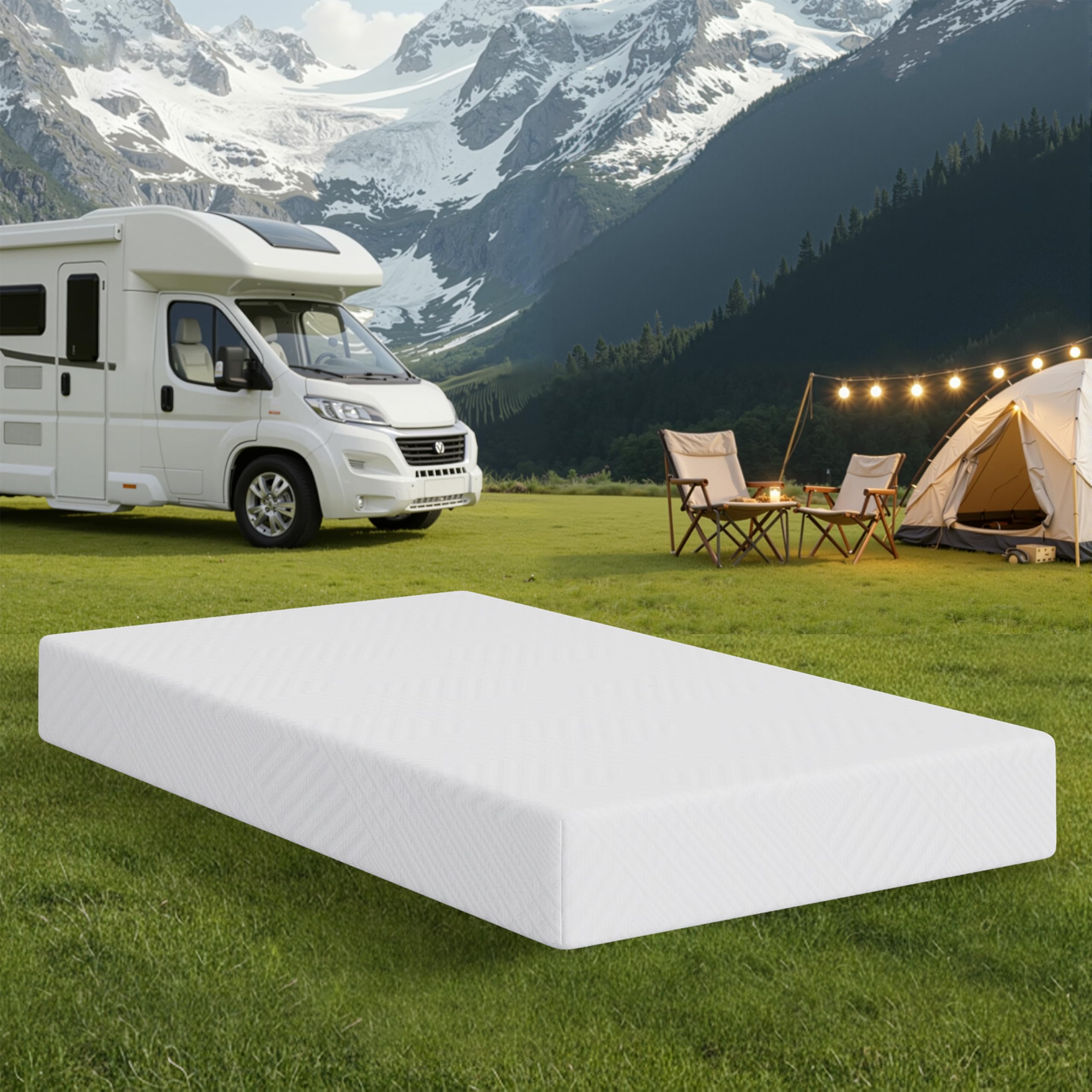
MLILY Short Queen RV Mattress 8-Inch
Key Features
- Size: Short queen, 60 x 75 in
- Thickness: 8 inches
- Mattress weight: 34 lb
- Weight capacity: 750 lb
- Price: Midrange
Thirty-four pounds is the number that decided this one for us. Every short queen here arrives rolled and boxed, and each one has to travel through an RV entry door and up onto a platform that’s often hemmed in by a slide or a wardrobe. At 34 pounds, this is the mattress one person can carry in and drop without rounding up help; the heaviest pick in the group is nearly twice that.
The feel is the second reason it holds the top spot. MLILY rates it around 5 out of 10, and that middle setting is what most people actually want in a camper: enough give under a shoulder when you’re on your side, enough support that you aren’t climbing out of a hole in the morning. Firmness is where these mattresses diverge most, and a 5 keeps you out of both ditches.
Smell matters more in an RV than in a house, because you’re sleeping a couple of feet from bare foam with the windows shut. This one is CertiPUR-US certified with a fiberglass-free barrier under a polycotton cover, and on odor it sits near the top of this group. The 8-inch loft is also the safe height: thick enough that the platform underneath doesn’t telegraph through, low enough that you aren’t remeasuring a bunk. For a camper you use a few weekends a season, that’s the least fussy thing you can put on the platform.
Pros
- Lightest short queen here at 34 pounds
- Medium 5-out-of-10 feel suits most sleepers
- 750-pound capacity covers two adults
- CertiPUR-US foam with a fiberglass-free barrier
Cons
- Cover is hand wash only
The MLILY is the one we recommend for most RVs: at 34 pounds it’s the lightest short queen here, so one person can carry it in, and the medium foam suits a wide range of sleepers.
Best for Tight Budgets
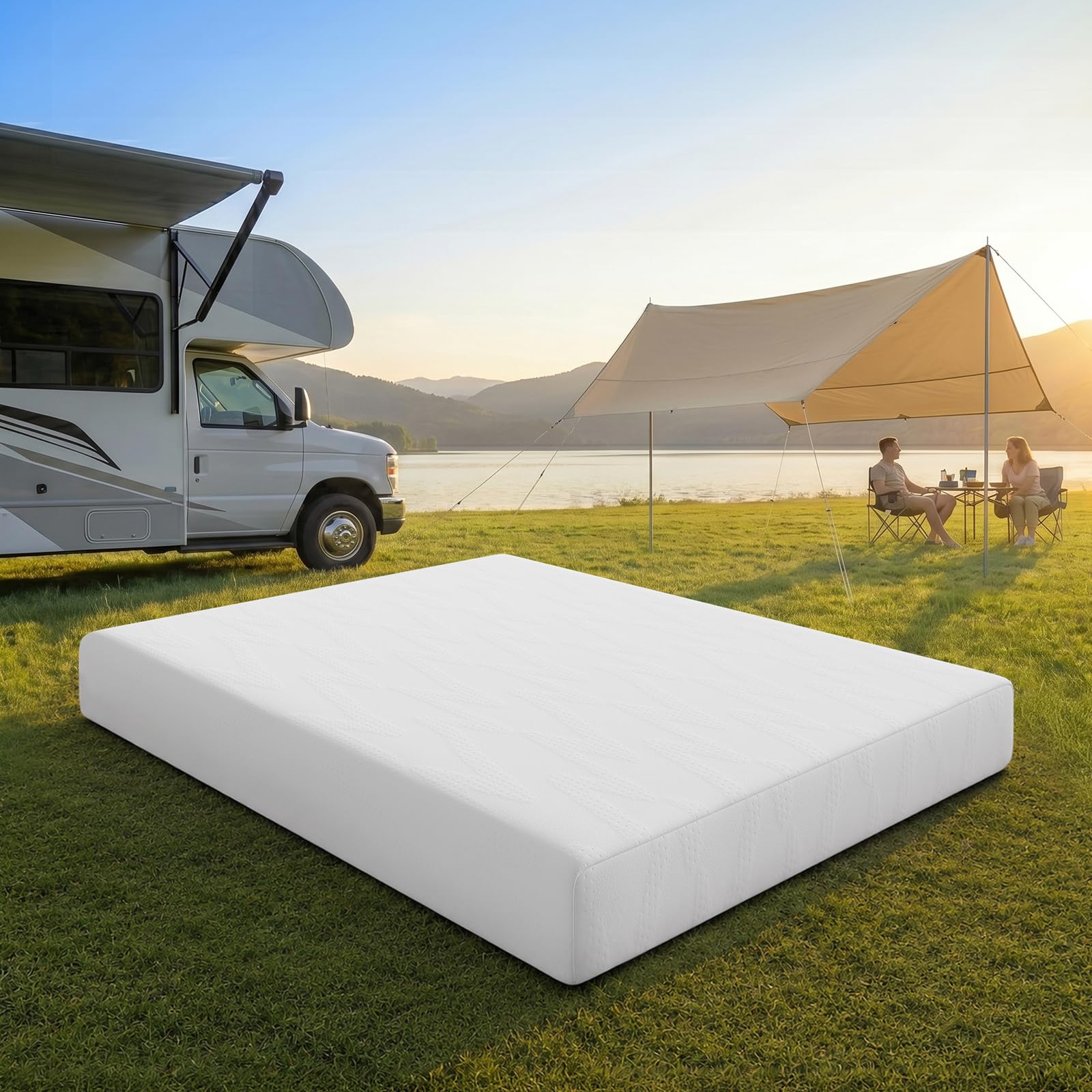
Novilla 8-Inch RV Short Queen
Key Features
- Size: Short queen, 60 x 75 in
- Firmness: Medium
- Thickness: 8 inches
- Mattress weight: 37.9 lb
- Price: Budget
There’s a clear budget option in this group, and it’s Novilla’s. What earns it more than the number on the listing is how little it asks of you: it arrives rolled, unrolls flat, and the cover is already on, so the install is unbox, position, wait. For someone replacing a stock camper mattress for the first time, that’s the whole job.
The medium label is where we set expectations. Budget foam tends to run firm, and this one lands on the firm half of medium — the kind of surface back sleepers like and side sleepers negotiate with. If you know you want plush, plan on a topper from the start; there’s nothing wrong with the mattress, but there’s no point pretending it’s softer than it is.
Where it genuinely punches up is motion isolation. Its three-layer foam is built to absorb movement and noise, and in a short queen, where you and a partner are always within elbow range, that counts for more than it sounds. CertiPUR-US foam and a knit cover round it out, and at 37.9 pounds it’s light enough to shove into position yourself.
Pros
- Unrolls flat with no assembly
- Motion isolation keeps a shared bed quiet
- Light enough to position solo at 37.9 pounds
- CertiPUR-US certified foam
Cons
- Loft can finish well short of 8 inches
The value pick we point first-time camper owners to: setup is a five-minute job, motion isolation keeps a shared short queen quiet, and the firm-leaning medium suits back sleepers.
Best for Couples
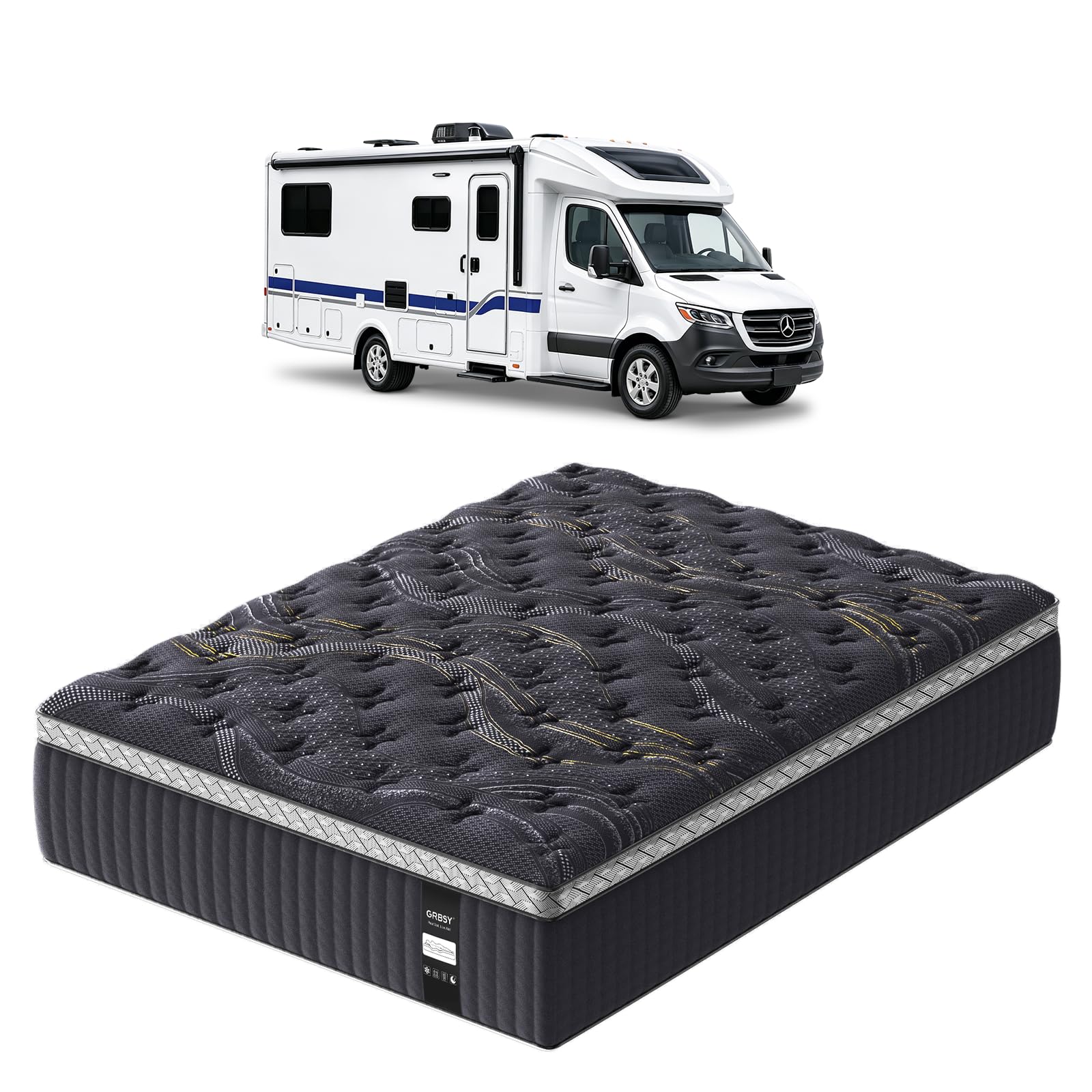
Grbsy 12-Inch Hybrid RV Short Queen
Key Features
- Size: Short queen, 60 x 75 in
- Thickness: 12 inches
- Construction: Hybrid with 1,000 pocket coils
- Mattress weight: 66 lb
- Price: Premium
Twelve inches and a thousand pocket coils make this the outlier of the group: the only hybrid here, and the only one that behaves like the mattress in your house instead of a slab of foam in a cover. If you’ve been sleeping on a camper mattress that feels like a bench, this is the largest single upgrade available short of swapping the rig.
Coils do two things foam can’t here. The 7-zone build is firmer through the middle with more give under shoulders and hips, and the reinforced edge is the part that matters in a camper — you sit on the edge of a short queen constantly because there’s nowhere else to sit. The coil core also stops every turn from traveling, which is worth something when two people share a bed this narrow.
The catch is vertical. Twelve inches is a lot of bed for an overcab bunk or a slide-out with a low ceiling, so measure from the platform to whatever is above it before you order: 12 inches of mattress plus a sleeper is a different number than the 8-inch foam most RVs ship with. The 365-night trial is what makes the leap reasonable — a full year of real trips to find out whether the hybrid life suits you, backed by a 10-year warranty.
Pros
- Pocket coils with 7-zone support
- Reinforced edge for a bed you sit on
- 365-night trial and 10-year warranty
- Motion isolation for couples
Cons
- Heaviest of the group at 66 pounds
Worth the step up if you want a coil mattress in the camper: 12 inches of hybrid with genuine edge support and a 365-night trial, provided your bunk has the clearance.
Best for Heavier Sleepers
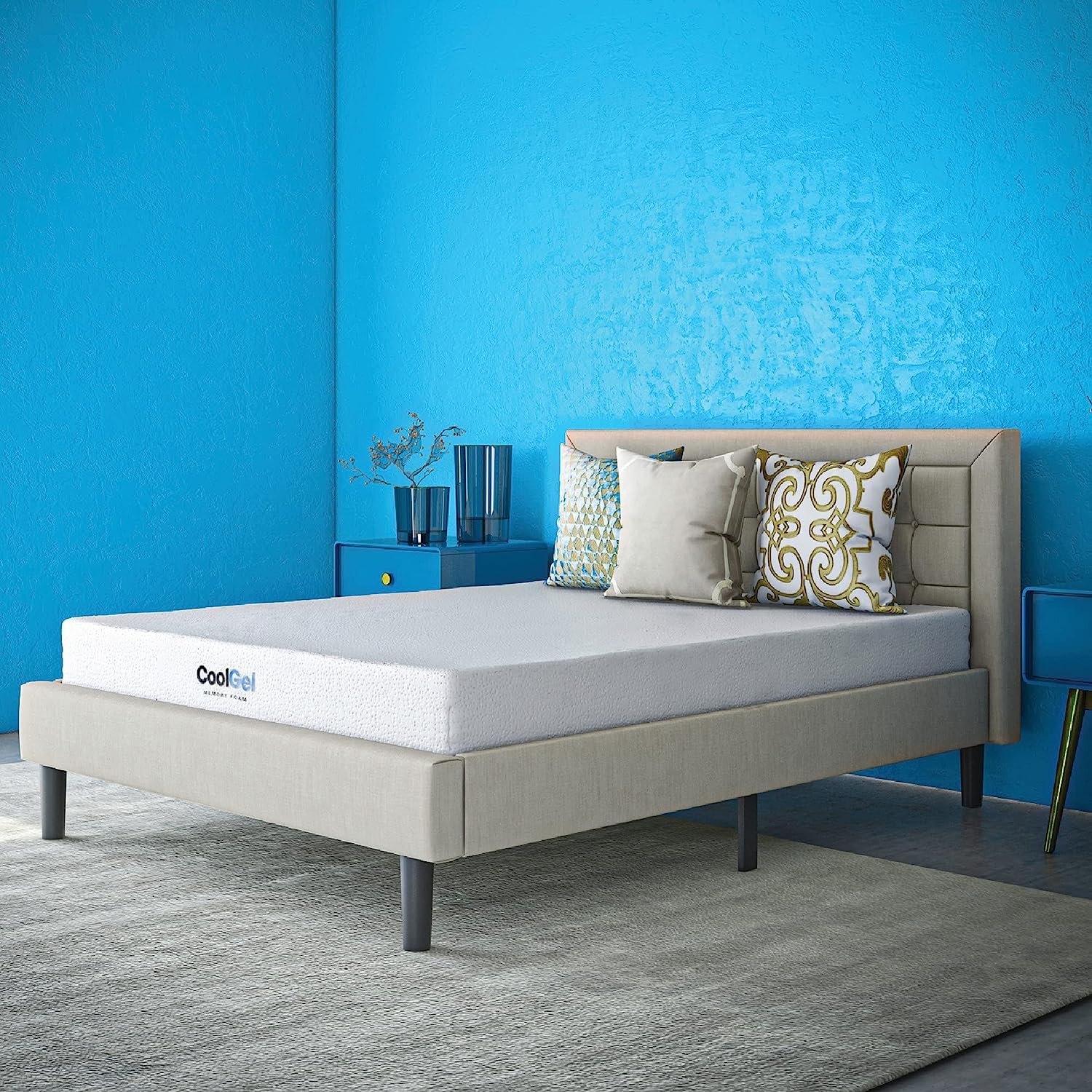
Cool Gel 8-Inch Short Queen
Key Features
- Size: Short queen
- Thickness: 8 inches
- Mattress weight: 52 lb
- Weight capacity: 1,000 pounds
- Price: Midrange
A 1,000-pound weight capacity is the highest here, and it’s the whole reason this one has a place in the guide. Foam that bottoms out is the failure you actually feel in a camper bed, and the high-density core under the gel layer is rated for more load than anything else in this group. If you’re a heavy sleeper, or you and a partner share the mattress every night, start here.
Firmness is the trade. The medium rating reads firm in practice, so if you want a soft landing, plan on a topper — the support is the point, not the cushioning. The gel-infused, open-cell foam is built to move air rather than trap it, which matters when your bedroom is a box that’s been sitting in the sun.
Odor is the other thing to plan around: of everything here, this is the one we most want unboxed in the driveway and left to air for a few days before the bed gets made. And check one detail before you order — the listing gives the length as both 75 and 80 inches depending on which field you read, so confirm the short queen measurement if your platform is tight.
Pros
- 1,000-pound capacity, the highest here
- Gel foam designed to move air
- CertiPUR-US foam, fiberglass-free barrier
Cons
- Runs firm for a labeled medium
- 52 pounds to lift into place
If you’re a heavier sleeper, this is the one: a 1,000-pound capacity and a firm, supportive surface, with more buyer history behind it than anything else here.
Best for Firm-Leaning Sleepers
Zinus Ultima 8-Inch Short Queen

Key Features
- Size: Short queen, 60 x 74 in
- Thickness: 8 inches
- Mattress weight: 44.4 lb
- Weight capacity: 500 lb
- Price: Midrange
Zinus lists this short queen at 74 inches long, and that single inch is the first thing to check. On a platform with a wall at one end and a wardrobe at the other, an inch is the difference between a bed that drops in and a bed you shove; on a pedestal with a little slack, you’ll never notice it. Measure before you order rather than after.
Instead of one flat slab, the foam is cut into seven zones — more give under shoulders and hips, firmer through the middle — which is a more useful version of medium than a number on a box. It still runs firm. If you want a soft bed, this isn’t it, but the zoning keeps a firm mattress from feeling like a plank.
Where it stops is load. The 500-pound capacity is the lowest here, so a single sleeper or a lighter couple is fine, and two adults who want margin should look at the 750- and 1,000-pound picks instead. Green tea and charcoal in the foam are there to keep it fresh between trips, the cover carries OEKO-TEX certification, and the small-box packaging is genuinely easier to get through a door.
Pros
- 7-zone foam eases shoulder and hip pressure
- OEKO-TEX certified cover
- Compresses into a genuinely small box
- Green tea and charcoal foam
Cons
- Loft may not reach the full 8 inches
A well-shaped medium-firm foam bed with a certified cover and a genuinely small box; check the listed 74-inch length and the 500-pound rating before you commit.
Best for Families and Pets
SynthoSpace 10-Inch Short Queen
Key Features
- Size: Short queen, 60 x 75 in
- Cover: Removable, hand wash
- Thickness: 10 inches
- Mattress weight: 41 lb
- Price: Midrange
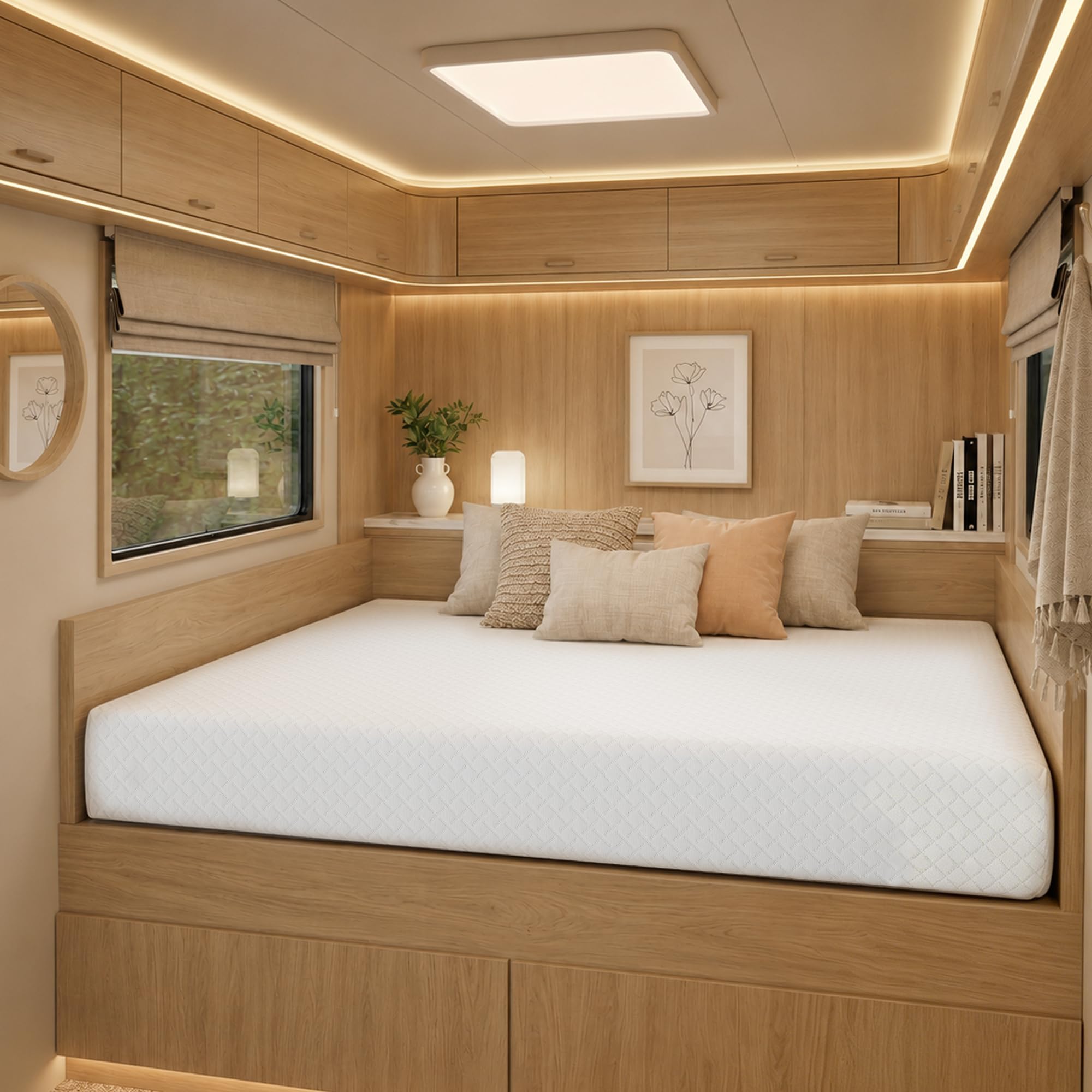
The cover zips off, and in a camper that is a bigger deal than it sounds. RV mattresses live with road dust, dogs, kids and the occasional spilled coffee, and being able to pull the top off and hand wash it beats spot-cleaning around a stain for the rest of the season.
Ten inches and a four-layer medium-firm build put it in the middle of this group: more cushion than the 8-inch foam picks, less bulk than the 12-inch hybrid. That’s the loft we like for a trailer with an open bunk and a platform bed, where you want a little more between you and the plywood without recutting your ceiling clearance.
Certification is where it goes further than most — CertiPUR-US foam plus Oeko-Tex Standard 100 on the cover — and in a small space with the windows shut, that’s worth something. The medium-firm rating is accurate in the way that matters: it’s a supportive bed rather than a sink-in one, which suits back sleepers and anyone who has been waking up sore on a stock mattress.
Pros
- Removable cover can be hand washed
- 10-inch loft adds cushion without hybrid bulk
- CertiPUR-US and Oeko-Tex Standard 100 certified
- Ten-year limited warranty
Cons
- No returns once the mattress is opened
The 10-inch middle ground, with a cover that comes off for washing and the strongest certification stack here — provided you’re certain of your size before it leaves the box.
How We Tested RV Mattresses
We started by pulling together mattresses sold specifically for RVs and campers, then narrowed the field by size availability—short queen, bunk, and custom-cut—firmness options, materials, and whether the cover could be removed for washing. The final 10 included memory foam, hybrid, and air-filled designs, all tested over eight months in a travel trailer and on campground trips. Each mattress got at least a week of overnight use, with the same testers sleeping on it for several nights in a row.
Firmness and back support were judged from the inside, not the showroom: I pressed into each mattress on hands and knees to see how far hips and shoulders sank, then slept on my side and back and noted whether I woke with a sore lower back. We also tracked heat—whether the surface felt clammy after a warm night with the windows closed—and checked for odor right after unzipping the cover and again 24 hours later.
Size was checked against real bunk dimensions, not just the label, and we made each bed with standard sheets to see how much fighting the corners required. For air-filled models, we timed inflation from plug-in to fully firm and again after a night of use to catch leaks or firmness drift. Quality came down to seams, corner construction, and whether the cover stayed put when we sat up; value was whether the comfort held up beyond a few nights compared with adding a topper to an existing mattress. Every mattress that made the list passed those checks, and we’ll keep sleeping on them to see what changes.
How to Choose an Rv Mattress
The mattress that fits your camper is decided by a tape measure and a doorway, not by the name on the box, and everything else follows from there.
Measure the Platform and the Doorway First
RV beds are built to whatever the floor plan allowed, so the label on the listing is a starting point, not a guarantee. Measure the platform’s length and width, then look at what sits above and beside it: the trim on a slide-out, a wardrobe door, the underside of the upper bunk. A mattress that measures right but blocks a drawer is still the wrong mattress.
Then measure the entry door. Every mattress here ships rolled and boxed, and a box that won’t go through the door is a problem no trial period solves. Listings also contradict themselves — one pick here is listed as both 75 and 80 inches long — so confirm the figure with the seller before you order if your platform is tight.
Think About Loft and Weight Together
An 8-inch mattress is the camper default for a reason: it drops into bunks, clears most upper-bed frames, and stays light enough to lift off a hinged platform when you want the storage underneath. Ten inches buys more cushion without much extra bulk. Twelve, as on the Grbsy hybrid, is a real bed, and 66 pounds is a real lift.
If your platform hinges up, or the bunk sits under a low ceiling, the thinner and lighter mattress is the better camper mattress even when the thicker one sleeps better. Where the headroom exists, though, the deeper bed is the one that stops feeling like a camper.
Firmness: What Medium Actually Means
Medium covers everything from a firm slab to a soft landing, and the number on the listing won’t tell you which one you’re getting. Foam tends to run firmer than the label suggests; coil hybrids feel softer at the surface and firmer underneath. Side sleepers want give at the shoulder, back sleepers want the middle held up, and couples usually land somewhere between.
A two-inch topper is the cheapest correction available and the right move when the fit, the loft and the support are already right. Judge the feel after the mattress has fully expanded, not on the afternoon you unbox it.
Plan for the First 72 Hours
Every mattress here arrives compressed, and none of them is finished expanding when you cut the wrap. Give it the full 72 hours at room temperature before you judge the loft or the feel, because a mattress measured on day one reads an inch or more thinner than it ends up.
Off-gassing is the other thing to plan for. In a closed-up camper the smell lingers far longer than it does in a bedroom, so unbox it in the driveway if you can, run the windows open, and let it air before you make the bed.
Capacity, Couples, and Motion
Short queens are shared beds, and weight capacity separates these picks more than any other figure: 500 pounds at the low end of this group, 1,000 at the top. Two average adults are fine on all of them, but if you want margin, or one sleeper is heavy, pay for the higher rating and skip the tightest one.
Motion isolation is the other half of sharing a narrow bed. A coil hybrid and a dense foam core both damp movement reasonably well; a thin, cheap foam slab transmits every turn. On a mattress this size, you feel it.
Frequently Asked Questions
Is an RV short queen the same as a standard queen?
No. A short queen is 60 by 75 inches, while a standard queen is 60 by 80, so you give up five inches of length. That five inches is usually what a regular queen uses to block a wardrobe door or overhang the foot of an RV platform.
Buy short queen sheets along with the mattress. Standard queen sheets will stretch over it, but they wrinkle loose at the foot and never sit flat.
Do I need a box spring under an RV mattress?
Not for any of these. Foam and hybrid mattresses want a firm, flat deck, and most RV beds are already a sheet of plywood on a pedestal, which is exactly right.
What you don’t want is a sagging platform or widely spaced slats, since foam sinks into the gaps and takes the shape of the deck. Lay a straightedge across the platform; if it rocks, fix that before the mattress goes on.
Can I cut a mattress down to fit an odd bunk?
We don’t. Cutting through the cover and the fire barrier takes the certification and the warranty with it, and it leaves you sleeping on exposed foam in the smallest room you own.
Order the size that matches your platform instead, and if your bunk is a size nobody stocks, a custom cut-to-size foam mattress from a specialist is the safer route than a knife.
How do I know when the RV mattress needs replacing?
Stock camper mattresses are usually thin foam over board, and they fail in a predictable way: a permanent dip where your hips sit, a firm ridge down the middle, and morning stiffness that fades an hour after you get up.
Press the foam where you sleep once you’re out of bed. If the dent stays, it’s done. No topper rescues collapsed foam, because the topper just follows the crater underneath it.
Final Verdict
We recommend the MLILY for a camper used the way most are: a few weekends a season plus one longer summer trip. At 34 pounds it’s the one you install alone, the 5-out-of-10 foam suits the widest range of sleepers, and the 8-inch loft drops into bunks a 12-inch hybrid won’t.
If you want coils, edge support and a bed that feels like home, and your bunk has the headroom, the Grbsy is the upgrade worth paying for. If the budget is the deciding factor, Novilla is where we start — just plan on a topper if you like a soft landing.