This post contains affiliate links. We may earn a small commission when you buy through our links — at no extra cost to you.
There’s a sound that tells you a sleep apnea pillow isn’t doing its job: the soft hiss of air escaping your mask seal at 3 a.m., usually into one eye. A pillow can’t treat apnea — your machine does that. What it can do is hold the mask clear of the mattress, keep your neck in line, and angle you so your airway stays open, which is often the difference between sleeping and fighting your equipment all night.
I’ve written about bedding long enough to know that listings are useless here; nothing on the page tells you whether the foam will pancake by March. So we slept on a dozen apnea pillows over six months — cutout styles and wedges alike, in both full-face and nasal masks. The ones that worked were the ones we forgot we were wearing.
Firmness, height, and footprint matter more in this category than in a regular pillow, and a washable cover matters more than people expect. Here’s what held its shape, kept the seal, and still felt worth the money.


Best for Cpap Mask Users
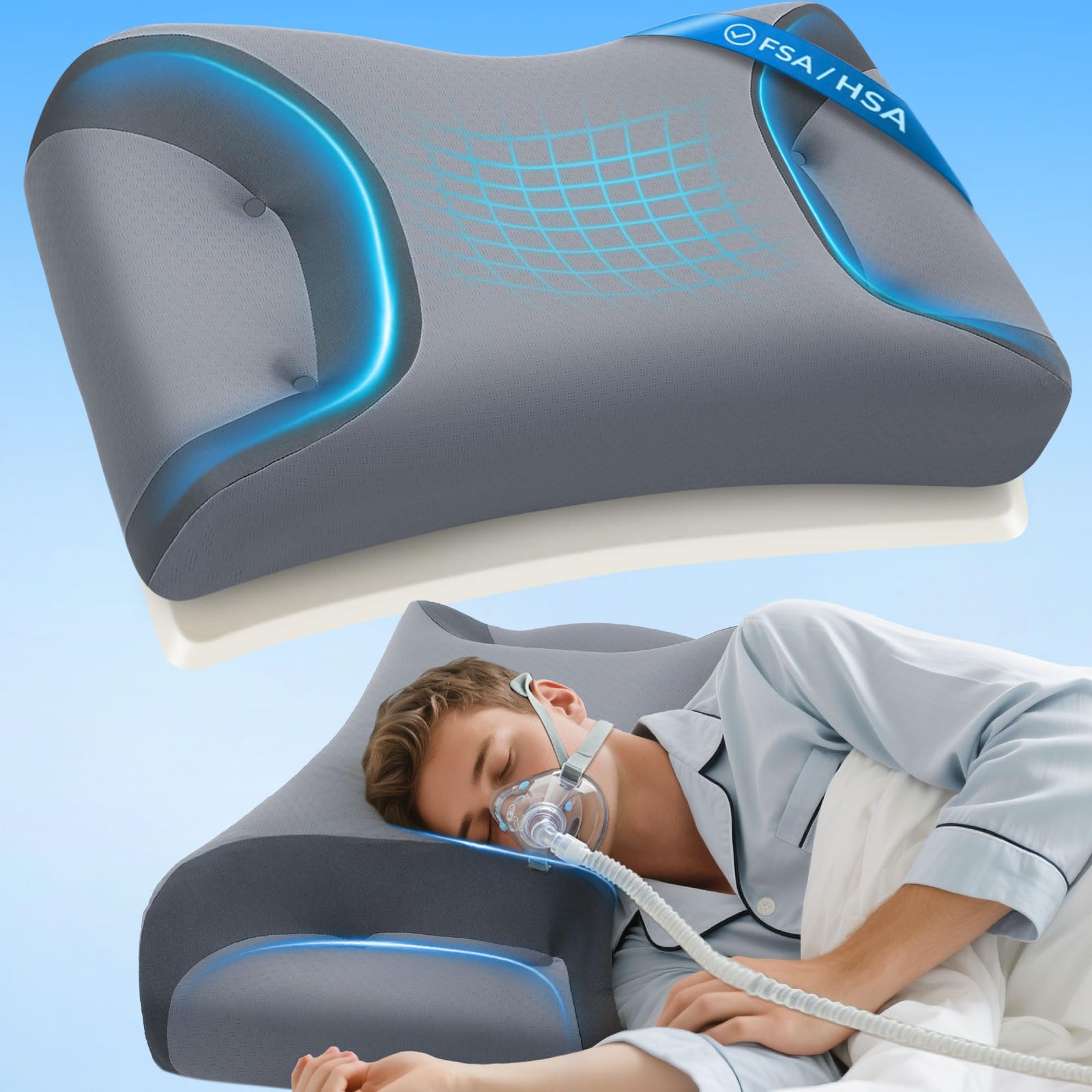
Lunderg CPAP Pillow
Key Features
- Loft: Adjustable with 1.1" removable layer
- Size: 21.65"L x 13.78"W
- Design: Two-sided contoured mask cutouts
- Pillowcases: 2 included
- Price: Premium
Mask leaks are what make CPAP nights miserable, and most of them start with the pillow. A standard pillow pushes the mask sideways the moment you roll onto your side, the seal breaks, and the machine ramps up to compensate. The Lunderg answers that with a contoured, two-sided shape — cutouts on both long edges, so whichever side you land on, the mask has somewhere to go instead of being pressed into your cheek.
What makes this the one we recommend first is the height adjustment. A 1.1-inch memory foam layer lifts out of the middle, so you can drop the loft for stomach sleeping or put it back for side sleeping without buying a second pillow. In our experience, the gap between a mask that stays put and one that doesn’t often comes down to half an inch, and this gives you the larger of the two adjustment ranges on this list.
The foam is dense and slow-rebound, firm on purpose, and that density is what keeps the cutout edges from collapsing onto the mask when your head settles. Two pillowcases come with it, one already fitted and one in a cooling fabric, so a clean case is always in the drawer instead of the laundry basket — a small thing that turns out to matter when you’re washing a case every few days.
Side sleepers with a full-face mask get the most from it. Back sleepers can use the cutouts too, but the payoff lands on the nights you turn over, which for most people is most nights.
Pros
- Cutouts on both sides work whichever way you turn
- Removable 1.1-inch layer adjusts the loft
- Two washable pillowcases included
- Dense foam holds the cutout edges open
Cons
- Firm, dense foam won’t suit soft-pillow sleepers
- Narrow 13.78-inch width leaves little room to sprawl
Our pick for anyone sleeping with a mask: cutouts on both sides give the mask somewhere to sit, and the removable layer tunes the height.
Best for Gentle Elevation
Kölbs Bed Wedge Pillow
Key Features
- Cover: Removable, machine washable
- Height: 7.5"
- Top layer: 1.5" memory foam
- Dimensions: 24"L x 24"W
- Price: Midrange
Height is where most wedge purchases go wrong, and 7.5 inches is the number that makes this one work. Across 24 inches of length it lifts your upper body on a shallow slope: enough of a rise to help with reflux and the kind of snoring that gets worse lying flat, shallow enough that you can still fall asleep on your side without feeling strapped into a recliner. The steeper wedges that prop you toward sitting are the ones that end up in the closet.
Under the cover it’s a high-density foam core with a 1.5-inch memory foam top — a modest amount of softness over something genuinely supportive. The jacquard cover unzips and goes in the washing machine, and the whole thing weighs about 3.7 pounds, light enough to flip to the foot of the bed in the morning or carry to a guest room. It reads as bedding rather than medical equipment, which matters for something that lives on the bed instead of under it.
Where this one stops is the mask. It raises your torso; it doesn’t open space around your face. If you sleep with CPAP, treat it as a companion to a contoured pillow rather than a replacement for one. For sleeping on an incline without a machine, though, it’s the easiest of the wedges here to live with, and the 24-inch square makes a decent reading prop during the day.
Pros
- Shallow 7.5-inch slope is easy to sleep on
- 1.5-inch memory foam over a supportive core
- Removable jacquard cover is machine washable
- Light enough to move or pack
Cons
- Dense core feels firm under just 1.5 inches of foam
The wedge we reach for first when someone wants elevation rather than mask clearance — gentle, washable, and easy to move from room to room.
Best for Snoring and Reflux
Sleepnitez 8-Inch Wedge
Key Features
- Cover: 60% Tencel, 40% polyester
- Height: 8"
- Dimensions: 27.2"L x 25.2"W
- Memory foam layer: 3.25"
- Price: Midrange
Most wedges are one uniform block of foam with a thin pad on top, and you feel every bit of that block through your shoulder. This one carries 3.25 inches of memory foam over its core, more than double what the Kölbs offers, and the difference shows up exactly where a hard wedge hurts: the shoulder you’re lying on, the hip taking your weight, and the tailbone.
The second design choice we appreciate is the front edge. It tapers down close to mattress level instead of ending in a step, so there’s no ledge digging into your lower back when you settle in or sit up. At 27.2 by 25.2 inches it’s wider than the other wedges here, which keeps it from going crooked overnight — though it also claims more of the mattress.
We keep this one in the roundup for a specific buyer: the person who tried a wedge, woke up sore, and gave up. It’s softer and it costs more, and the 8-inch height puts you a touch steeper than our gentle pick. The memory foam top is also why you may drift toward the foot over the night; a fitted sheet pulled tight over the whole thing gives the cover less to slide on.
Pros
- 3.25 inches of memory foam cushions shoulders and hips
- Tapered front edge blends into the mattress
- Wide 27.2-inch footprint resists going crooked
Cons
- The priciest wedge in this group
- 8-inch rise is steeper than a starter wedge
The most cushioned wedge here: thick memory foam and a taper that fades into the mattress, for sleepers who found hard wedges unbearable.
Best for Side Sleepers
IKSTAR CPAP Pillow
Key Features
- Size: 25.2"L x 14.9"W x (5.5"/4.7")H
- Cover: Removable, washable
- Cutouts: Larger mask cutouts
- Height insert: 2 cm
- Price: Midrange
Cutout size is the spec that decides whether a CPAP pillow works for you, and these are the larger of the two on this list. If you wear a full-face or hybrid mask, extra clearance is the difference between the mask resting in the hollow and the pillow nudging it every time you turn. The butterfly shape pairs that with a shallow center cradle and wings on either side, so you can roll without collapsing the seal.
A 2 cm insert pulls the loft down from 5.5 inches to 4.7, and we like that this one starts lower. Back and stomach sleepers often find a tall contoured pillow pushes the chin toward the chest; a lower profile keeps the neck closer to straight. The foam is listed as soft, and it feels forgiving against the cheek in a way the Lunderg doesn’t.
Where it gives ground is support and hardware. That softer foam does less to hold your head where you put it, and it ships with a single removable cover rather than two, so laundry day means the pillow takes a night off. The center cradle is also shallow — good for a side sleeper, less convincing if you want firm cervical support.
At 25.2 by 14.9 inches it’s wider than our top pick, which means more pillow to roll onto before you’re off the edge. Pair that with the bigger cutouts and it’s the one to try if you have a broad face or a mask with a hose that comes off the top.
Pros
- Larger cutouts suit full-face and hybrid masks
- Adjustable height drops to a low 4.7-inch profile
- Wider 14.9-inch surface than our top pick
Cons
- Softer foam gives less rigid head support
- Ships with one cover, not two
The CPAP pillow we point to when a full-face mask keeps getting shoved: bigger cutouts, a lower profile, and less money than our top pick.
Best for Steep Incline
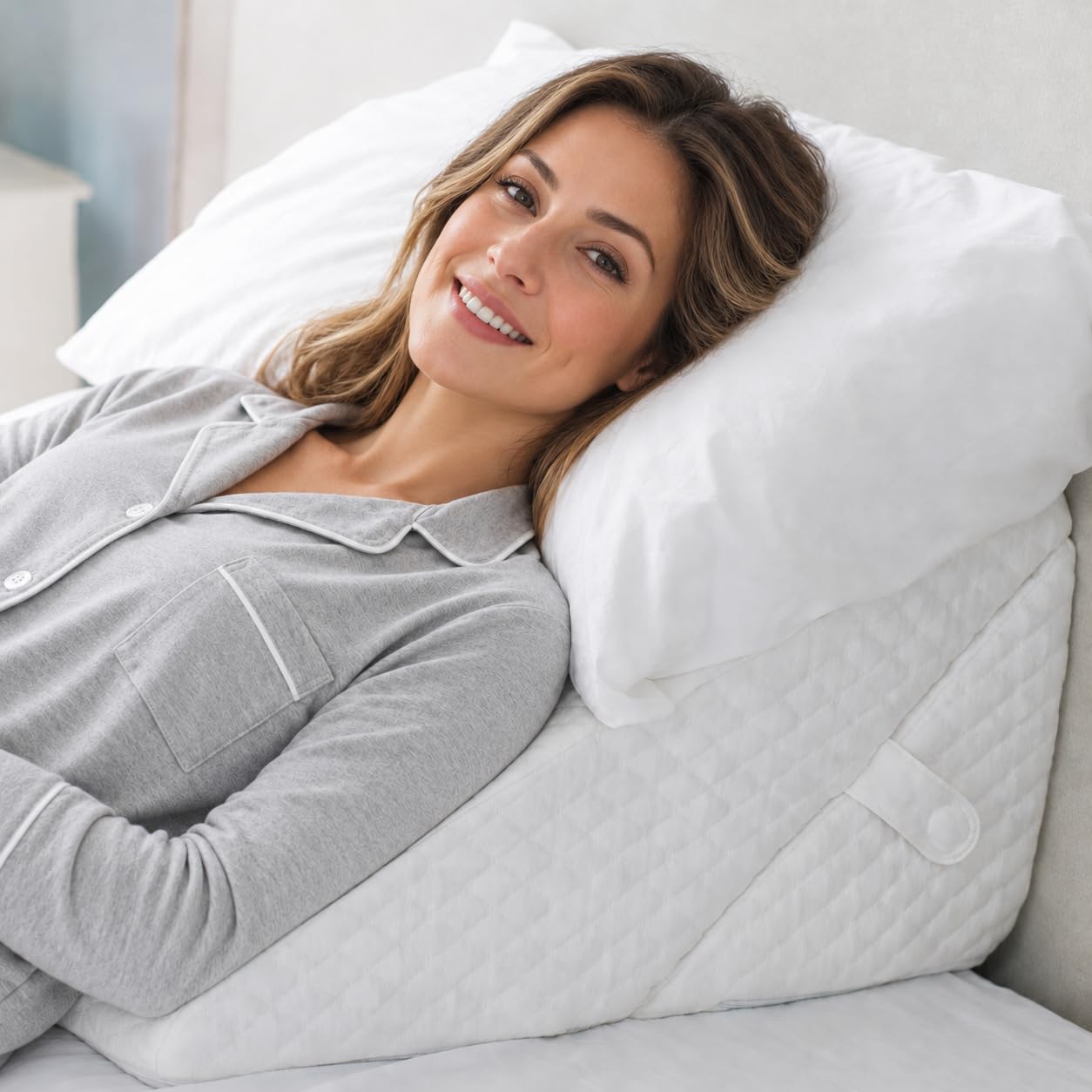
Bekweim Wedge Pillow
Key Features
- Fill: Memory foam over foam base
- Cover: Polyester, washable
- Height: 12" (reconfigures to 9")
- Dimensions: 22"L x 22"W
- Price: Budget
Twelve inches is a different category of elevation from the wedges above. Where the Kölbs and the Sleepnitez tilt you back at a shallow angle, this one raises your whole torso on a much steeper slope — the position people end up in when reflux, a bad cold, or a surgery recovery makes lying flat impossible. The same pillow reconfigures to 9 inches, which is the setting most sleepers will actually use night to night.
It’s a memory foam top over a supportive foam base, and the firmness is the point: a wedge that gives too much stops elevating anything. The polyester cover is cool to the touch and washes, and at about 7.3 pounds the whole thing stays where you put it, though it’s a two-hand job to move.
Our reservation is the footprint. At 22 inches square and a foot tall, it eats a real share of a full-size mattress and makes making the bed a small project. It’s firm enough, too, that side sleepers may find the edge unforgiving under a shoulder. On a queen or king where you need the height, those are trade-offs worth taking; on a narrow bed, go with the 7.5-inch Kölbs instead.
Pros
- 12-inch incline reconfigures to 9 inches
- Firm base holds the angle without flattening
- Washable, cool-to-the-touch polyester cover
- Lowest-priced pick in this group
Cons
- Firm surface with little give at the shoulder
- Bulky footprint takes up bed space
For a steep incline and a big bed: 12 inches of elevation that reconfigures to 9, with firm foam that holds the angle all night.
How We Tested Sleep Apnea Pillows
We started by rounding up every pillow sold specifically for apnea and reflux — several dozen listings — and filtering by shape, fill, adjustable height, and whether the cover came off for washing. That left twelve, which we bought at retail so we were testing exactly what shows up at your door.
Each one then lived on a tester’s bed for at least two weeks, with the full rotation running six months. Two of our testers wear CPAP every night, one in a full-face mask and one in a nasal mask, and both logged how often they woke to a leak, whether the mask cleared the cutout edge when they rolled from back to side, and how their neck felt at 6 a.m. Testers on adjustable-height models pulled out one layer at a time until the mask sat level. Our reflux tester slept on the wedges and noted whether she slid toward the foot of the bed by morning and whether the height pushed her chin toward her chest.
We measured loft with a ruler on night one and again at eight weeks to see what the foam did under a full night’s weight, and pressed a palm into each pillow to note whether it sprang back or stayed dented. Footprints got measured against a queen mattress so a wide wedge didn’t crowd out a partner. Every removable cover went through the wash three times at the temperature on its care tag, and we checked seams, pilling, and how much the foam smelled out of the box.
At the end we judged value with one question: would we buy this with our own money? We also flagged which pillows were FSA/HSA-eligible, since that changes the real cost for plenty of households. Everything that made the list is something we were still happy to sleep on in month six.
How to Choose a Sleep Apnea Pillow
The first decision isn’t firmness or height — it’s whether you sleep with a mask, because a CPAP pillow and an elevation wedge solve different halves of the same problem.
Start With the Mask
If you use CPAP, the pillow’s job is keeping the seal intact while you turn. That means contoured cutouts, so the mask sits in a hollow instead of being pressed sideways into your cheek — the Lunderg and the IKSTAR both do this, and the wedges don’t. If you don’t use CPAP, or you’ve been told to sleep elevated, a wedge raises your whole upper body and lets gravity help keep your airway open.
Buying the wrong type is the most common mistake here. A wedge won’t stop mask leaks, and a contoured pillow won’t do much for snoring on its own.
Match the Height to How You Sleep
Wedge heights cluster around 7.5 to 8 inches for a gentle incline and 12 inches for a steep one. Steeper is not more effective — it’s just the one fewer people can sleep on. If you’ve never used a wedge, start at 7.5 or 8 and give it a week before you decide.
Loft matters just as much on a contoured pillow: too tall and your chin drops toward your chest, too low and your shoulder takes the load. Both CPAP pillows here adjust, with a removable 1.1-inch layer on the Lunderg and a 2 cm insert on the IKSTAR, which is worth having if you’re between sizes.
Firmness: What Dense Foam Buys
Every pillow in this group draws some complaint about firmness, and there’s a reason: the same density that holds a cutout open or keeps a wedge from flattening also feels hard on the first few nights. Memory foam softens with body heat, so give it a week before you judge.
If you know you hate a firm surface, the Sleepnitez’s 3.25-inch foam layer is the most forgiving here. If the mask moving is your problem, choose the firmer contour and accept the break-in.
Covers, Cleaning, and Bed Space
These get washed more often than a regular pillow, since a mask rests against the fabric every night, so check that the cover comes off and whether a spare ships with it. The Lunderg includes two; the others come with one, and a 27-inch wedge cover isn’t something you’ll find at a linen sale.
Wedges are also big. A 24-inch square claims a real share of a full-size mattress, and the Sleepnitez’s 27.2 inches claims more. Measure the bed before you hand a foot of it over.
Frequently Asked Questions
Can a sleep apnea pillow replace my CPAP machine?
No. A pillow changes your sleeping position and, with the contoured designs, keeps a mask from being pushed off your face. It doesn’t hold your airway open the way positive pressure does. If you’ve been prescribed CPAP, keep using it.
What a pillow can do is make therapy easier to stick with. If you’re waking up to reseat a leaking mask, one of the cutout pillows is the fix; if you’re snoring without a machine, choose a wedge.
Can I use a regular pillowcase on one of these?
Not usually. Wedges run 22 to 27 inches square and the CPAP pillows are contoured with cutouts, so a standard case won’t sit flat on any of them. Use the cover that comes with the pillow and buy a spare from the same maker.
The Lunderg already includes a second case, which is part of what you’re paying for at the top of this list.
Are sleep apnea pillows FSA or HSA eligible?
Several of these are sold as eligible — the Kölbs, Sleepnitez, IKSTAR, and Bekweim all state FSA or HSA eligibility. Pay with your benefits card at checkout and keep the receipt in case documentation is requested.
The product page isn’t the final word, though: your plan sets the rules. Confirm with your plan administrator before you buy.
Final Verdict
The Lunderg is the pillow we recommend to anyone sleeping with a mask. Two-sided cutouts and a removable layer solve the two things that break CPAP nights — a mask shoved sideways and a loft that’s wrong for your position — and it stays useful as your sleep position changes.
If you’re not on CPAP, or you want elevation on top of therapy, the Kölbs is the better buy: a 7.5-inch incline gentle enough to fall asleep on, with a washable cover and a fraction of the bulk. Need a much steeper angle and have a queen bed to spare? Take the Bekweim at 12 inches.