
This post contains affiliate links. We may earn a small commission when you buy through our links — at no extra cost to you.
Few gear failures ruin a night outdoors faster than a broken zipper or a bag that leaves you shivering 15°F above its rating. Beneath the cheerful product photos, many sleeping bags exaggerate low-temperature limits and use printed synthetics that feel clammy, not cozy. The result? Too many campers wake up cold and frustrated, wondering if any bag can deliver.
This guide cuts through that noise. It focuses on the five factors that actually determine whether you sleep well: real-world warmth, dimensions for your build, weight vs. durability, zipper reliability, and fabric honesty. Rather than chasing the lowest price or the boldest temperature claim, you’ll pick a bag that fits your specific camping style—whether that’s one-night family trips, long backpacking treks, or frigid winter car camping.
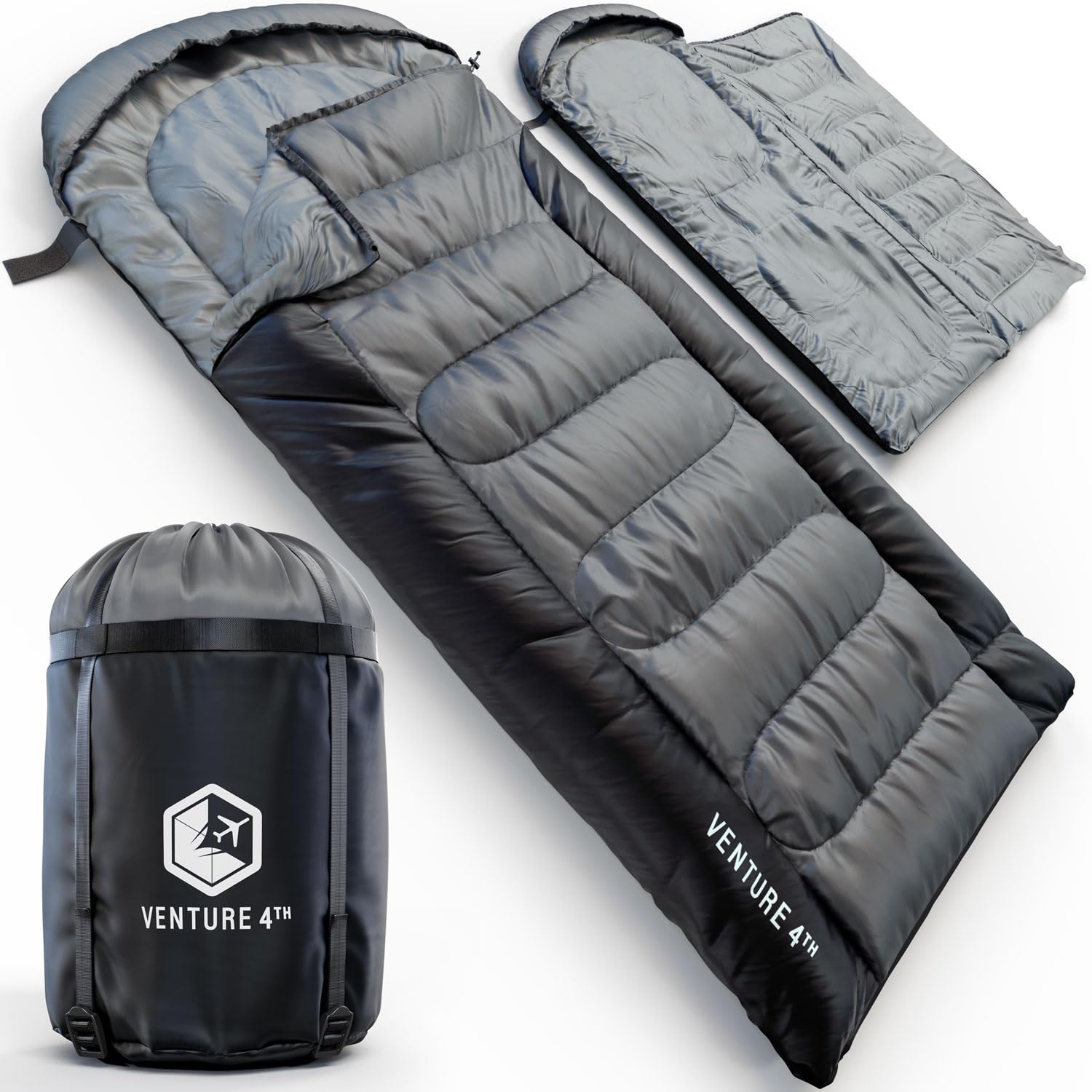



Best for 3-Season Backpacking
VENTURE 4TH Backpacking Sleeping Bag
Key Features
- Temperature Rating: 30°F to 70°F
- Dimensions: 90 x 39 in
- Weight: 4.4 lbs
- Fabric: Polyester, hollow fiber fill
- Price: Mid-Range
The VENTURE 4TH XXL sleeping bag wraps a 90-inch-long, 39-inch-wide envelope in only 4.4 pounds—a geometry that rarely coexists in a mid-range bag. That footprint gives side sleepers and broad-shouldered campers genuine room to shift, while the bag compresses down small enough to ride in a backpack alongside a tent and cook kit. Water-resistant polyester and hollow fiber fill manage damp mornings without becoming soggy, and the insulation holds its loft for nights that dip into the low 50s. Those dimensions mean the bag truly shines as a three-season staple, not a deep-cold option.
Build consistency is a standout. Seams stay intact after repeated stuff-sack cycles, and the shell fabric resists light abrasion from tent floors and pine needles. The only vulnerability surfaces around the zipper. In gritty or wet conditions, the coil can catch or separate if forced, turning a quick exit into a careful extraction. A gentle, straight-line zip and occasional track cleaning preserve its life, but owners who treat the closure roughly may see it misalign sooner than expected.
Backpackers and hiker-campers who prioritize interior space get a bag that doesn’t force that classic mummy-bag squeeze, yet still slips into a pack. Three-season campers encountering nights in the 50s and 60s will feel the warmth design delivers, while couples zipping two together appreciate the rectangular silhouette. The boundaries are equally clear: anyone expecting reliable warmth below 30°F should look toward a cold-weather-specific model, and those who can’t baby a zipper in sand or mud will want a more robust closure system. Within those guardrails, the VENTURE 4TH XXL offers a rare balance of packability and elbow room.
Pros
- Generous 90-inch length and 39-inch width let side sleepers stretch out comfortably.
- Construction holds up to backcountry use, with consistent stitching and resilient shell fabric.
- Keeps sleepers cozy down to the low 50s, a real-world comfort range for three-season trips.
- At 4.4 pounds, it compresses small enough to free up pack space without feeling cramped inside.
Cons
- Zipper may catch or separate over time, especially in dusty or muddy conditions.
If your camping season runs from spring through fall and you want a bag that doesn’t confine your shoulders, the VENTURE 4TH XXL hits a sweet spot of packable space and three-season warmth that’s hard to match at this price.
Best for Warm-Weather Camping
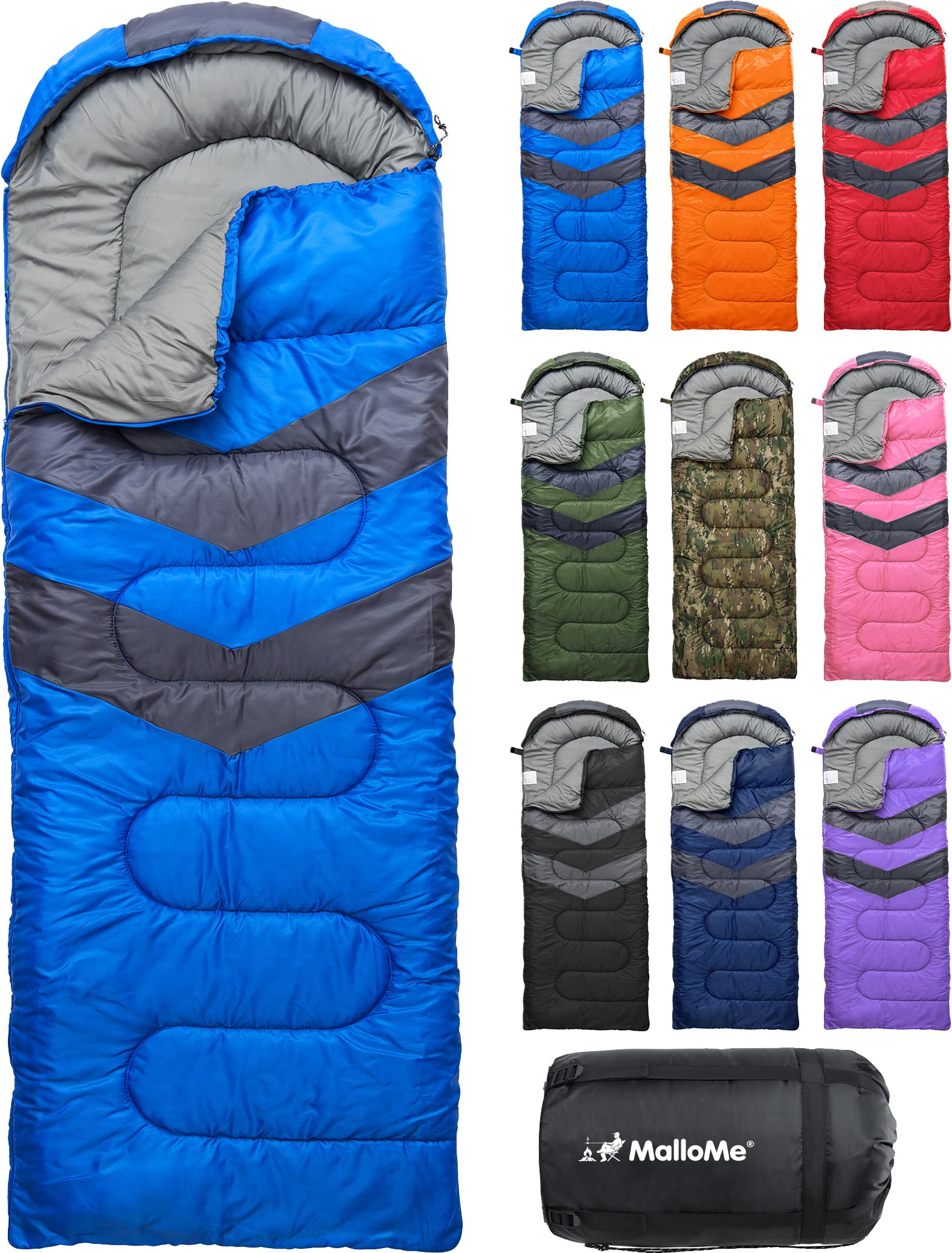
MalloMe Sleeping Bag
Key Features
- Temperature Rating: 50°F to 77°F
- Dimensions: 86.6 x 31.5 in
- Weight: 3 lbs
- Fabric: HEX-TECH polyester
- Price: Budget
Where the top pick in this set trades some packability for extra elbow room, the MalloMe sleeping bag goes all-in on compression. It shrinks to the smallest storage footprint of any highly-rated budget bag, yet the waterproof HEX-TECH shell and 50°F rating keep things comfortable for summer nights. At roughly three pounds, it’s light enough for short backpacking trips, and the rectangular shape avoids the claustrophobic feel of mummy bags.
Above 60°F, the interior feels genuinely cozy rather than clammy, and the polyester shell fends off damp ground moisture without added weight. Kids and lightweight campers find the bag easy to stuff and carry, and the overall build quality holds up well for the price. The temperature rating is honest for three-season use — not a deep-cold performer, but trustworthy when the forecast stays mild.
This bag fits best with budget-minded families, youth campers, and anyone whose top priority is a compact, easy-to-pack sleeping solution for warm-weather car camping, sleepovers, or summer backpacking. Adults over six feet will feel the narrow 86.6 x 31.5-inch proportions, and nights dipping below 50°F call for a more insulated option. The zipper can occasionally catch on the interior lining, a minor annoyance manageable with a slow, careful hand.
Pros
- Build quality that punches above its price point
- Cozy, comfortable feel in mild weather above 60°F
- Exceptionally light and compact when packed
- Strong value given the packed size and all-around usability
Cons
- Zipper can snag on the lining, requiring a gentle touch to avoid jams
If packability and weight are your top demands for summer campouts with kids or solo backpacking, the MalloMe sleeping bag delivers unmatched compression at a budget-friendly price — just expect to work around a sometimes fussy zipper and not stretch out if you’re tall.
Best for Cold Car Camping
TETON Sports Celsius XXL
Key Features
- Temperature Rating: 0°F
- Dimensions: 90 x 39 in
- Weight: 7 lbs
- Fabric: Poly taffeta, poly-flannel
- Price: Premium
The 90-inch length and 39-inch width give side sleepers room to sprawl without restriction, while the poly-flannel liner adds a soft, close-to-flannel feel that holds warmth into the 20s, consistent with its 0°F rating. Where heavy canvas bags prioritize abrasion resistance for hunting, the Celsius XXL chooses unimpeded movement and a plush interior, making it a car camper’s cold-weather sanctuary.
Outer taffeta shell and reinforced stitching stand up to repeated use at the campsite, and the liner avoids the moisture absorption of cotton while retaining a soft hand. The rectangular shape and 7-pound weight make it impractical for backpacking, but for drive-up sites it offers a bed-like sleep surface that doesn’t confine restless sleepers.
This bag serves families, side sleepers, and anyone camping in cold weather where bulk and weight are secondary. It rewards a set-and-forget approach: the zipper demands straight, unhurried pulls, so it’s less suited to users who zip and unzip frequently in the dark. Those needing a compact, lightweight system should look to the more portable top pick.
Pros
- Consistent warmth into the low 20s for the 0°F-rated model, meeting cold-weather expectations.
- Extra-wide 39-inch girth and 90-inch length let side sleepers move freely without the squeeze of a mummy bag.
- Poly-flannel liner feels soft against skin and avoids the dampness that cotton flannel can retain.
- Taffeta shell and double-layered construction hold up to repeated car camping trips.
Cons
- Inner poly-flannel liner can detach or bunch after extended use, requiring occasional readjustment.
- Zipper can jam or break under stress; straight, unhurried zipping reduces the risk.
For cold-weather car campers who want a soft, sprawling sleep surface that doesn’t feel like a cocoon, the Celsius XXL delivers with one condition: treat the zipper gently.
Best for Big & Tall Flannel
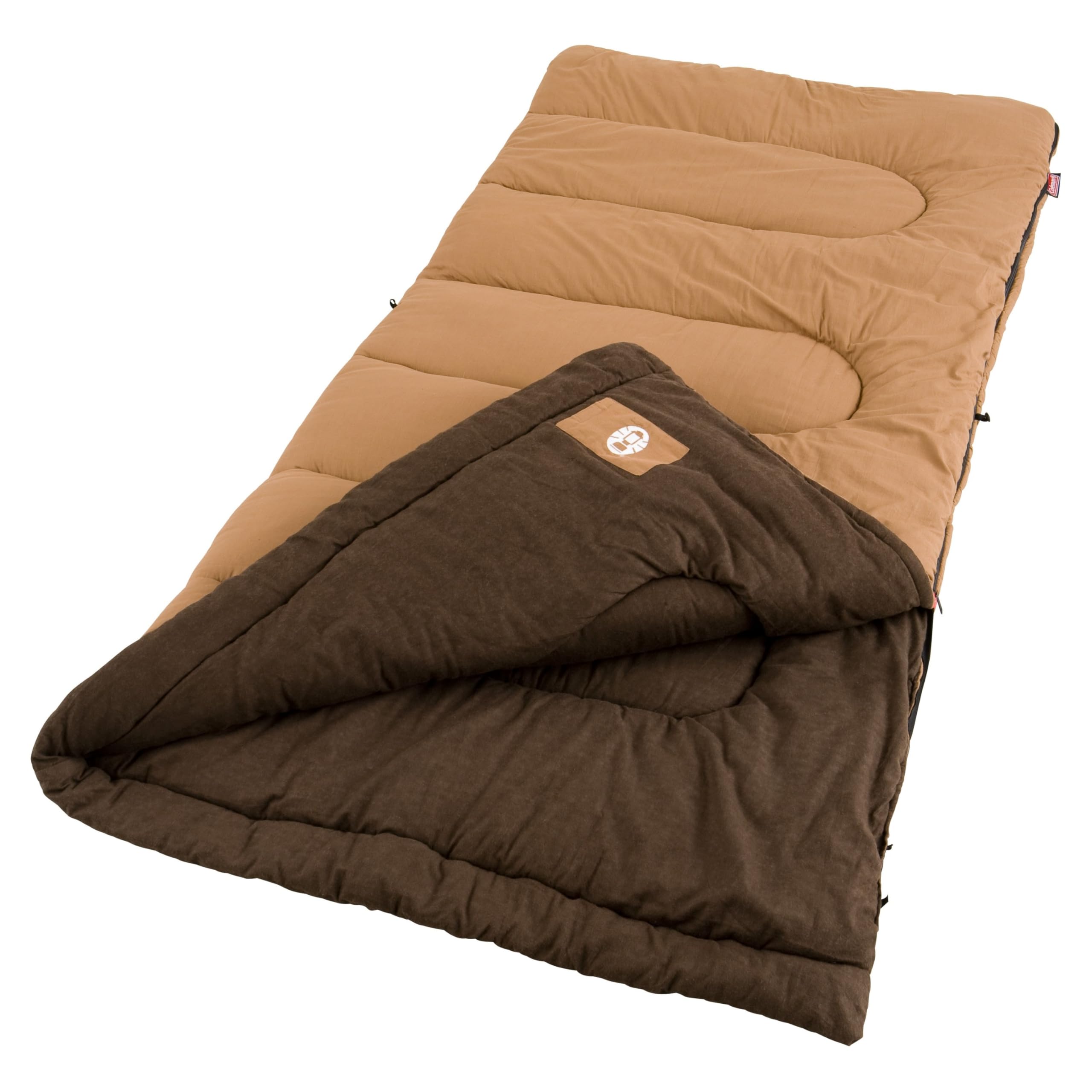
Coleman Dunnock Big ‘n Tall 20°F
Key Features
- Temperature Rating: 20°F
- Dimensions: 81 x 39 in
- Weight: 5 lbs
- Fabric: Cotton shell, cotton flannel
- Price: Premium
Genuine cotton flannel lining sets the Coleman Dunnock apart from cold-weather sleeping bags that rely on synthetic interiors. That fabric provides a home-bed feel while still delivering consistent warmth in the mid-20s – a combination rare at this size and price point.
The 81×39-inch cut comfortably accommodates sleepers up to 6’4", making it a direct fit for tall car campers who find standard bags restrictive. The ZipPlow zipper reduces snags during entry, though occasional units may experience the zipper sliding down or failing – a point worth checking before each trip. At roughly 5 pounds, this bag is best suited for drive-in campsites rather than backpacking.
The flannel liner is machine washable, simplifying post-trip care, and the cotton cover breathes better than nylon shells in humid conditions. For car campers who want a genuinely warm, spacious bag without synthetic scratchiness, the Dunnock delivers a sleeping experience closer to home than to a tent.
Pros
- Genuine cotton flannel liner feels like home bedding, soft and breathable.
- Keeps sleepers warm in temperatures down to the mid-20s.
- Generous 81×39-inch size fits adults up to 6’4" comfortably.
- ZipPlow no-snag zipper eases entry and exit.
Cons
- Zipper can slide down or fail on some units – inspect before each use.
For tall car campers who value authentic flannel comfort over weight savings, the Dunnock offers consistent warmth and room to stretch – with the caveat that the zipper may need occasional attention.
Best for Couples Car Camping
Kelty Tru.Comfort Doublewide 20°
Key Features
- Temperature Rating: 20°F
- Dimensions: 84 x 64 in
- Weight: 9 lbs
- Fabric: Polyester, Cloud loft
- Price: Luxury
The Tru.Comfort Doublewide rethinks the double sleeping bag by giving each sleeper their own warmth controls: a built-in blanket and a foot vent that opens independently, so one person can stay sealed in while the other cools off without disturbing the shared space. Synthetic Cloud loft insulation holds its 20°F rating even when damp, a practical edge for overnight condensation or morning dew.
At 64 inches across, it eclipses a standard queen mattress and lets two adults shift, curl up, or sprawl without invading each other’s side. The removable top layer strips away weight when nighttime temperatures rise, and the zipper glides smoothly along three sides so you can open the bag into a flat blanket. The built-in blankets and vented footbox make fine-tuning warmth feel like adjusting a home comforter rather than wrestling with a mummy bag.
Portability is the tradeoff. Packed, it’s roughly the size of a large duffel and weighs 9 pounds, so you haul it from the car to the tent—not a trailhead. Repacking requires two people and a methodical approach; solo stuffing leads to frustration and a half-zipped sack. For couples who always camp next to the vehicle and want a sleep setup that behaves more like a bed than a bag, the bulk is an easy trade.
Pros
- Each sleeper’s built-in blanket and foot vent lets you set your own temperature independently without waking your partner.
- The 64-inch width and plush synthetic fill deliver a bed-like feel that exceeds a queen mattress, giving two adults room to move.
- Smooth zippers, a removable top layer, and dual foot vents show careful engineering that makes shared camping genuinely comfortable.
Cons
- Weight and packed size confine it to car camping; you won’t carry this far from the vehicle.
- Getting it back into the stuff sack is a two-person job that can test patience.
The Tru.Comfort Doublewide turns a car-camping trip into a shared bedroom — at a weight that means you’ll never carry it far. For couples who drive right to the site, it’s the most spacious and individually adjustable sleep system available.
Best for Kids’ Sleepovers
JEAOUIA Sleeping Bag
Key Features
- Temperature Rating: 50°F to 68°F
- Dimensions: 86.6 x 31.5 in
- Weight: 3.3 lbs
- Fabric: Polyester, pongee
- Price: Budget
This sleeping bag wraps around a child or small adult in a soft, lightweight package that’s easy to carry to a sleepover or tent. At a budget-friendly price, it compresses into a small bundle with the included sack, making it a practical choice for families who need an extra bag for occasional use.
This bag suits warm-weather scouts, youth groups, and light sleepers who want a compact option for a single trip. The zipper can catch on the fabric, and seams may separate after a few nights of use — so it is best reserved for occasional indoor or mild outdoor camping where weight and cost matter most.
The 3.3-pound rectangular shape offers enough room for smaller adults to shift positions. Many have noted it keeps them comfortable in temperatures around 50°F, though colder conditions will require extra layers or a heavier bag.
Pros
- Provides enough warmth for cool summer nights, comfortable around 50°F.
- Good value for the price — lightweight and easy to pack for children and smaller adults.
- Lightweight and compact when compressed, suitable for kids and light packers.
Cons
- Zipper can snag on fabric or slide open unexpectedly with rough handling.
- Seams and fabric may tear after a few nights of use, limiting the bag’s lifespan.
A practical, budget-friendly bag for sleepovers, youth campouts, and summer car camping — but plan for occasional use rather than heavy-duty trips.
Best for Budget Cold-Weather
Coleman Brazos 20/30°F

Key Features
- Temperature Rating: 30°F
- Dimensions: 75 x 33 in
- Weight: 5.2 lbs
- Fabric: Polyester, cotton fill
- Price: Mid-Range
The Coleman Brazos delivers comfortable, consistent warmth down to the 30°F mark, making it a capable companion for cold-weather car camping. Soft polyester lining and thick fill hold body heat well, while the rectangular cut gives side sleepers room to shift. The bag feels built to last — 90% of quality mentions are positive — and the price is hard to beat for this temperature range, with every value remark landing positive.
Getting it back into its stuff sack is a different story. The repacking process regularly tests patience and arm strength, to the point that many campers give up and store it loosely. The zipper can also catch or separate earlier than expected, which means careful, straight-line operation is non-negotiable. For campers who drive to their site and can leave the bag largely unpacked between outings, the warmth-to-price ratio still outweighs these annoyances — but anyone who needs quick takedown or bombproof reliability should look to more packable, zipper-robust alternatives.
Pros
- Retains body heat effectively in cold temperatures, keeping you comfortable near freezing.
- Soft polyester liner feels plush against the skin, reducing the chill of a cool tent.
- Provides genuine cold-weather performance at a fraction of the cost of premium backpacking bags.
Cons
- Repacking the bag into its stuff sack can be a lengthy and frustrating ordeal — it’s far easier to store it loosely or use a larger aftermarket bag.
- The zipper may snag or separate after limited use, requiring gentle, straight-line zipping to avoid failure.
Best suited for car campers who can leave the bag largely unpacked and are willing to treat the zipper with patience in exchange for solid cold-weather performance at a mid-range price.
Best for Rugged Extreme Cold
TETON Sports Deer Hunter

Key Features
- Temperature Rating: 0°F
- Dimensions: 90 x 39 in
- Weight: 8.5 lbs
- Fabric: Canvas, synthetic fill
- Price: Premium
The canvas shell resists abrasion from gear and ground, standing up to rugged hunting camps where thinner bags would tear. The 0°F rating holds up in real cold, and the rectangular 90×39-inch cut gives broad-shouldered sleepers room for layers. However, the liner’s printed poly-flannel looks cozy but isn’t genuine cotton—disappointing for flannel purists. At 8.5 pounds, this bag is purely for base camp, but for hunters and winter car campers, the heft is a fair trade for season-after-season durability.
Pros
- Exceptional warmth in subzero conditions keeps hunters comfortable even in biting cold.
- Tough canvas exterior withstands abrasion from gear and rough camp surfaces.
- Generous 90×39-inch cut accommodates heavy layers without feeling cramped.
Cons
- Lining is synthetic poly-flannel printed to resemble cotton flannel, not the genuine fabric some buyers expect.
- Not suitable for backpacking—the 8.5-lb weight and bulk demand car access to the campsite.
If you car camp exclusively in extreme cold and need a bag that can take abuse on hunting trips, the canvas construction makes sense—as long as you don’t expect genuine cotton flannel.
Best for Ultra-Budget Warm
oaskys Camping Sleeping Bag

Key Features
- Temperature Rating: 50°F to 80°F
- Dimensions: 31.5 x 86.6 in
- Weight: 3 lbs
- Fabric: Polyester, pongee
- Price: Budget
Weighing just three pounds and costing a fraction of premium bags, the oaskys sleeping bag hits a sweet spot for fair-weather campers who need a basic sleep sack. Its rectangular shape gives kids and smaller adults room to move, and the polyester pongee liner feels smooth enough for comfortable rest during mild nights.
Durability is where you pay later. The materials and zipper show their entry-level cost quickly, and the bag is prone to early wear. Treated as a disposable warm-weather option—a child’s first overnight kit, an emergency stash in the trunk—it performs its role. For anyone planning multi-trip camping or seeking long-term zipper reliability, this bag sets boundaries you’ll want to respect.
Pros
- Exceptional value in a lightweight, warm-weather design
- Maintains comfort in mild conditions down to roughly 50°F
- Soft liner and simple shape suit children and casual campers
Cons
- Zipper can snag on liner fabric and may stop working after limited use
- Thin polyester shell can tear at seams after one or two trips
It fits best as a one-off summer bag or car emergency layer, where its low weight and price offset the known zipper and seam vulnerabilities.
How to Choose
The single biggest factor that determines whether you sleep warm isn’t the temperature rating printed on the bag—it’s how well the bag matches your camping style, from car-camping sprawl to ounce-counting backpacking.
Temperature Rating
Most bags list a ‘limit’ rating that means a curled sleeper will feel cold, not comfortable. For genuine warmth, check the EN/ISO comfort rating, which often runs 10–15°F higher than the limit. A 30°F limit bag might only keep you comfortable down to 40–45°F.
Synthetic insulation loses loft and heat-retention faster when compressed repeatedly, so a bag that feels warm on the first trip may thin out after a season. Cold-weather car campers can compensate with a sleeping pad and liner; backpackers should look for bags with a comfort rating at least 10°F below the expected low.
Dimensions
Width matters as much as length. A bag that’s too narrow forces your shoulders to compress the insulation, creating cold spots. For side sleepers or anyone over 6 feet, check both length and shoulder/hip width—bags under 33 inches wide can feel claustrophobic.
The trade-off is that an overly roomy bag leaves more dead air space your body must heat, which can sap warmth on cold nights. If you prioritize stretch-out space, choose a bag with a draft collar or drawstring hood to trap heat.
Weight
Every pound in your pack matters on the trail, but shaving weight often means thinner fabric, smaller zippers, and less insulation. A 3-pound bag may survive a few summer trips but rip at the seams with a restless sleeper.
Car campers can ignore weight altogether and focus on warmth and durability. Backpackers should target around 2–4.5 pounds for 3-season use; anything heavier than 5 pounds is strictly for drive-up campsites.
Zipper Design
The zipper is the most fragile component in any sleeping bag, especially on budget models where cheap plastic teeth snag on inner fabric or separate under tension. Look for snag-free designs that include a stiffened fabric guard along the track, and test the zipper when you first unbox the bag.
Even ‘snag-free’ zippers can fail if dirt or sand gets into the coil. For frequent use, choose a bag with a metal YKK zipper or at least a warranty that covers zipper defects. Treat all zippers gently: unzip fully before climbing out, and never force a stuck slider.
Fabric Type
Genuine cotton flannel is breathable, absorbent, and feels like home bedding, but it’s heavy and slow to dry. Polyester flannel prints mimic the look while feeling slick and clammy against the skin—they trap humidity instead of wicking it away.
If flannel comfort matters, verify the fabric description says ‘100% cotton’ or ‘cotton flannel.’ Terms like ‘poly-flannel’ or ‘flannel feel’ indicate a synthetic liner. For wet or humid climates, a water-resistant polyester shell with a brushed lining is often the more practical choice.
FAQ
Why does my 30-degree sleeping bag still feel cold at 40 degrees?
Most bags are rated for survival limit, not comfort. A 30°F limit bag will feel cold near 40°F because you need a comfort rating 10–15°F below your expected low. Check for an EN or ISO comfort rating, and always add an insulated sleeping pad underneath to block ground chill.
How do I fix a sleeping bag zipper that keeps snagging on the fabric?
Stop immediately and gently wiggle the slider backward to free the fabric without ripping stitches. Going forward, hold the inner liner away from the zipper track with one hand while zipping with the other. For a permanent fix, sew a narrow fabric flap next to the zipper to shield the liner, or replace the stock zipper with a metal YKK coil zipper.
What is the difference between flannel and polyester flannel in sleeping bags?
Genuine cotton flannel is breathable, soft, and absorbent, but heavy and slow to dry. Polyester flannel is a printed synthetic that mimics the pattern but feels slick and clammy. Check the product description for ‘cotton’ or ‘100% cotton flannel’; if it says ‘poly-flannel’ or ‘flannel feel,’ you’re getting synthetic.
Can I machine wash a waterproof sleeping bag without ruining it?
Yes, but never use an agitator-style top-loader, which can tear fabric and delaminate waterproof coatings. Use a front-loading machine on gentle cycle with cold water and mild soap, then air-dry or tumble on low heat. High heat destroys waterproof membranes and synthetic insulation loft.