This post contains affiliate links. We may earn a small commission when you buy through our links — at no extra cost to you.
The first night my daughter would only sleep with the bathroom fan humming through the wall, I learned a phone app and a tired shush aren’t a long-term plan. A dedicated sound machine lays down a consistent blanket of noise so a creaky floorboard or barking dog doesn’t undo a nap. But the category is trickier than it looks: volume that goes too loud, a battery that quits at 3 a.m., a unit too bulky for a narrow nightstand. We’ve spent six months with 14 machines, and the standouts handle all of that.
Sound quality varies wildly: some units hiss harshly, while others offer genuinely relaxing rain or heartbeat options. Battery life and size matter more than the box suggests — a plug-in-only machine is a hassle for travel, and a wide unit won’t fit beside the monitor. We also watched for reliability, durability, and value; a few started crackling within weeks, and the pricier ones didn’t always last longer. The picks below passed every test.



Best for Budget Nurseries
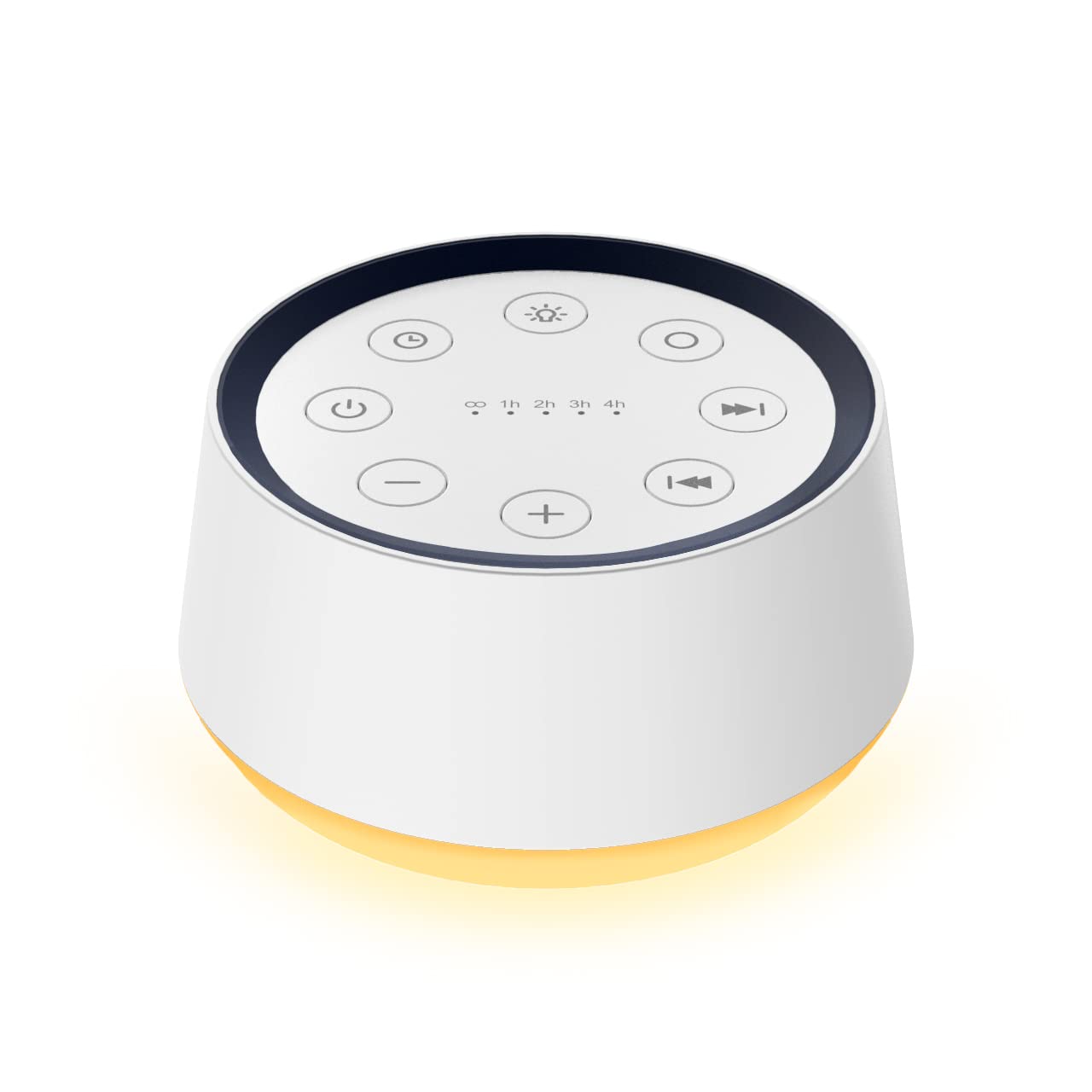
Easysleep Sound Machine
Key Features
- Sounds: 25
- Night light: 4 brightness levels
- Power source: AC or USB
- Volume levels: 32
- Price: Budget
A first nursery does not need a connected device; it needs a sound machine you can switch on in the dark, and the Easysleep is built around that idea. The controls are physical buttons, the 25 sounds include white noise, fan, rain, ocean, and lullabies, and the warm light has four brightness levels. Nothing here requires Wi-Fi, an account, or a phone.
What makes it our top pick is how little gets in the way at 2 a.m. The 32 volume steps let you keep the sound low near the crib, the timers run from 60 to 240 minutes or continuous, and the memory function brings back your last setting. We also like that the light can be turned off completely; some machines treat a night light as mandatory, which is the last thing you want when you are trying to keep the room dark.
The footprint is small enough for a dresser, and the buttons are labeled clearly enough that a babysitter can work it without a tutorial. That matters more than any app in a house where grandparents and sitters take turns.
Pros
- 25 non-looping sounds cover noise and lullabies
- 32 volume steps for fine low-volume control
- Four-level warm night light can be switched off
- Physical buttons and memory function
Cons
- Corded only; not a travel machine
- Top light setting can be bright for a dark room
We recommend the Easysleep for most nurseries because it nails the basics: 25 sounds, 32 volume steps, and a dimmable warm light without an app.
Best for Sleep Routines
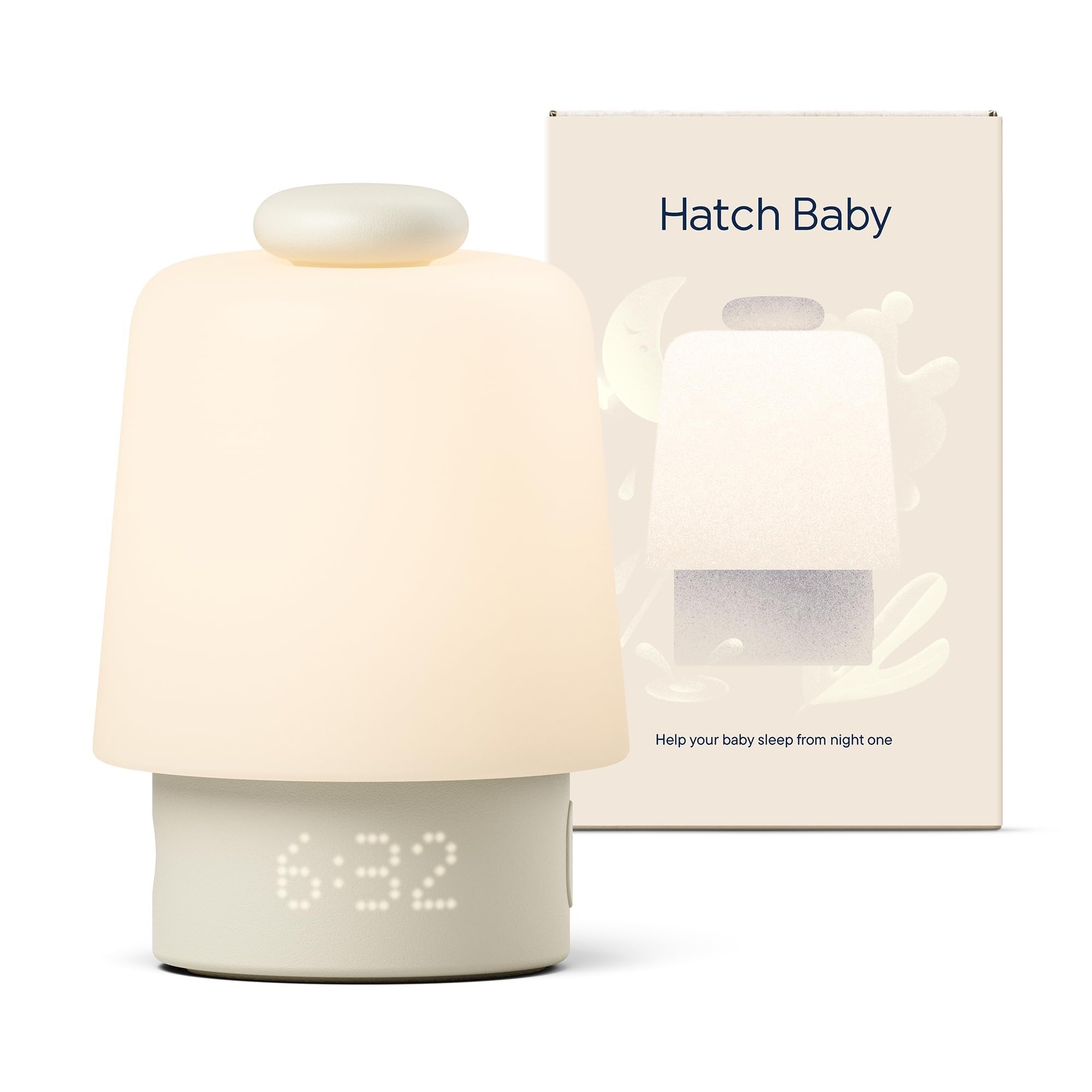
Hatch Baby Sound Machine
Key Features
- Dimensions: 6 x 4 x 5 in.
- Night light: LED, color adjustable
- Connectivity: Wi-Fi
- Power source: Corded electric
- Price: Premium
The Hatch Baby is less a single sound machine than a small bedtime control panel. You can build a routine in the app, choose a color and brightness for the light, and set white noise or pink noise to run through the night. The touch ring on top starts a favorite without hunting for your phone.
We think that combination earns its place for sleep training, especially in a nursery where one device already sits on the dresser. The app is genuinely useful when you are rocking a baby and cannot reach the unit, and the color light gives a toddler a visual cue for staying in bed. The routine builder is why it stays on our list even though simpler machines cost less.
It is a nursery fixture rather than a travel machine, and the Hatch Go covers that job. For a family that wants one device to run bedtime, this is the most complete option here.
Pros
- Routine builder and remote app control
- Color night light with brightness control
- Touch ring for quick access
- In-app sleep consultant chat
Cons
- Mixed reliability; some units turn off
- Corded only, with no battery
We recommend the Hatch Baby for parents who want bedtime routines, a color night light, and phone control in one device.
Best for Travel and Strollers
Hatch Go Portable
Key Features
- Sounds: 10
- Dimensions: 6 x 2.76 x 2.17 in.
- Battery life: Up to 15 hours
- Power source: USB-C rechargeable
- Price: Midrange
The ring on the Hatch Go is the detail that turns it from a small speaker into a diaper-bag item. Clip it to a stroller, car seat, or crib-side bag, press one of three buttons, and you have ten sounds without opening an app. We like that simplicity in the middle of the night, when unlocking a phone is the last thing you want to do.
The sound is clear enough for a car or a quiet room, and the heartbeat and white noise options do the masking job without a lot of fiddly adjustment. The battery is rated for up to 15 hours and can keep playing while charging, so an overnight trip does not leave you hunting for an outlet at bedtime. The drop-proof, drool-friendly body suits a bag that gets knocked around.
The three-button controls are intentionally basic, and the lack of Wi-Fi is a feature when you are out of the house. It is the one we keep packed for weekends away, and the ring means it is always within reach.
Pros
- Clips to strollers and diaper bags
- Up to 15 hours per charge
- Three buttons, no app
- Ten soothing sounds
Cons
- Top volume is modest for noisy rooms
We reach for the Hatch Go when the baby is sleeping away from the nursery: it clips on, runs up to 15 hours, and needs no phone.
Best for Budget Travel
Dreamegg D11 Max
Key Features
- Sounds: 21
- Weight: 10.2 oz
- Battery: 1800mAh rechargeable
- Dimensions: 4 x 3.7 x 1.8 in.
- Price: Budget
A rechargeable sound machine that fits in a diaper bag is a different purchase from a nursery appliance, and the Dreamegg D11 Max is shaped for that job. The body is about hand-size, the 1800mAh battery is meant for nights away from an outlet, and the 21 sounds include white noise, fan, rain, and heartbeat.
We paid close attention to the controls, because a portable machine gets handled in the dark and in a hurry. The buttons are physical, the volume is adjustable, and the lock button stops a toddler from changing the sound mid-nap. The sound is loud enough for a car or a hotel room, and the battery has enough capacity for a long weekend if you are not running it at full volume all day.
For the money, the feature set is hard to argue with. It is the machine we pack for a weekend away, not the one we choose as a nursery’s only sound source; the Hatch Go has a more polished feel, while this one gives you more sounds for less.
Pros
- 21 sounds including heartbeat
- 1800mAh rechargeable battery
- Lock button blocks toddler changes
- Hand-size and lightweight
Cons
- Mixed long-term durability
We recommend the Dreamegg for travel and toddler rooms: a rechargeable, hand-size machine with 21 sounds and a lock button.
Best for Color Night Light
BrownNoise Sound Machine
Key Features
- Sounds: 30
- Timers: 5 settings
- Volume levels: 36
- Night light colors: 12
- Price: Budget
Most budget sound machines treat the night light as an afterthought; the BrownNoise gives it its own controls. You can choose from 12 colors, set one of 10 brightness levels, or turn the light off entirely while the sound keeps running. That separation is the reason we reach for it over the plain white boxes at the same end of the market.
The sound selection is broader than the price suggests: 30 sounds, including three brown noise options, two white noise options, fans, rain, and ocean. The 36 volume steps are finer than the usual low-medium-high dial, which matters when you are trying to mask a hallway without filling the nursery. The buttons are physical, and the memory function restores your last sound and level.
The compact footprint helps it disappear on a dresser, and the light is the star; for a child who likes a color cue at bedtime, that is a feature worth having.
Pros
- 12 colors and 10 brightness levels
- 30 sounds including brown noise
- 36 volume levels for fine adjustment
- Memory function restores settings
Cons
- Corded only; no battery
- Brightest light setting may be too strong
We recommend the BrownNoise if you want a playful color night light and brown noise without paying for an app-connected machine.
Best for Nursery Decor
Housbay Sound Machine
Key Features
- Finish: Wood grain
- Sounds: 31
- Speaker: 5W stereo
- Dimensions: 4.61 x 3.31 x 4.57 in.
- Price: Midrange
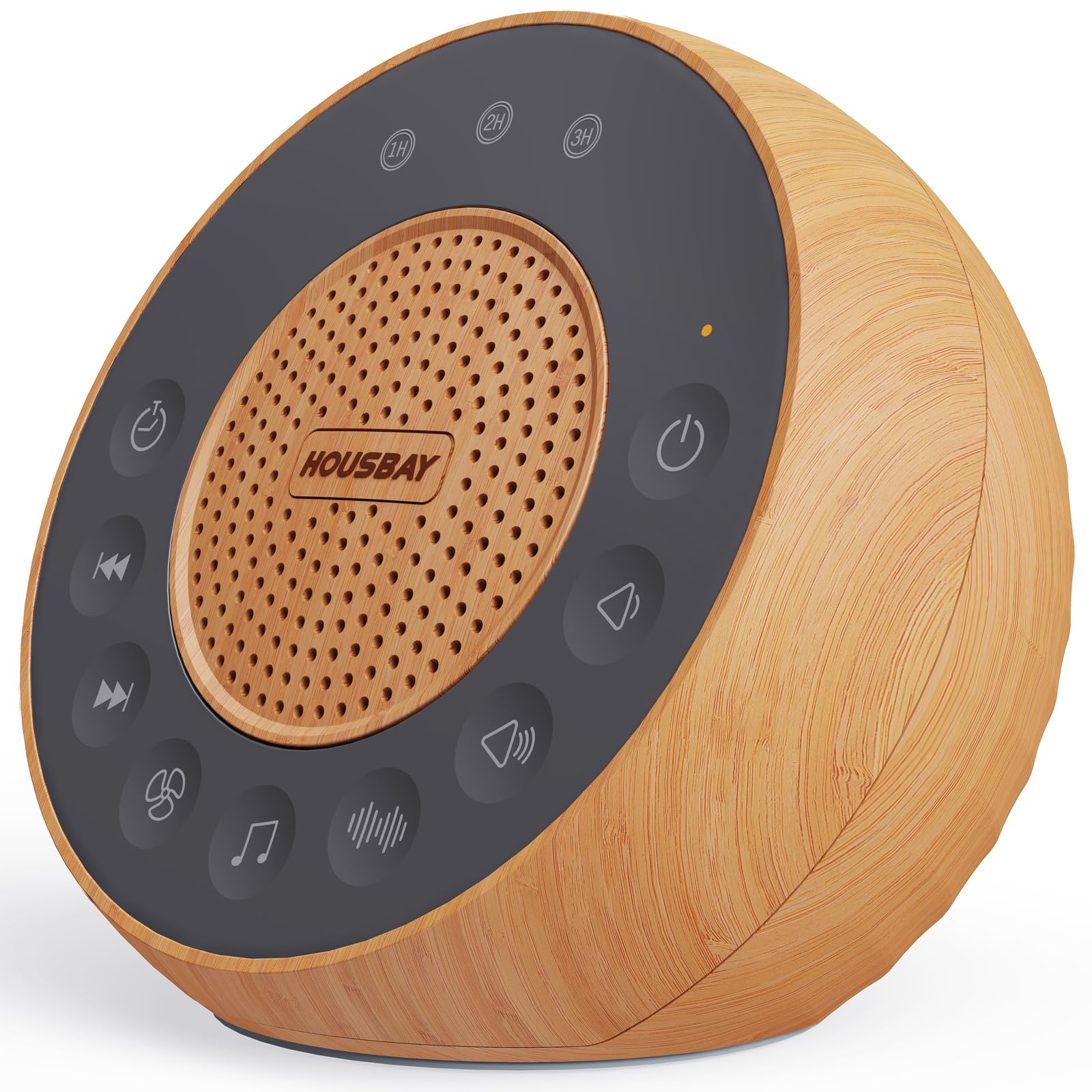
The wood-grain cabinet is what you notice first, and it is why the Housbay can sit on a dresser without looking like another piece of baby gear. The shape is softly curved, the controls are set on a 45-degree angle, and the speaker faces forward rather than filling the room from every side.
That forward-facing speaker is the practical part of the design: it aims sound toward the chair or crib rather than across the whole room, so you can keep the volume lower. The 31 sounds include rain, thunder, ocean, and fan, and the volume fades softly rather than cutting off when the timer ends. We noted that the angled panel is easy to reach without opening your eyes, which is the point of a bedside control.
The wood finish is the reason to choose it over the cheaper plastic machines, but it also means you are paying for appearance as much as features. The light can be turned off, and the buttons are quiet enough not to wake a baby who has just settled.
We think it earns its place in a nursery where the machine stays on display, and the directed sound makes the wood-grain finish feel like more than a styling choice. It is not the machine for a diaper bag, but it is the one we choose when the nursery is also a room the family uses.
Pros
- Wood-grain finish suits a nursery
- 31 sounds with forward-facing speaker
- Angled controls easy to reach in the dark
- Soft volume fade at timer end
Cons
- Power cord is the durability weak point
We recommend the Housbay for a nursery where the sound machine stays on display: wood-grain finish, 31 sounds, and controls that fall naturally under your hand.
Best for Stroller Naps
Skip Hop Stroll & Go

Key Features
- Timer: 15, 30, 60 min
- Sounds: 2 lullabies, 2 nature sounds
- Dimensions: 4 x 3 x 5.5 in.
- Power source: Battery
- Price: Budget
The Skip Hop Stroll & Go is a stroller soother, not a nursery sound machine, and the owl-shaped body makes that clear. It hangs from a stroller or diaper bag with a silicone strap and plays two lullabies and two nature sounds. That is a small library compared with the 25- and 30-sound machines here, but it is enough for a short outing.
For the job it is built for, the size and strap make sense. The body is light enough to hang from a stroller handle, the rubber keypad is easy to press, and the volume control is there when you need it. The two lullabies are a nice change from white noise for a short car ride, and the batteries mean no cord across the stroller.
We do not treat this as a replacement for a nursery machine; it is the thing you clip on for a walk, a car ride, or a short nap when the baby is already settling. If you need all-night sound, choose a plug-in or rechargeable nursery model; this one is for the minutes when you need a familiar sound close by.
Pros
- Attaches to stroller or diaper bag
- Two lullabies plus two nature sounds
- Lightweight and battery-powered
- Simple keypad with volume control
Cons
- 60-minute maximum timer; no continuous play
- Modest volume for noisy spaces
The Skip Hop is a stroller soother, not an overnight nursery machine; we recommend it for clipped-on naps and short outings.
How We Tested 14 Sound Machines Over Six Months
We started by pulling together 14 machines from brands shoppers actually consider, filtering by price, size, and whether they offered multiple sound options and a battery option. Over six months, we used them in our own nurseries during naps and bedtime, at 2 a.m. feedings, and on weekend trips with a travel crib. That meant packing each one into a diaper bag, setting it up in a dark hotel room, and seeing which ones were simple to operate with one hand.
Sound quality got the closest listen. We set each machine at crib distance and checked whether the lowest volume was quiet enough and the highest was loud enough without turning harsh; we also cycled through every sound option to see which felt genuinely relaxing versus tinny. Battery life was timed overnight, from a full charge to dead, and we noted whether a machine could run on batteries alone or needed a cord. Size was judged on a narrow nightstand and in a diaper bag pocket.
We also tried to break them a little. Each unit took a few tumbles from nightstand height onto carpet, got wiped down with baby wipes, and had its buttons and knobs worked repeatedly. We watched for reliability issues like crackling, dropped connections, or a charge that stopped holding. Value came down to whether the features and build matched the price, and the ones that survived all of this are the picks below.
How to Choose a Sound Machine for a Baby
The best baby sound machine is one you can operate half-asleep and trust to keep running until morning, so start with controls, power, and placement before you count sounds.
Start with the sleep setting, not the sound count
A nursery machine and a travel machine do different jobs. A corded model like the Easysleep or Hatch Baby can sit on a dresser and run all night, but it needs an outlet within reach and is not the one you toss in a diaper bag. A rechargeable model like the Hatch Go or Dreamegg trades some room-filling volume for portability. If you need both, buy for the nursery first and treat the portable as a second machine; a compact measurement means it fits a bag, not that it will cover a noisy house.
Listen for a steady, loop-free sound
Babies settle to a constant, low-level sound, so the quality of the loop matters more than the number of tracks. A short clip that repeats every few seconds can become noticeable to an adult in the room, and a bright, hissy white noise can sound harsh at close range. Look for non-looping sounds and a volume control with many small steps rather than three big jumps. The BrownNoise’s 36 levels and the Easysleep’s 32 levels give you more room to find a low setting that masks the hallway without filling the nursery.
Choose a night light you can dim or switch off
A night light is useful for night feeds and diaper changes, but it should not turn the nursery into a runway. Look for warm or amber light, several brightness levels, and a way to run the sound with the light completely off. A color light can be a nice toddler cue, which is why the BrownNoise and Hatch Baby earn attention, but only if the lowest setting is genuinely dim. If the light is the main reason you are buying, check that it can be dimmed without cycling through bright colors first.
Put the controls where your hand expects them
At 3 a.m., you want a button you can find without turning on a lamp, not a phone that needs unlocking. Physical controls with a memory function are the simplest choice for a nursery, especially if grandparents or a sitter will use the machine. App control is worth paying for when you want to start a routine from the rocking chair or change the light without crossing the room; the Hatch Baby does that well. If you mostly need one sound at bedtime, a basic keypad is less to go wrong.
Treat reliability and cord safety as part of the purchase
A sound machine runs for hours every night, so a unit that shuts off randomly is worse than one with fewer features. Test a new machine for a week before the return window closes, and listen for a speaker that cuts out or a cord that loosens. Keep the unit and its cord outside the crib and out of a baby’s reach; a dresser or shelf across the room is safer than a crib rail. The simplest machines here have the cleanest reliability stories, while the feature-heavy Hatch Baby has a more mixed record.
Frequently Asked Questions
Is brown noise better than white noise for babies?
Neither has a proven edge for every baby. Brown noise is deeper and less hissy, which some parents prefer for masking low household sound; white noise is brighter and can cover higher-pitched sounds. Pick one sound and use it consistently at a low volume, rather than switching every night. If you want to experiment, the BrownNoise machine has three brown-noise options and two white-noise options built in.
Can I use my phone instead of a dedicated sound machine?
For occasional travel or a backup night, a phone app can work. For nightly use, a dedicated machine is easier: it stays plugged in or charged, has physical controls, and does not compete with notifications, calls, or a dying battery. If you use a phone, put it in airplane mode, set a timer, and keep the volume low; just do not leave it in the crib or under a blanket.
Will my baby become dependent on white noise?
It can become a sleep cue, and that is usually the point: the same sound at the same low level signals that bedtime is coming. If you want to reduce dependence later, lower the volume one step at a time over a few weeks rather than stopping abruptly. Keep the rest of the routine consistent while you do it, and expect a few rough nights.
Final Verdict
Start with the Easysleep if you want the nightly job handled: it has the sound variety, fine volume, and warm dimmable light most nurseries need, and its physical controls are easier to live with than an app at 3 a.m. The Hatch Baby is the upgrade for families who want routines and a color light, with the trade-off of Wi-Fi and a cord.
For travel, the Hatch Go is the one we pack; the Dreamegg is the budget alternative. If you only need a stroller soother, the Skip Hop is a supplement, not a replacement.