This post contains affiliate links. We may earn a small commission when you buy through our links — at no extra cost to you.
A sound machine works by giving your brain one steady, predictable sound to rest on instead of the random spikes of a neighbor’s TV, a truck outside, or a partner’s snoring. But the wrong machine becomes its own disturbance: a thin speaker hiss, a rain track that loops every 12 seconds, or a fan sound so shrill it makes you tense. We’ve spent six months living with 14 machines—on nightstands, in a nursery, and beside a home-office desk—and the differences show up fast. The right one helps you fall asleep, stay asleep, and tune out the house without calling attention to itself.
The number of sound options matters less than I expected. I’d rather have a handful of white noise, fan, and rain settings that sound natural and loop cleanly than 30 choices with an electronic edge. Volume range matters just as much: the lowest setting has to be quiet enough for a light sleeper, the highest loud enough to mask a garbage truck. The picks below are the ones we kept plugged in after the novelty wore off.



Best for Adults and Snorers
Yogasleep Dohm Classic
Key Features
- Power: Corded, 7-ft cord
- Dimensions: 5.75 x 5.75 x 3.25 in
- Sound source: Real fan
- Speed settings: 2
- Price: Midrange
A real fan, two speeds, and one switch: that’s the whole pitch for the Dohm Classic, and it is why the machine has stayed in bedrooms for decades. The fan moves air and creates a continuous, non-looping hush rather than a recording that repeats. We tested it as an adult sleep machine, not as a nursery gadget, and the simplicity is the point: one switch, one job, no light show to manage.
What earns it the top spot is how well that single sound masks a room. The fan noise is natural rather than tinny, and it settles into the background instead of calling attention to itself. The two speeds cover the usual range from gentle hush to a more assertive block-out, and the small footprint leaves room on a nightstand. For a guest room, a home office, or a couple trying to mute street noise, it is the least complicated machine here.
The ceiling is the one thing we flag. If you are trying to cover very loud snoring or a thin wall with a television behind it, the Dohm can run out of volume before the noise does. Otherwise, its limits are easy to live with because it asks so little of you. We never minded the single-purpose design; the fan is the whole relationship.
Pros
- Natural, non-looping fan sound
- Simple two-speed operation
- Masks snoring and street noise
- Small footprint for a nightstand
Cons
- No timer, app, or battery power
We recommend the Dohm Classic first because its real-fan hush masks a room naturally and asks nothing more than a switch.
Best for App-Based Routines
SNOOZ Original
Key Features
- Controls: App + 3 buttons
- Dimensions: 5.6 x 5.6 x 3.2 in
- Sound source: Real fan
- Volume levels: 10
- Price: Premium
The SNOOZ Original makes a convincing case that one sound is enough, provided that sound is a real fan and you like the idea of scheduling it from your phone. It produces a single continuous fan noise, and the app handles auto on/off at bedtime and wake-up. That combination is more useful than it sounds: the machine disappears into the routine instead of becoming another device to adjust.
The fan sound is fuller and more believable than the digital fan settings on cheaper machines, and the 10 volume levels let you fine-tune it without a jump from too quiet to too loud. We appreciate that the three buttons on top handle the basics, so the app is a convenience rather than a requirement. On a nightstand it looks more like a small speaker than a baby product, which matters in an adult bedroom.
The app is the other trade-off: it adds a setup step and a reason to keep your phone nearby, though the buttons cover daily use. If your goal is a realistic fan hush with a schedule, that is a small price to pay. The SNOOZ is a specialist, and it rewards people who want one sound done well.
Pros
- Realistic, non-looping fan sound
- App schedules bedtime and wake-up
- Ten volume levels
- Compact, modern look
Cons
- Only one fan sound; no nature tracks
- App setup is needed for scheduling
We think the SNOOZ Original is the best choice if you want a realistic fan sound with app scheduling and don’t need a library of sounds.
Best for Nursery Routines
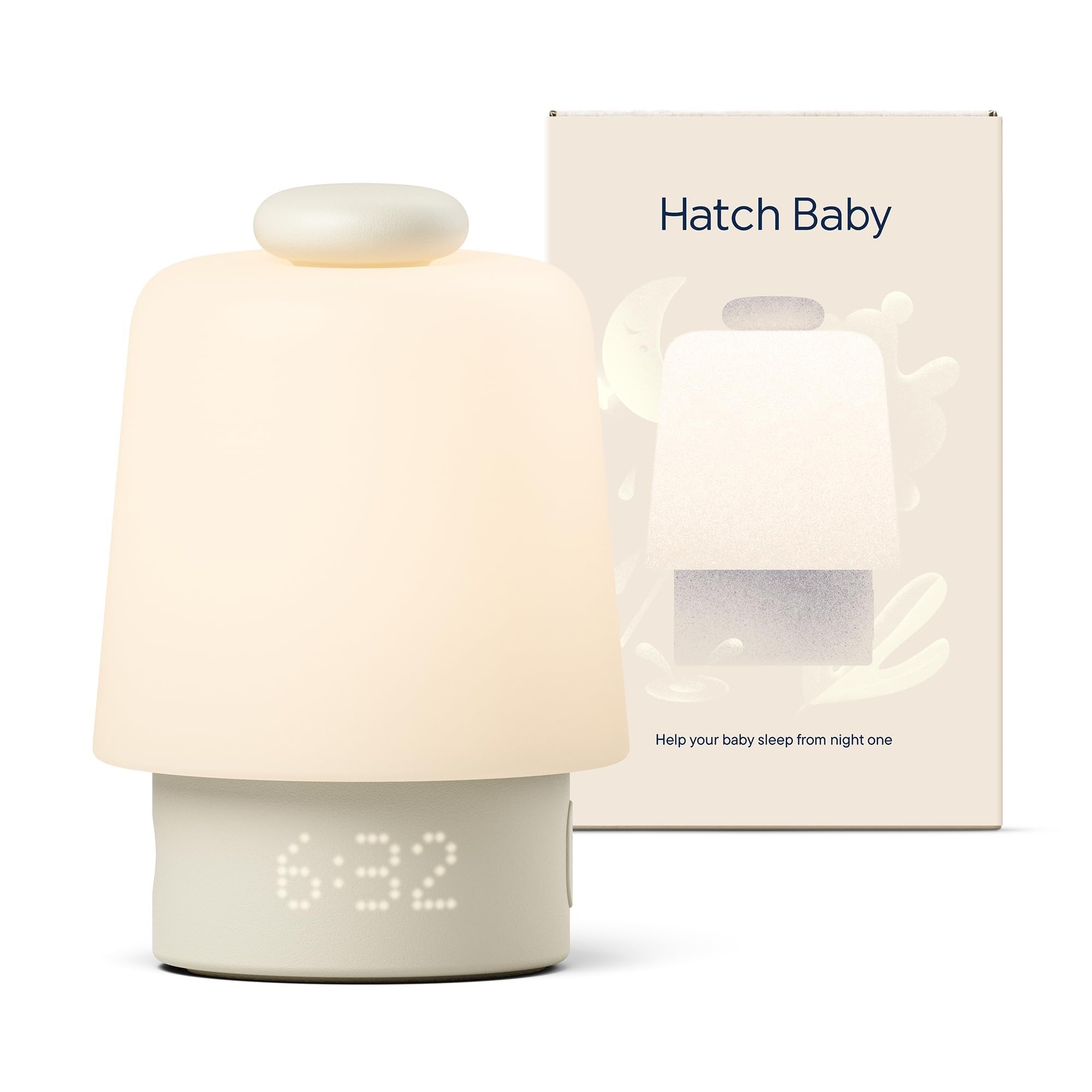
Hatch Baby Sound Machine
Key Features
- Power: Corded electric
- Control: Wi-Fi app
- Dimensions: 6 x 4 x 5 in
- Night light: Adjustable colors
- Price: Premium
The Hatch Baby is the pick for parents who want the whole bedtime sequence in one place: sound, light, and a schedule they can adjust from a phone. The app lets you save favorite sounds and colors, set routines, and change the nursery without opening the door. It is a baby product first, and the routine builder is the reason to pay for it.
The sound quality is better than the usual nursery afterthought. Pink noise, water sounds, and white noise come through smooth rather than tinny, and the light can be dimmed to a glow that is useful for feedings without waking the room. We also like the sleep-consultant chat in the app, which is a more useful extra than another novelty sound. The app is the control center, but the machine still works as a sound machine.
The Hatch is corded, so it stays on a dresser; for travel, the Hatch Go is the better sibling. If you want a simple fan sound for your own room, the Dohm is easier; if you want a programmable nursery, this is the one. We treat it as a routine tool, not a gadget, and that is why it earns a spot.
Pros
- Programmable sound and light routines
- Adjustable colors and brightness
- Smooth, non-tinny sleep sounds
- Useful sleep-consultant chat
Cons
- Long-term reliability is mixed
We recommend the Hatch Baby for parents who want programmable light and sound routines in one nursery device, provided they can live with app dependence.
Best for Travel and Strollers
Hatch Go
Key Features
- Power: USB-C rechargeable
- Sounds: 10
- Battery: Up to 15 hours
- Dimensions: 6 x 2.76 x 2.17 in
- Price: Midrange
The Hatch Go is the one we reach for when the sleep routine leaves the house: 10 sounds, a clip ring, and a rechargeable battery rated for up to 15 hours. It has three buttons, no app, no Wi-Fi, and no Bluetooth, which is exactly the point. You grab it, clip it to a stroller or diaper bag, and it keeps playing while it charges at night.
We like the sound selection for a portable unit. White noise, hush, heartbeat, ocean, and a handful of other options cover a nap, a car ride, or a hotel room, and the buttons are simple enough to work one-handed. The housing is drop-proof and drool-friendly, and the ring makes it easy to hang within reach. It is not a room-filling machine, though: the volume is built for close-range soothing rather than masking a loud living room.
For travel, that trade-off makes sense. The battery comfortably covers a night away, and USB-C charging means one less cable to pack. If you want a simple, rugged sound source for a stroller, a crib-side shelf, or a hotel, the Hatch Go is the easiest one to live with.
Pros
- 15-hour rechargeable battery
- Clip ring attaches to strollers
- 10 sounds with simple buttons
- No app or Wi-Fi needed
Cons
- No app scheduling; button-only control
We reach for the Hatch Go when sleep has to happen away from home; its clip ring and 15-hour battery make portable soothing genuinely easy.
Best for Budget Sound Variety
BrownNoise Sound Machine
Key Features
- Sounds: 30
- Timers: 5
- Night light: 12 colors, 10 brightness levels
- Volume levels: 36
- Price: Budget
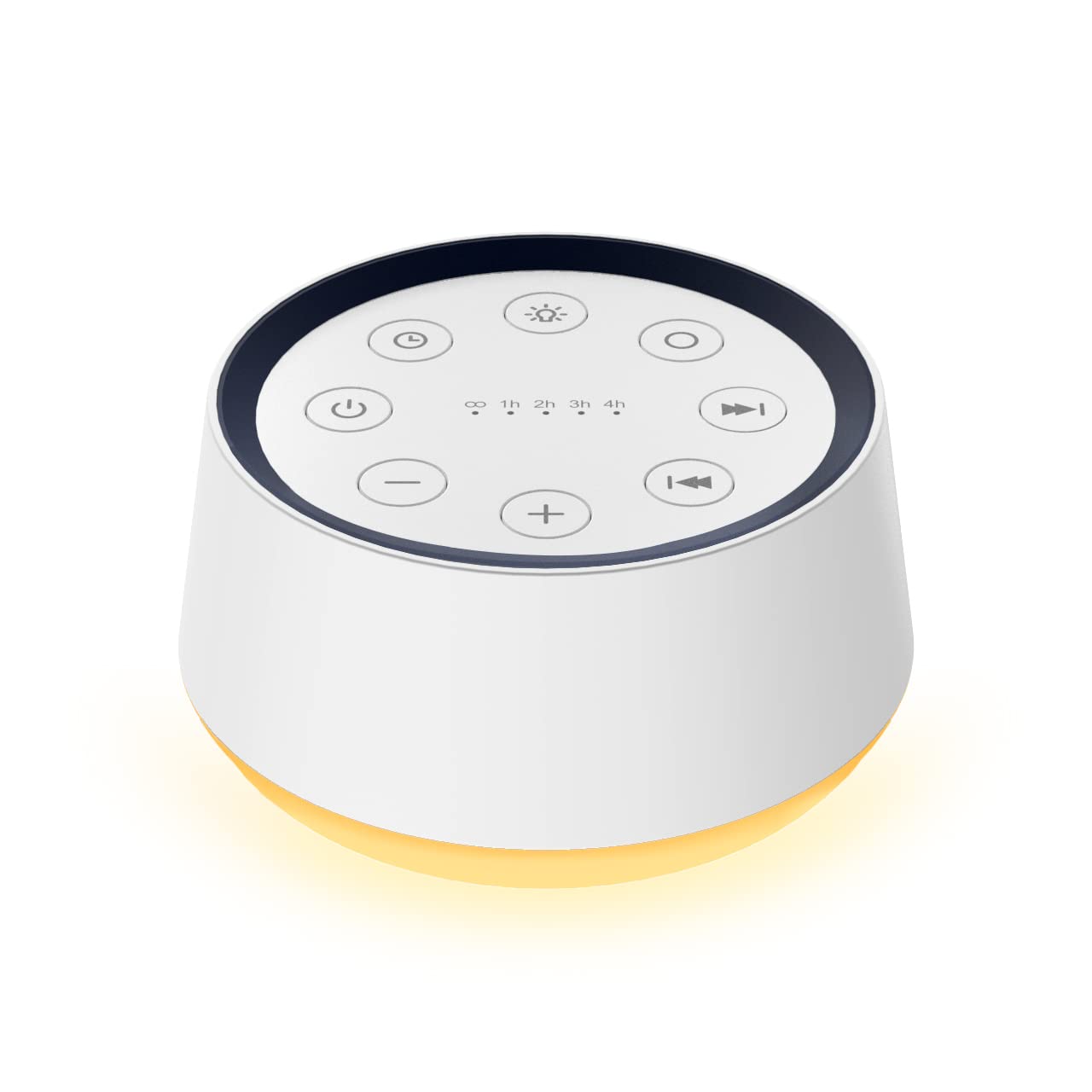
The BrownNoise machine throws nearly everything into a small box: 30 sounds, 36 volume steps, five timers, and a 12-color light. It is a budget machine with a very long feature list, and the brown-noise tracks are the reason we point to it first. Three separate brown-noise options give you a deeper, less hissy rumble than standard white noise, which is useful if white noise sounds too bright.
The 36-step volume range is the feature we value most. It lets you creep up on the right level instead of choosing between too quiet and too loud, and the five timers cover a nap or a full night. The light is a real night light, not a tiny indicator: 10 brightness levels and 12 colors, all controlled from the top panel. We appreciate the memory function, which restores your last sound, volume, and timer when you turn it back on in the dark.
The controls are busier than the Dohm’s single switch. We did not mind the extra buttons because they are laid out plainly, but anyone who wants a one-knob appliance will find it fussy. For a budget setup where you want brown noise, a timer, and a colorful night light in one place, it earns its spot.
Pros
- Three brown-noise tracks
- 36 volume steps
- 12-color night light
- Five timer settings
Cons
- Must stay plugged in
We point budget shoppers to the BrownNoise machine for its brown-noise tracks, wide volume range, and colorful night light in one plug-in unit.
Best for Simple Bedside Use
Easysleep Sound Machine

Key Features
- Sounds: 25
- Timers: 5 (60-240 min)
- Night light: 4 warm levels
- Volume levels: 32
- Price: Budget
The Easysleep puts a four-level warm night light under a 25-sound speaker, and the combination is more useful than it sounds. It is a small bedside unit with 32 volume steps, five timers, and a memory function that brings back your last settings. The light is warm rather than color-changing, which suits a nursery check or a trip to the bathroom without turning the room blue.
The controls are easy to work by feel, and the light can be turned off entirely when you want darkness. The 25 sounds cover white noise, fan, rain, ocean, birds, train, piano, lullabies, and meditation, so there is enough variety to find a texture that does not grate. We appreciate the 3.9-inch footprint, which is small enough for a crowded nightstand, and the AC or USB power option gives you some flexibility in where it goes.
The warm light is a single color rather than a palette, which is fine for sleep but less fun for a child who wants to pick a color. For a simple, affordable bedside machine with a gentle glow, that is an easy compromise. We set it and forget it, which is the highest compliment for a sleep machine.
Pros
- 25 sounds plus four-level warm light
- 32 volume steps and five timers
- Memory restores last settings
- Compact bedside footprint
Cons
- No battery; needs AC or USB power
We recommend the Easysleep as a simple bedside machine with a warm light, plenty of sounds, and controls that make sense in the dark.
Best for Cord-Free Travel
Dreamegg D11 Max

Key Features
- Power: USB rechargeable
- Sounds: 21
- Battery: 1800mAh
- Dimensions: 4 x 3.7 x 1.8 in
- Price: Budget
The Dreamegg D11 Max is the budget pick for people who want cord-free sound without the Hatch Go’s premium price. It has 21 sounds, an 1800mAh rechargeable battery, and a hand-sized body that fits in a diaper bag or on a bedside shelf. The battery is the headline: it is built to run for nights away rather than just a nap.
The sound selection is broad for the size, with white noise, fan, rain, ocean, lullabies, and a heartbeat option. The volume climbs higher than we expected for a portable unit, and the lock button is a thoughtful touch if a toddler is within reach. It charges over USB, so it shares a cable with other travel gear. The plastic body is plain but neutral enough to disappear in a guest room.
The battery needs a charging routine if you use it every night, and the portable design means it gets knocked around more than a bedside unit. The lock button helps protect your settings, but the D11 Max is still a travel machine at heart. It is the kind of unit you toss in a bag for a trip, not the one you install as a permanent nursery fixture.
For travel and occasional bedside use, it is a lot of machine for a budget price. We treat the D11 Max as a cord-free spare rather than the main sleep machine at home, and that is where it makes the most sense. If you need a permanent nursery unit, the corded Hatch Baby is the sturdier choice.
Pros
- 1800mAh rechargeable battery
- 21 sounds in a hand-sized body
- Lock button protects settings
- USB charging
Cons
- Long-term durability is mixed
We recommend the Dreamegg D11 Max for budget travel because its cord-free battery and 21 sounds cover nights away without a premium price.
How We Tested 14 Sound Machines
We started with a shortlist of 40 sound machines sold by established brands and narrowed it by specs, price, and customer feedback, looking for a mix of simple dial models and app-connected options. We ended up testing 14 for six months, running each one nightly for at least a week in a bedroom, a nursery, and a home office. We rotated them through the same spots so the comparison was fair, and we kept notes on how quickly we fell asleep, how often we woke, and whether the sound was still pleasant after 20 minutes.
At each spot, we set the machine at its lowest and highest volume and listened for hiss, clicking, and loop seams in every sound option. We used a phone decibel meter at the pillow and at the doorway to see whether the quietest setting stayed quiet and the loudest could mask traffic, a furnace, a neighbor’s television, and snoring. We also lived with the sounds: white noise during work calls, rain at bedtime, fan settings in the nursery, and a timer on overnight to see whether the machine shut off cleanly or woke us when it clicked back on.
Durability and reliability got their own checks. We unplugged and replugged each machine, cut power at the outlet to see whether it remembered volume and sound settings, and wiped down the housings weekly. We packed a few into bags for weekend trips and dropped nothing—though we did note which buttons felt loose and which cords ran warm. To judge value, we compared what each machine offered against the rest of the field, not against its price tag alone: a simple model with clean sound and steady performance scored higher than a feature-packed one that reset itself or developed a rattle.
How to Choose a Sound Machine
The best sound machine is the one whose noise you can live with all night, not the one with the longest feature list.
Start With the Sound Source
The first decision is whether you want a real fan or a digital recording. A fan-based machine like the Dohm Classic or SNOOZ Original produces continuous mechanical noise with no loop to notice, which is why we reach for one when sleep is the only job. Digital machines can offer white, pink, brown, fan, rain, and ocean sounds, plus timers and lights. Choose digital if you want variety or a specific texture; choose fan-based if you have ever been distracted by a repeating loop.
Match Volume and Tone to the Room
Maximum volume matters if you are masking snoring, traffic, or a loud apartment; low-volume control matters more in a nursery, where the machine should fade into the background. A wide volume range is useful, but so is a tone that stays smooth at low settings. We pay more attention to the quiet end than the loud end, because a machine that sounds harsh at midnight will not get used. Place it across the room rather than at ear level, and adjust from there.
Decide How Much Routine You Want
A timer is enough for many people: set it for an hour or leave it on all night. An app adds schedules, remote control, and in the Hatch Baby’s case, a full light-and-sound routine. That convenience is real, but it also means another device to set up and keep connected. If you want to adjust the machine in the dark without looking at a phone, physical buttons are the better choice. If you want the nursery to shift from bedtime to wake-up on its own, pay for the app.
Plan for Power and Placement
Corded machines are the simplest choice for a permanent bedside spot, while rechargeable models like the Hatch Go and Dreamegg D11 Max are the ones that leave the house. Check the battery claim against how you use it: a machine that runs overnight needs enough charge for a full night, plus a charging routine. Keep cords out of cribs and away from a child’s reach, and make sure the controls are usable without turning on a light. The best placement is the one you can reach from bed without knocking anything over.
Frequently Asked Questions
What is brown noise, and who should choose it?
Brown noise is a deeper, lower-frequency rumble than white noise, closer to a distant waterfall or a heavy fan. It suits people who find white noise too hissy or bright. The BrownNoise machine includes three brown-noise tracks, and its 36 volume steps let you keep the sound low. Try a brown-noise track before buying if you mainly want masking for sleep.
Is it safe to leave a sound machine on all night in a baby’s room?
Yes, with the same basics you use for any nursery device: keep the unit and its cord out of the crib and away from your baby’s reach, set the volume low, and follow the manufacturer’s placement instructions. A cordless model such as the Hatch Go is easier to keep clear of the crib, but it still belongs on a shelf or dresser, not inside the sleep space.
Can a sound machine replace a fan for office privacy?
It can mask steady office chatter and HVAC hum, but it does not cancel voices the way active noise cancellation does. Choose a continuous fan or white-noise setting, place the unit between you and the noise, and keep the volume just high enough to blur speech. A small plug-in model with a dedicated fan sound, like the Dohm, is the most straightforward choice.
Final Verdict
The Yogasleep Dohm Classic is the sound machine we recommend first because it does the core job with the least fuss: a real fan, two speeds, and a natural hush that masks a room without asking you to open an app. If you want scheduling and a more adjustable fan sound, the SNOOZ Original is the upgrade. For nursery routines, the Hatch Baby is the more capable choice. The Dohm remains the default for adults who just want to sleep.