
This post contains affiliate links. We may earn a small commission when you buy through our links — at no extra cost to you.
A sleeping bag’s temperature rating rarely tells the full story. The standardized test assumes a warm pad and an average metabolism, but on the trail, cold spots and your own tendencies shift comfort by 10–15 degrees. Many backpackers expect a 40°F bag to keep them warm, only to shiver at 45°F.
The bags here are chosen for realistic warmth and the right weight-to-pack-size balance. Whether you side-sleep and need extra width or count grams on a thru-hike, each pick addresses a specific use case.
The core trade-off is minimal weight versus room to move. Knowing what matters more for your trips—every ounce or sprawl space—prevents cold nights and cramped shoulders.

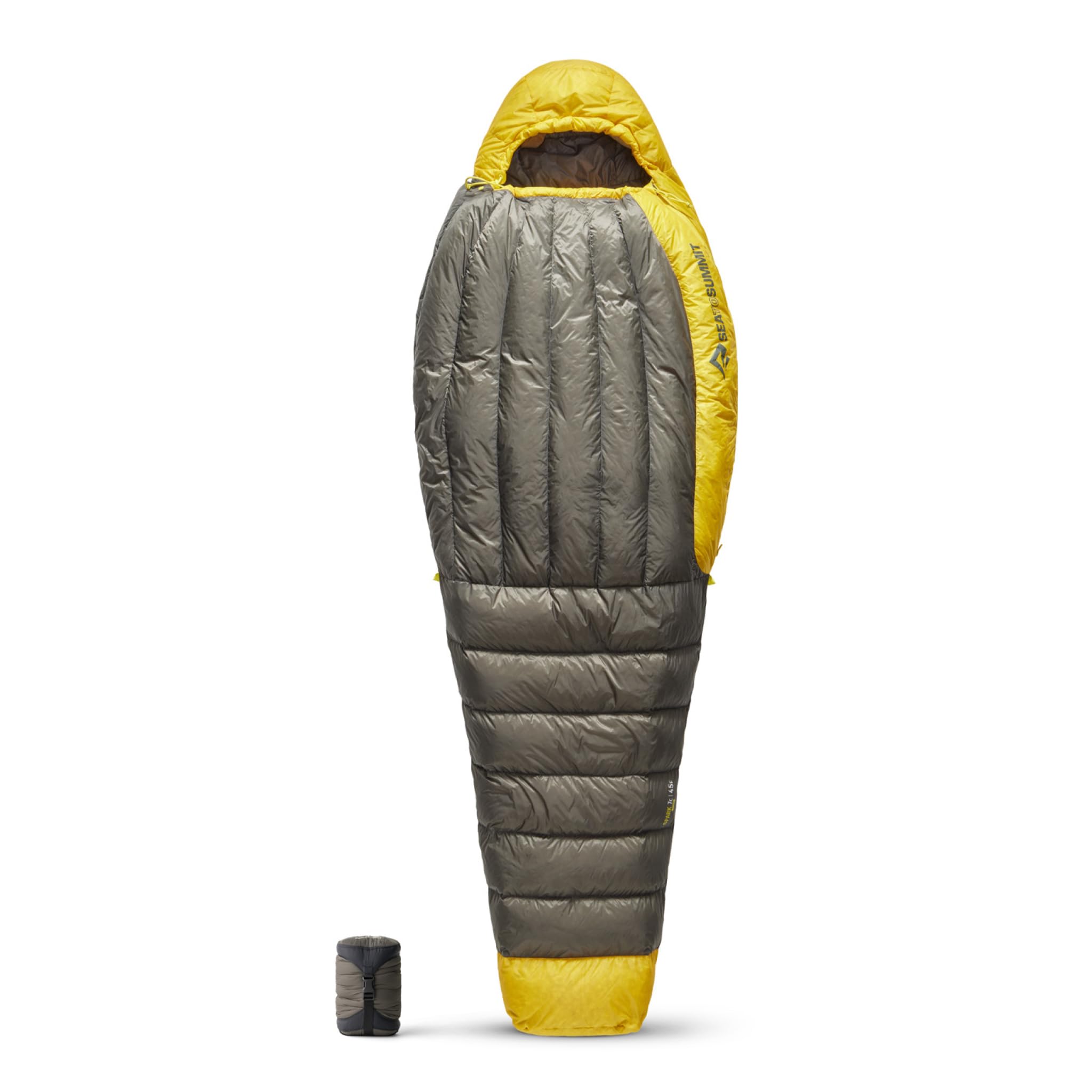


Best for Value 3-Season
Naturehike Down 42/52F
Key Features
- Weight: 1.3 lbs
- Temp Rating: 42–52°F comfort
- Fill: 650 FP duck down
- Shape: Rectangular
- Price: Mid-Range
At 1.3 pounds, the Naturehike Down 42/52F pushes into ultralight territory without the usual premium cost. The 650-fill-power duck down compresses into a bundled cylinder just 4.7 inches tall and 10.2 inches wide—smaller than a loaf of bread—and the included compression sack cinches it even further. That packability means it vanishes into a pack, leaving room for food and layers on multi-day trips.
A rectangular cut with a full-length YKK zipper gives side sleepers and anyone who tosses at night room to sprawl. The shape avoids the straitjacket sensation common in mummy bags, and the 295 grams of RDS-certified down distribute evenly so limbs can bend without pushing against a cold spot. The shell fabric moves quietly, which matters when shifting on a sleeping pad in a quiet campsite.
The 650-fill down holds warmth well for its weight, keeping most sleepers comfortable into the low 40s when paired with an insulated pad. Cold sleepers, however, may feel a chill as the thermometer nears freezing—the 42–52°F comfort range assumes average metabolism and a good mat, so building in a 10°F buffer is sensible for spring and fall trips. The YKK zipper glides smoothly but can catch on the thin shell fabric if you rush the pull; taking a beat to clear the material avoids snags.
This bag fits backpackers who want a single 3-season solution under 1.5 pounds and prefer the wiggle room of a rectangular shape. It’s an especially strong value for those stepping up from synthetic bags into down warmth without the steep price of elite ultralight models. Just know its limits: sustained sub-freezing temps call for a heavier cold-weather system, and gram-obsessed minimalists who’d spend over $300 to save a few ounces will find lighter options elsewhere.
Pros
- Weighs just 1.3 lbs, rivaling far pricier ultralight down bags.
- Rectangular cut and soft shell give side sleepers unrestrained comfort.
- Compresses exceptionally small and includes a compression sack.
- 650-fill duck down provides solid warmth for 3-season use above freezing.
Cons
- The YKK zipper can snag on the lightweight shell if not guided carefully.
- Cold sleepers may feel the bag runs cool when nights dip below 40°F.
For backpackers seeking a sub-1.5-pound down bag that doesn’t cost $300, this Naturehike model strikes the best balance of weight, roominess, and genuine 3-season warmth.
Best for Gram-Counting Hiking
Sea to Summit Spark 45F
Key Features
- Weight: 0.91 lbs
- Temp Rating: 45°F comfort
- Fill: 850+ FP RDS down
- Shape: Mummy
- Price: Premium
Sea to Summit packs 850+ fill power RDS down into a 14.56-ounce mummy that compresses to grapefruit size. A waterproof breathable footbox, contoured mummy cut, and PFC-free DWR on the 10-denier nylon shell focus every gram on insulating efficiency without short-lived water repellency treatments.
The 45°F comfort rating locks this bag into warm-weather missions. Where the top pick balances cost, weight, and 3-season capability, the Spark strips away every ounce for dedicated summer ultralight kits. A non-PFC Ultra-Dry down treatment helps loft retention in humidity, making it viable for damp coastal or tropical trips.
Weight-obsessed thru-hikers and bikepackers on well-planned summer routes will find the saving worth the premium. The tradeoff is that real-world warmth data is sparse—you’re trusting Sea to Summit’s lab testing rather than extensive user verification. Cold sleepers or anyone expecting nighttime dips into the 30s will want an insulated pad and liner, or a higher-temperature bag.
Pros
- Weighs just 14.56 ounces, putting it among the lightest fully featured down bags available.
- 850+ fill power down delivers excellent loft and packs down smaller than most synthetic or lower-fill alternatives.
- Waterproof breathable footbox stands up to tent condensation or damp ground at the foot end.
- PFC-free DWR and non-PFC down treatment suit environmentally conscious ultralight buyers.
Cons
- 45°F comfort rating confines use to warm-weather trips; it can’t handle shoulder-season or alpine conditions.
- 10-denier nylon shell needs careful handling—sharp zipper teeth or rough surfaces can snag or puncture the fabric.
- Luxury-tier price commands a premium for a single-season bag that lacks multi-season versatility.
For summer ultralight purists willing to pay for every saved gram, the Spark’s 850+ fill down and sub-pound weight deliver elite packability—provided nighttime lows never flirt with the 40s and you’re comfortable relying on Sea to Summit’s engineering over broad user feedback.
Best for Budget Summer Use
REDCAMP Ultra Light Bag
Key Features
- Weight: 1.5 lbs
- Temp Rating: 59–77°F range
- Fill: Synthetic polyester
- Shape: Envelope
- Price: Budget
Weighing just 1.5 pounds and compressing to the size of a small loaf, the REDCAMP Ultra Light Bag strips away every ounce of unnecessary weight for summer backpacking. It packs into a durable compression sack that stashes easily into an overloaded pack or day bag. Unzipped flat, it doubles as a campsite throw or pairs with a second bag for a snug double setup.
The polyester shell and lining are soft against the skin, and the rectangular cut allows more knee room than a mummy. Warmth is strictly a warm-weather affair — the comfort floor sits around 68°F, and nights below 55°F call for a liner or extra clothing. On humid nights, the synthetic fill maintains loft better than down when damp.
Hostellers, festival-goers, and budget-conscious backpackers who camp from June through early September find the most value here. The compression strap seam can give way if you crank on it with full force — a gentle cinch preserves long-term use. Avoid this bag for shoulder seasons or rocky terrain where gear gets tossed around.
Pros
- Just 1.5 lbs — among the lightest budget synthetic bags, barely felt in a pack.
- Packs down to 7.9×4.7 inches; compression sack tucks into tight backpack pockets.
- Soft interior fabric and comfortable rectangular cut for warm-weather sleeping.
- Unzips completely into a blanket or connects to a second bag for a couple’s setup.
Cons
- Compression strap seam can tear under heavy tension — cinch with light pressure.
A budget synthetic bag that delivers genuine weight savings for summer outings, as long as you treat the compression straps with care and keep it above 55°F.
Best for Warm-Weather Minimalism
Naturehike Compact Bag
Key Features
- Weight: 1.67 lbs
- Temp Rating: 60°F comfort, 32°F limit
- Fill: Synthetic
- Shape: Envelope
- Price: Budget
Where the Naturehike Down bag uses 650-fill goose down to hit 1.3 lbs, this synthetic envelope achieves its own kind of ultralight feat: a packed diameter of barely 6 inches while still costing under $40. That grapefruit-sized bundle slips into panniers, kayak hatches, or the bottom of a daypack without bulging.
At 1.67 lbs and 80.7 by 33.5 inches, the bag provides just enough interior space for a summer overnight. The synthetic fill maintains its loft even in humid conditions, and the envelope shape allows full unzipping into a blanket—handy for lounging or warmer nights.
The main trade-offs center on fit and warmth. The 33.5-inch width can feel confining for broad-shouldered sleepers or anyone who turns frequently. The comfort rating realistically ends around 50°F, making this a strict warm-weather bag. For budget-conscious minimalists who never push into shoulder seasons, that’s an acceptable boundary. Those needing more elbow room or three-season range will find the Naturehike Down bag a more flexible alternative.
Pros
- Exceptionally lightweight for a synthetic bag at 1.67 lbs
- Packs down incredibly small—about the size of a large grapefruit
- Excellent value for money
- Surprisingly comfortable for a slim, compact bag
Cons
- The 33.5-inch cut may feel restrictive for larger or active sleepers
- Warmth drops off noticeably below 50°F; strictly a summer bag
For warm-weather minimalists who prize pack size and price above all else, this bag delivers—it compresses astonishingly small and costs very little. Cold sleepers and broad-shouldered campers should look to the roomier down option instead.
Best for Roomy Down Camping
QEZER Down Bag
Key Features
- Weight: 1.68 lbs
- Temp Rating: 45–61°F comfort, 36°F limit
- Fill: 600 FP duck down
- Shape: Semi-rectangular
- Price: Mid-Range
85 inches long and 31.5 inches wide, this semi-rectangular bag lets tall or broad sleepers stretch out and shift sides without fighting fabric — all while staying under 2 pounds. That combination of room and moderate weight is rare in the ultralight category, where most bags squeeze sleepers into mummy cuts.
The warmth tradeoff shows up in real-world use: some bags feel toasty around 30°F with layers, while others leave users cool at 40°F. This unit-to-unit variation means cold sleepers should plan for a 10–15°F buffer and always pair it with an insulated pad. For spring, summer, and early fall trips where temperatures stay above freezing, the bag performs well.
This bag suits hikers who value unrestricted movement over shaving every last ounce — especially those with broad shoulders or long legs who find mummy bags claustrophobic. It works best for shoulder-season backpacking when paired with a warm pad and clothing layers, and doubles as a roomy car-camping option.
Pros
- Spacious 85” x 31.5” cut offers genuine room to shift positions without adding bulk
- Compresses into a small package for its size, fitting easily into a 40L pack
- 600-fill down provides decent warmth relative to weight when matched with proper layers
- Stitching and baffle construction hold up well over regular use at this price point
Cons
- Warmth consistency varies between units — some bags feel noticeably cooler than others near 40°F
- Zipper can snag on the lightweight shell fabric if rushed, requiring careful handling
Best for hikers who prioritize unrestricted movement and can pair it with an insulated pad and clothing layer for cooler nights.
Best for Ultra-Budget Summer
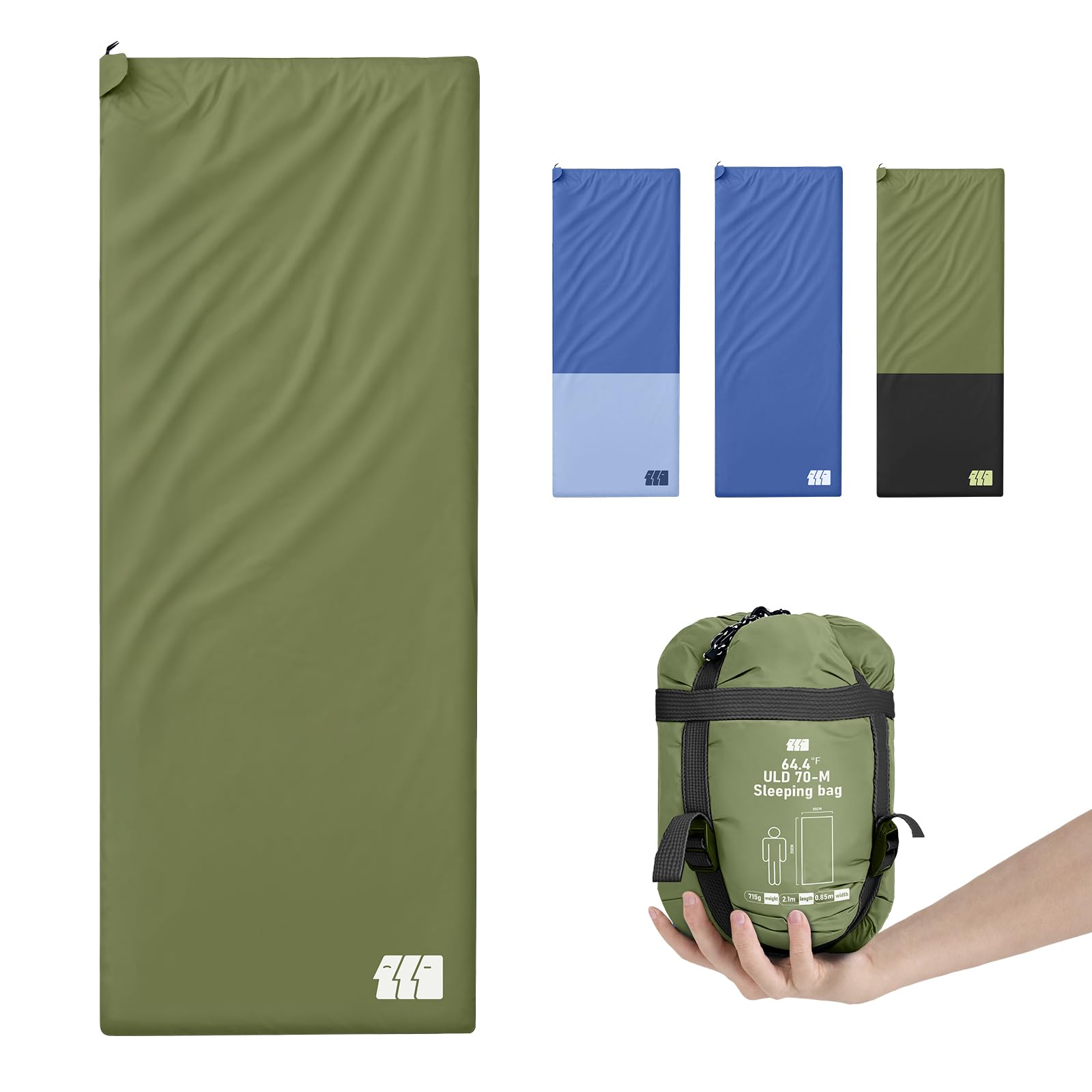
TANSTRIDER Warm Weather Bag
Key Features
- Weight: 1.5 lbs
- Temp Rating: 50–70°F
- Fill: Cotton/polyester
- Price: Budget
The TANSTRIDER Warm Weather Bag wraps a soft cotton lining into a 1.5-pound package that compresses small enough to slip into a daypack. That weight and packability make it a natural fit for summer hikers who want to keep their load light, and the included compression sack eliminates the need for extra stuff sacks.
Where it makes sense: mild festival nights and hostel stays where hard ground isn’t an issue. The minimal padding means rocky soil can transmit every lump without a sleeping pad, and the 30-inch width can feel confining for broad-shouldered sleepers. That’s the tradeoff for the wallet-friendly price and soft interior — a fair one if you’re a casual camper who always brings a pad and doesn’t mind a trim cut.
Pros
- Lightweight 1.5-lb build adds minimal strain to summer hiking kits
- Keeps sleepers warm in 50–70°F evening conditions
- Compresses to daypack-friendly proportions using the included sack
Cons
- Thin padding offers little cushion on hard ground — a pad is necessary
- Narrow 30-inch cut can feel restrictive for broader-framed sleepers
A sensible pick for festival-goers and warm-climate travelers who prioritize a soft lining and low price, as long as you pack a sleeping pad and don’t need wiggle room.
Best for Spacious Car Camping
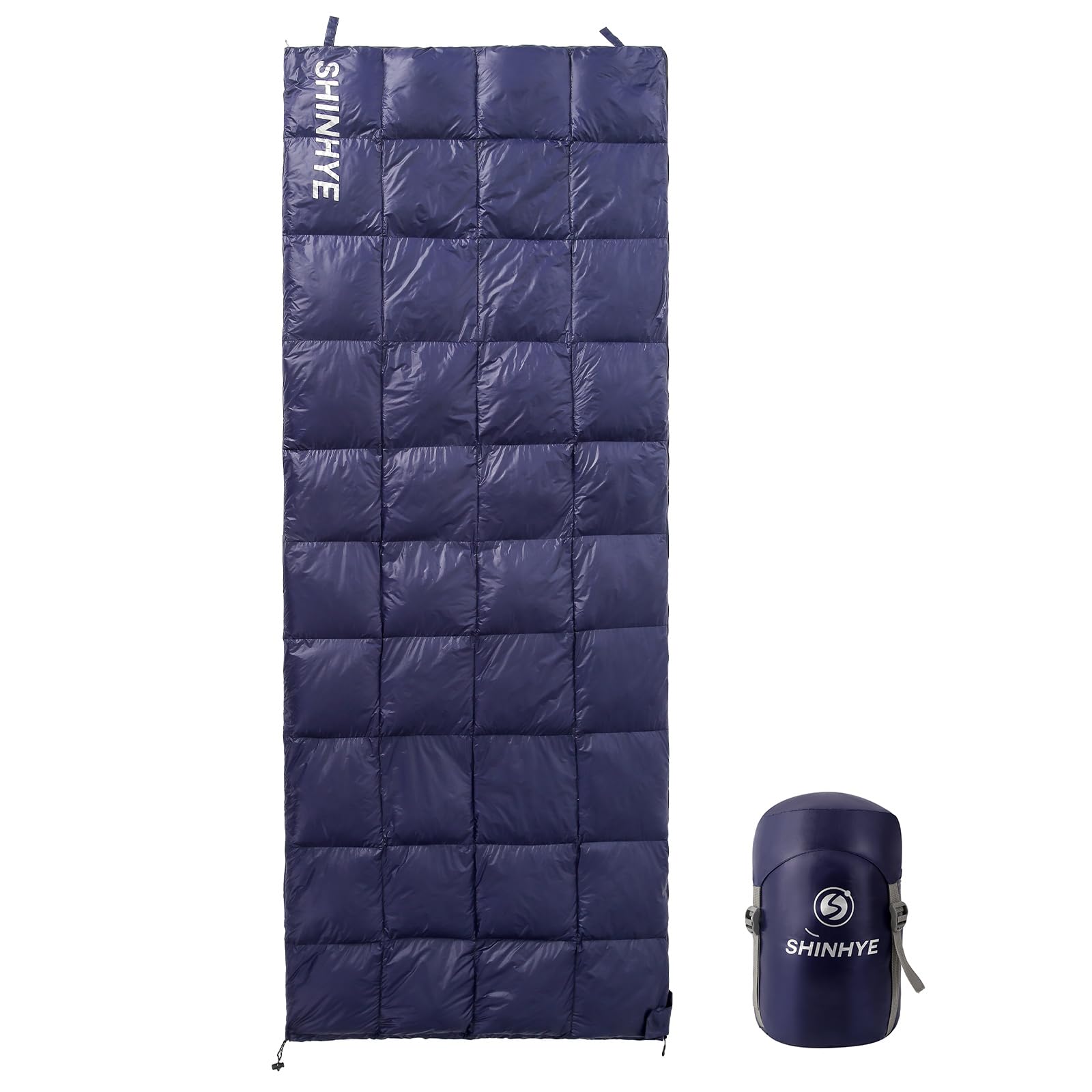
ShinHye Down Bag
Key Features
- Weight: 2.16 lbs
- Temp Rating: 40–59°F
- Fill: 500g duck down
- Price: Mid-Range
The ShinHye Down Bag packs 500g of duck down into an oversized rectangular cut that stretches to queen-size dimensions and fully unzips to become a shared layer for two. That generous space and down loft make it a comfortable car-camping or RV choice where packed bulk isn’t a dealbreaker. For backpackers focused on grams, the 2.16-lb weight and roughly 13.5-by-6-inch packed cylinder are a hard disconnect from the “ultralight” label; the down insulation and large footprint simply weigh more. A lingering chemical smell, noted to persist even after a month of airing, requires upfront patience before trips.
Pros
- Provides comfortable warmth for cool nights around 50°F with duck down loft.
- Very roomy interior accommodates a queen-size bed and shelters two people when fully unzipped.
Cons
- A persistent chemical odor can linger for weeks even after airing, which may be off-putting for sensitive noses.
- Marketed as ultralight but weighs 2.16 lbs, making it too heavy for ounce-counting backpacking and better suited to car setups.
Car campers and RV travelers who want a roomy, down-filled bag that can double as a two-person blanket will find it fit for purpose—as long as they budget time for thorough off-gassing before the first trip.
How to Choose
The most critical decision is matching the bag’s real-world warmth to your sleep habits, because a temperature rating alone won’t keep you comfortable.
Weight
True ultralight performance demands aiming under 1.5 lbs. Every ounce trimmed typically comes from thinner fabrics, less fill, or a narrower cut. A 1.3-lb down bag might feel plush in summer, but as temperatures drop, the reduced insulation leaves less margin for error—cold sleepers will notice drafts sooner.
Packed Size & Compressibility
Down compresses far smaller than synthetic fills, often shrinking to the diameter of a grapefruit. Synthetic bags, even lightweight ones, stay bulkier and can resist stuffing if the shell is stiff. If your trip requires fitting gear into bear canisters or small panniers, prioritize down or check the compression sack’s listed packed dimensions.
Temperature Rating
Ratings like 40°F refer to a standard lab test with a high-R-value pad and a metabolic rate that may not match yours. In the field, most backpackers need a 10–15°F buffer, especially when using an uninsulated pad or sleeping in a drafty shelter. Pair the bag with a pad rated R‑4 or higher, and treat the comfort rating as the real limit.
Fill Material
Down delivers the best warmth-to-weight ratio and packs smallest, but loses loft when wet—hydrophobic treatments help, yet prolonged humidity can still degrade performance.
Synthetic fill insulates when damp and dries faster, making it a safer choice for coastal or rainy trips. However, synthetic bags are heavier per degree of warmth and gradually lose loft with repeated compression.
Shape & Interior Room
Mummy bags save weight and trap heat by hugging the body, but they leave little room for side-sleepers to bend knees or roll over. Semi-rectangular or envelope shapes offer 5–10 extra inches of width, accommodating broad shoulders at the cost of a few ounces and slightly more heat loss. If claustrophobia or comfort dictates your sleep quality, those extra inches matter more than a lower scale number.
FAQ
Why is my ultralight sleeping bag not warm enough even though the temperature rating says 40°F?
That rating comes from a lab test with a standard warm pad and an assumed metabolic rate; on the trail, a thinner pad, drafts, or your own cold-sleep tendency drop the effective warmth. Always add a 10–15°F buffer above the comfort rating and use an insulated pad with an R-value of at least 4.
Can an ultralight down sleeping bag withstand damp or humid conditions?
Modern hydrophobic down and PFC-free DWR shells resist light moisture, but prolonged dampness can still collapse down’s loft and cut insulation. For consistently wet trips, a synthetic bag maintains warmth when wet, though it will be heavier for the same temperature rating.
How much should a true ultralight sleeping bag weigh?
A bag under 1.5 lbs qualifies as truly ultralight; premium down models can dip below 1 lb for warm-weather use. The exact weight depends on the temperature rating—a 3-season down bag at 1.3 lbs strikes the best balance for most backpackers.
What is the difference in packed size between down and synthetic ultralight sleeping bags?
Down compresses to a fraction of synthetic bulk, often shrinking to the size of a large grapefruit, while a similar-temperature synthetic may fill a small daypack. Synthetic bags resist compression more, so down is the go-to when every cubic inch of pack space counts.
How do I keep the zipper from catching on the thin fabric of my ultralight sleeping bag?
Lightweight shell fabrics snag easily, but the fix is simple: operate the zipper slowly while guiding the fabric away with your other hand. Some bags include a stiffened tape behind the zipper path; if yours doesn’t, adding a thin ribbon pull helps reduce bulk snags.