
This post contains affiliate links. We may earn a small commission when you buy through our links — at no extra cost to you.
The worst six seconds of a winter morning happen between the alarm and the overhead light, when you’re awake enough to resent everything. A wake-up light is meant to close that gap, brightening gradually so you surface into something closer to sunrise than to a siren. In practice the category splits sharply: some models ramp so slowly you sleep straight through the sunrise, others jump from dim to glaring in ten minutes, and plenty have alarms fiddly enough to need a manual at 6 a.m.
I started sleeping next to one the January my phone alarm began reading as a threat rather than a nudge. Over the past six months my team and I have slept beside 12 wake-up lights, from palm-sized domes to full sunrise simulators, and what separated the good ones wasn’t the spec sheet — it was how the brightness curve felt at 6:20 a.m., whether the birdsong made me want to throw a pillow, and whether the pricier models did anything the cheap ones didn’t. Peak brightness matters less than the shape of that ramp. The picks below all got the curve right.


Best for All-Around Sunrise Alarm
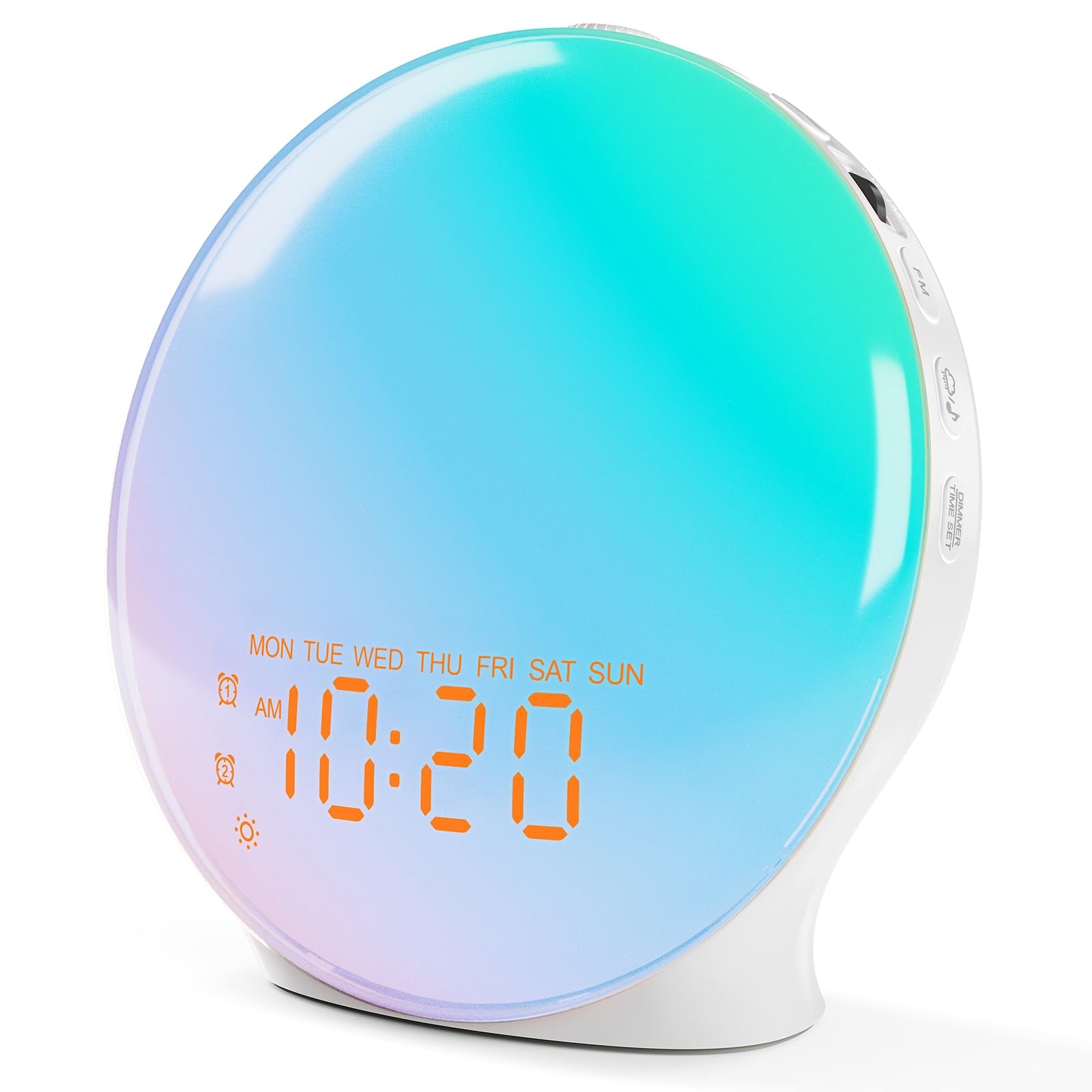
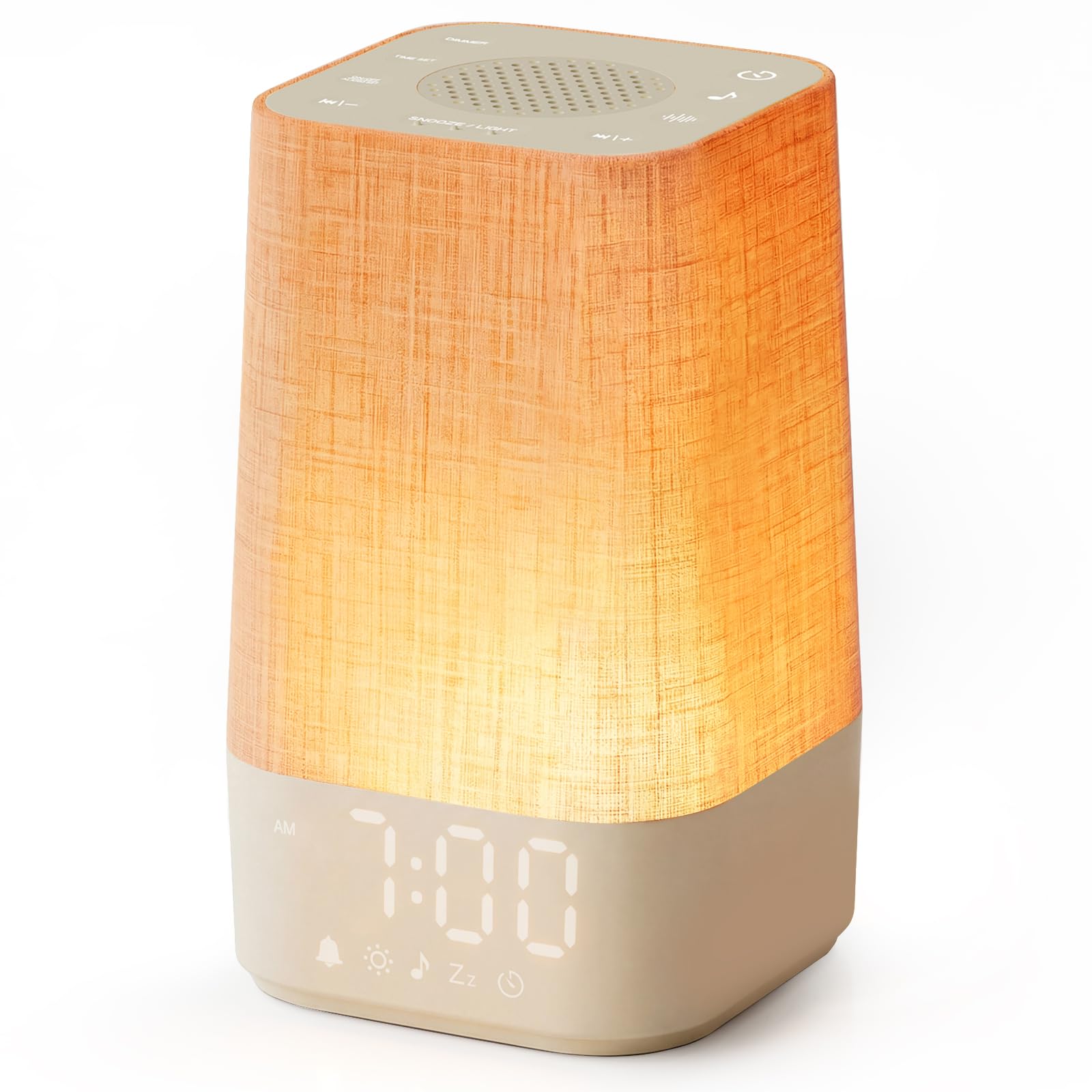
Odokee Sunrise Alarm Clock
Key Features
- Wake modes: 3
- Sound library: 25 sounds
- Sunrise duration: 5–60 minutes
- Nightlight colors: 12
- Price: Midrange
The Odokee’s 5-to-60-minute sunrise is the feature that earns it the top spot. You can stretch the ramp long enough to wake before the alarm or shorten it when you need to be up quickly, and the three wake modes let you run light only, sound only, or both. That flexibility is the difference between a clock you use every day and one you abandon after a week.
What we appreciate most is how little ceremony it asks for. There’s no app, no account, and no Wi-Fi handshake at bedtime; the controls are physical and the display dims across its full range. In our testing, that made it the one we reached for on ordinary weeknights, when a complicated routine is the last thing you want.
The sound library is broader than most: 25 options, including white, pink, brown, and blue noise plus nature recordings, and a 5-watt speaker that handles Bluetooth audio. We liked having a light-only mode for quiet mornings and a sound-only mode for naps. Once programmed, we rarely touched the buttons.
The 12 nightlight colors are a pleasant extra for middle-of-the-night feeds or reading, but the sunrise is the reason to buy it. The clock is light enough to move from nightstand to dresser without fuss, and the display dims low enough that it doesn’t become the brightest thing in the room. It’s the one we leave plugged in.
Pros
- Adjustable 5–60 minute sunrise
- Three wake modes without an app
- 25 sounds and Bluetooth audio
- Dimmable display and 12 nightlight colors
Cons
- Feature-heavy setup takes patience
We recommend the Odokee for most bedrooms: it gives you an adjustable sunrise, rich sound, and simple physical controls without tying your morning to an app.
Best for Reading Lamp Wake-Up
Philips SmartSleep HF3520/60
Key Features
- Radio: FM
- Display: Automatic dimming
- Wake sounds: 5
- Brightness settings: 20
- Price: Premium
The Philips earns its premium place by being more than an alarm: it’s a reading lamp with 20 brightness settings and a sunset simulation that gives you a reason to use it before bed, not just at dawn. We noticed the light quality first—warm, even, and easy to dial down—and the tap-snooze top is the kind of physical control you can find without opening your eyes. It feels like a small lamp that happens to wake you, which is a different pleasure from a gadget.
The sunrise and sunset are the headline, but the five natural sounds and FM radio make it a complete bedside radio. We liked having the radio as an option for mornings when a birdsong loop feels too precious. The 20 brightness settings also let you set a ramp that starts almost invisibly and ends bright enough to read by. That range is the reason it can serve as both a nightstand lamp and a wake-up light.
The friction is the interface. Programming it takes some patience, so we set it up once and then left it alone. We found the payoff in the lamp and sunset features; if you won’t use those, a simpler clock is the better buy.
What we kept coming back to was the ritual: dim the lamp, set the sunset, wake to a gradual glow. That’s a different purchase from a gadget, and it’s the reason this one stays in the premium slot. If you want a wake-up light that earns its place on the nightstand all evening, this is it.
Pros
- Doubles as a 20-setting reading lamp
- Sunrise and sunset simulation
- Five natural sounds plus FM radio
- Tap snooze and auto-dimming display
Cons
- Premium price for the feature set
- Takes up more nightstand space
The Philips is the wake-up light we choose when we want a real bedside lamp and a sunset wind-down, and we’re willing to learn its controls.
Best for Budget Bedrooms
JALL Full-Screen Sunrise Clock
Key Features
- Alarms: Dual
- Bluetooth: Yes
- Sound library: 25 sounds
- Sunrise duration: 10–60 minutes
- Price: Budget
The JALL’s budget price and full-screen face are the first things you notice: the light spreads across the whole front instead of a small globe, which makes the sunrise feel roomier. It brightens from 10 to 100 percent over 10 to 60 minutes, then adds sound, and you can set separate weekday and weekend alarms. That’s a lot of morning flexibility for the least expensive tier here.
For the money, the feature list is absurdly complete: 25 sounds, Bluetooth, FM radio, 17 colors, and a display dimmer. We used it as a sound machine more than we expected, and the dual alarms are genuinely useful in a shared bedroom. Once we set our two schedules, we mostly left it alone.
We were also surprised by how much we liked the dimming range. In a dark bedroom, the clock can drop low enough that it stops competing with the sunrise, which matters if you’re sensitive to light. The sound quality is fine for nature loops and talk radio, though we don’t treat the speaker as a serious music system. That’s the right trade-off for a budget clock.
The JALL doesn’t feel as refined as the Philips or as polished as the Odokee, but it covers the essentials for a budget bedroom. If you want a second alarm for a guest room or a kid’s room, this is the one we point to. The full-screen light is the part that makes it feel less like a compromise than the price suggests.
Pros
- Full-screen sunrise with 10–60 minute ramp
- Dual weekday/weekend alarms
- 25 sounds, Bluetooth, and FM radio
Cons
- Controls are busy for a first-time setup
The JALL is the budget pick we recommend when you want a full-screen sunrise, dual alarms, and a lot of sounds without paying midrange money.
Best for Sound-Sensitive Sleepers
Wkzay Sunrise Alarm Clock
Key Features
- Sleep timer: Yes
- Sound library: 30 sounds
- Sunrise duration: 10–60 minutes
- Brightness levels: 13
- Price: Budget
Thirty sounds and a 10-to-60-minute sunrise are the two specs that got our attention, but the useful part is the mix: 10 white-noise options and 20 nature recordings, with separate volume and brightness controls. The 13 brightness levels give you a finer ramp than the fixed-step clocks, so you can start almost invisibly and creep up on the alarm.
We tested it in a room with a streetlight outside, and the warm glow was easy to bring up without flooding the room. The display can be turned all the way off, which we appreciated on nights when we didn’t want a clock face staring back at us. It’s a small thing, but it’s the difference between a bedside device that disappears and one that demands attention.
The cylinder shape is compact and focused on the bed, and the nature recordings are soothing rather than tinny. The volume ramp is gradual enough that we didn’t bolt upright, and the separate brightness control means you can keep the light low while the sound does more of the work.
If you’ve tried sunrise clocks and slept through the light, this is the one we point to first, because the sound library gives you more ways to find a wake-up cue that actually reaches you. It’s also the easiest to live with if you share a room and need to keep the light low. We kept it on the nightstand even after testing the bigger lamps.
Pros
- 30 sounds, including 10 white-noise options
- 10–60 minute sunrise with 13 brightness levels
- Separate volume and brightness controls
Cons
- Not shaped like a reading lamp
The Wkzay is our pick for sound-sensitive sleepers: 30 sounds, 13 brightness levels, and a sunrise you can stretch from 10 to 60 minutes.
Best for Routine Builders
Hatch Restore 3
Key Features
- Wake light: Sunrise alarm
- Connectivity: Wi-Fi and Bluetooth
- Sleep sounds: 80+
- Subscription: Hatch+ trial included
- Price: Premium
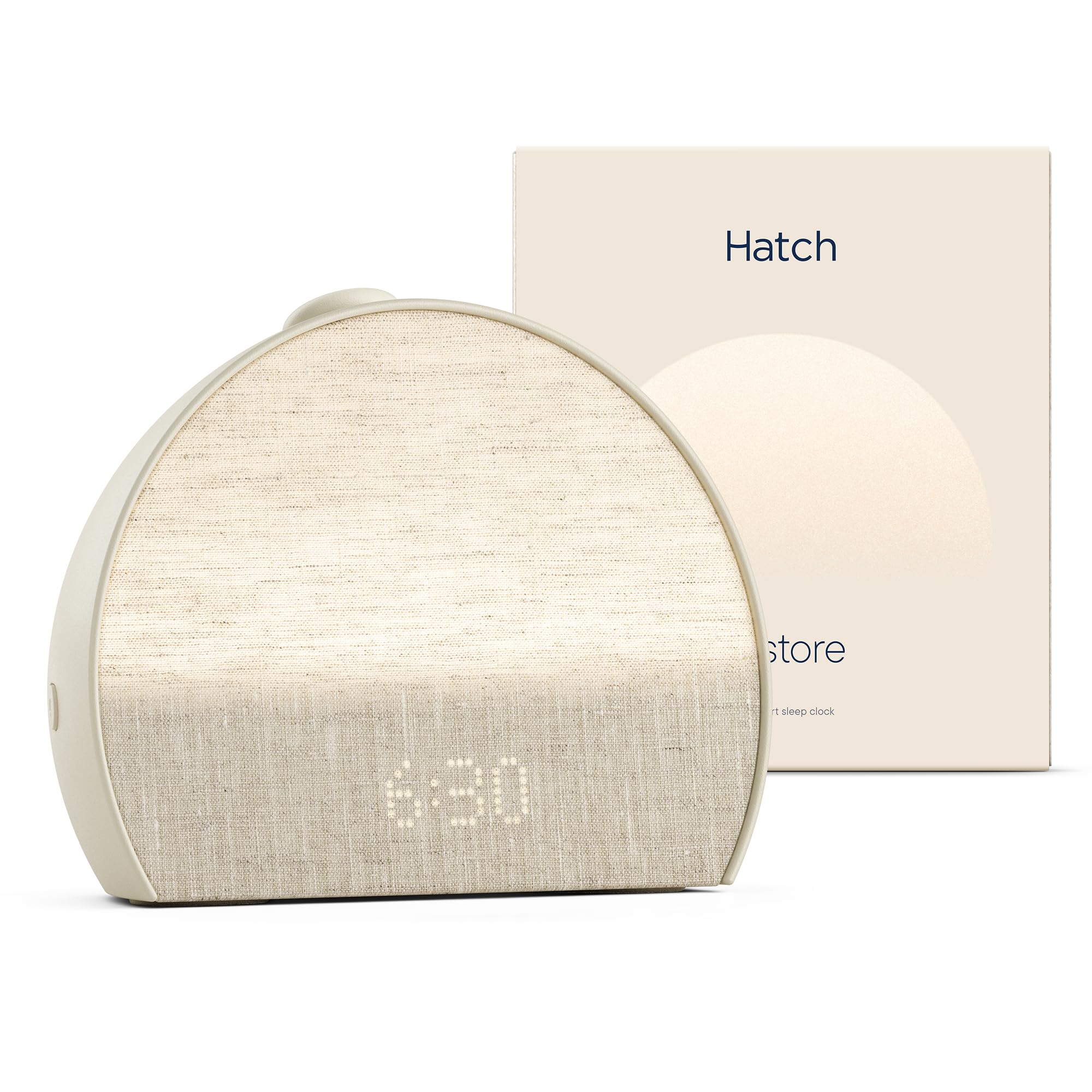
The Restore 3 is less a clock than a bedside routine: you build a wind-down in the Hatch app, choose a reading light and a sleep sound, then let the sunrise alarm bring you back in the morning. The putty finish and semicircular shape look more like a small speaker than an alarm, which is the point. It’s the best-looking device here, and it’s the only one that feels designed to be seen all evening.
We liked the screen-free idea—there’s no glowing clock face to negotiate—and the 80-plus sounds are a real library rather than a loop of six birds. The sunrise is gentle and the app makes it easy to adjust the routine without memorizing button combinations. That convenience is the reason it earns a place here, but it’s also the catch: your alarm lives behind a phone, a Wi-Fi connection, and a subscription tier.
The sound quality is better than most bedside clocks, and the design is the nicest here if your bedroom has a modern, minimal look. The subscription is the part to weigh: the best content sits behind Hatch+, so the routine is only as complete as you’re willing to pay for. If you want a simple, phone-free sunrise, this is not the one.
What won us over was the routine, not the hardware: the combination of a dim reading light, a soundscape, and a gradual morning glow felt more intentional than a clock radio. That’s a specific kind of buyer, and the Hatch serves them well. We just don’t buy it for the alarm alone.
Pros
- Guided wind-down and sunrise routine in one
- 80+ sleep sounds with strong sound quality
- Screen-free design with app control
Cons
- Premium price
The Hatch is for the buyer who wants a guided wind-down and a sunrise alarm in one; it’s the most polished routine device here, and the app is central to how it works.
Best for Radio Lovers
DreamSky Sunrise Clock Radio
Key Features
- Radio: FM and Bluetooth
- Alarm tones: 8
- Sunrise duration: 0–60 minutes
- Brightness levels: 20
- Price: Budget
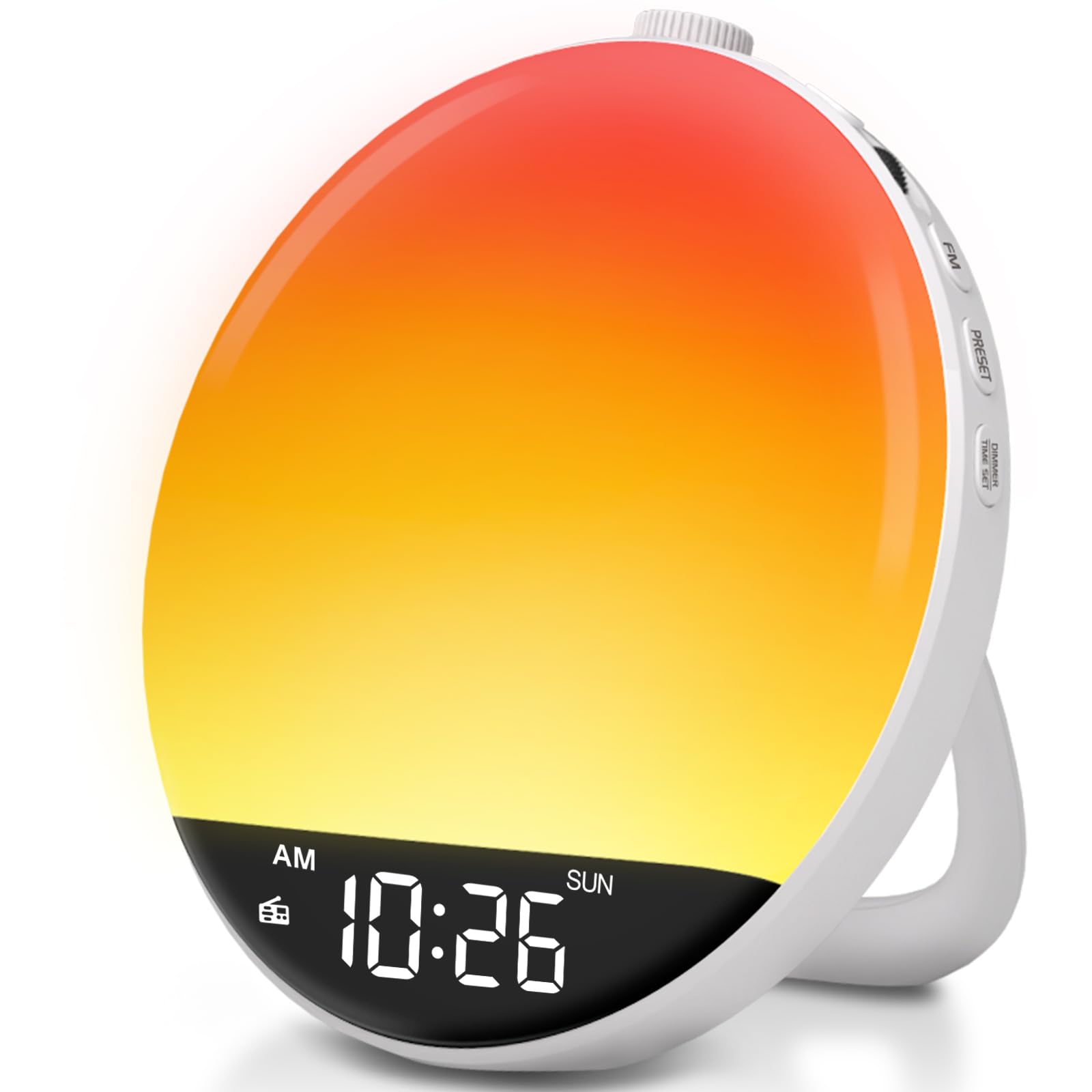
The DreamSky’s big numerals and FM radio make it a clock radio first and a wake-up light second, which is exactly why it appeals. The display is readable from across the room, dims to your liking, and the radio has a long external antenna and Bluetooth. If you’ve missed the bedside radio more than you’ve missed a smart speaker, this is the familiar shape.
The sunrise light runs up to 60 minutes with 20 brightness steps, and there are eight alarm tones plus a customizable snooze. We liked the USB charging port more than we expected—it clears one cable from the nightstand—and the room-temperature readout is a small but useful touch. It’s a practical clock, not a lifestyle device.
The alarm is the part we treat carefully. Alarm timing can be inconsistent, so we set a phone backup on mornings that matter and treat it as a backup alarm rather than the only wake-up call. That’s a real caveat, but it doesn’t erase the appeal for a guest room, a kitchen, or anyone who wants a radio with a sunrise glow.
As a pure wake-up light, it’s outclassed by the Odokee and Philips; as a clock radio that happens to brighten gradually, it’s the most useful one here. The big display and physical dials make it easy to live with, even if the alarm needs a safety net. We kept it in the kitchen, where the radio and temperature readout earned their keep.
Pros
- Large, readable numerals with dimmable display
- FM radio, Bluetooth, and USB charging
- 20 brightness steps and 60-minute sunrise
Cons
- FM tuning can be fiddly
The DreamSky is the clock-radio crossover we recommend for big numerals, FM radio, and a sunrise light at a budget price.
Best for Small Nightstands
Vicsoon Sunrise Alarm Clock
Key Features
- RGB colors: 6
- Wake options: 7
- Sunrise duration: 30 minutes
- Warm light levels: 3
- Price: Budget
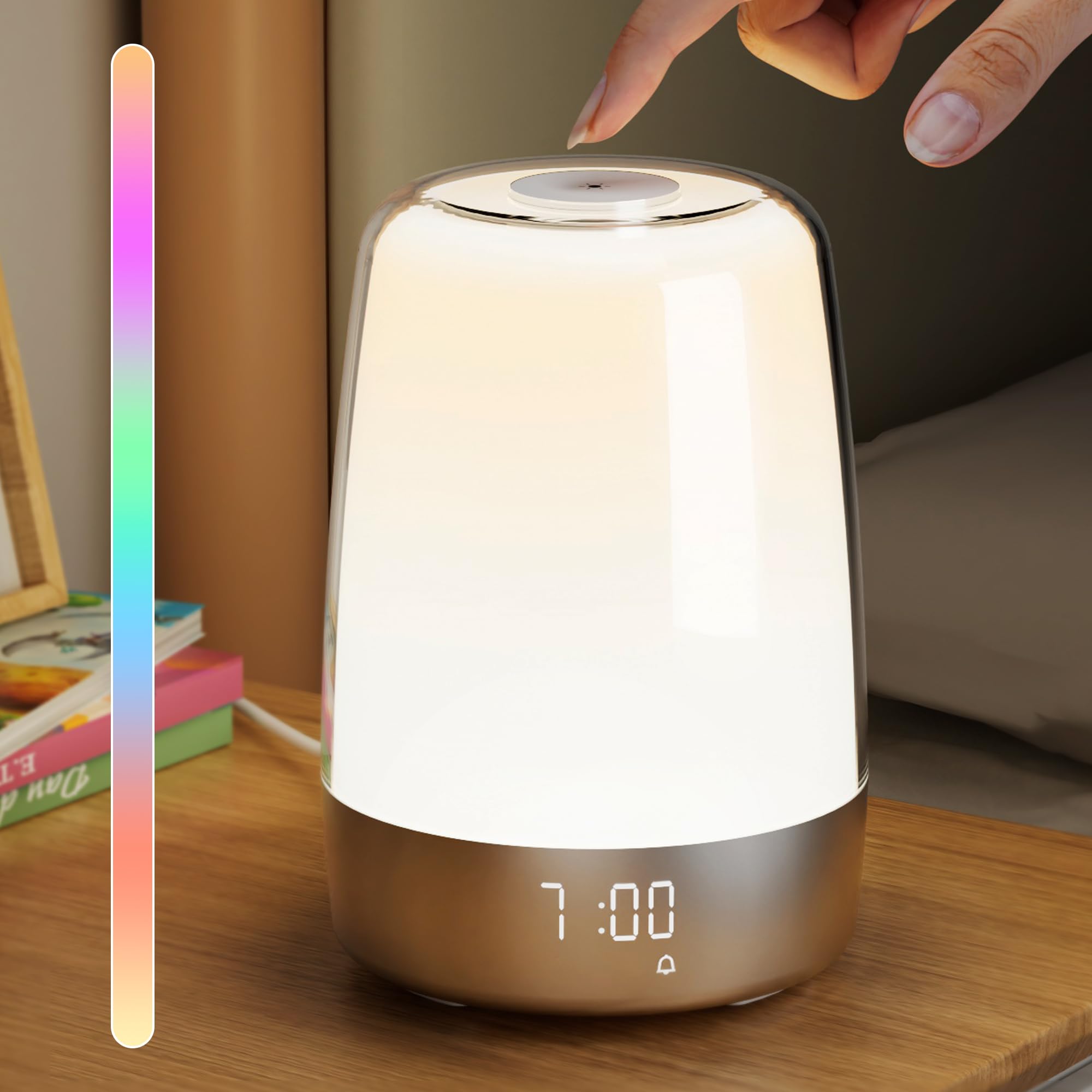
The Vicsoon is the smallest clock here, a 4-inch cylinder that takes up less space than a mug. Its sunrise is a straightforward 30-minute ramp, and there are only three warm brightness levels and six colors, so there’s less to fiddle with at bedtime. We liked that simplicity for a guest room: it’s the one you can set without reading a manual.
The seven wake options include beep, birdsong, stream, rain, and ocean, plus sound-only and light-only modes. The warm light is pleasant for reading, and the three levels are easy to cycle through. The display is dim in daylight, which is the main compromise on a clock this small.
It’s a corded model, so plan an outlet; that’s the main practical limit for a nursery or a guest room. The controls are simple, and the tap-to-change colors make it easy to use without a manual. We also liked that the light can run on its own, without an alarm sound, for a quiet morning.
What we kept coming back to was the size and the tap-to-change colors: it’s the one that fits on a narrow shelf and still gives you a gentle morning glow. It’s the easiest to tuck into a small room. We left it in the guest room, where the small footprint mattered most.
Pros
- Very compact 4-inch footprint
- 30-minute sunrise with seven wake options
- Three warm light levels plus six colors
Cons
- Sunrise duration is fixed at 30 minutes
- Low light can still be bright for a dark room
The Vicsoon is the compact pick for a tight nightstand or a kid’s room: a simple 30-minute sunrise, seven wake options, and a small footprint.
How We Tested 12 Wake-Up Lights Over Six Months
We started by pulling together every wake-up light sold in the U.S. that we could get our hands on, then cut the list using spec sheets: sunrise duration, maximum brightness, sound options, footprint, and whether the thing had a backup battery or kept its settings after a power cut. Price was part of the filter, but so was whether the extra money bought features you’d actually use at 6 a.m. That left 12 models, which lived on real nightstands for six months, through workday mornings and lazy Sundays alike.
Every light was set for a 6:15 wake-up, and we wrote down when we actually opened our eyes versus when the alarm finally sounded — a slow ramp is worthless if the light is still dim at the buzzer. We read brightness on a meter at ten-minute intervals through each sunrise cycle, ran the lights at full output for weeks to see if they faded, and set them up once behind blackout curtains and once in a room with an east-facing window. Sound got judged half-asleep, which is the only honest way: we listened to every tone at its lowest and highest volume and noted the ones that made us flinch.
Usability came down to middle-of-the-night fiddling — could we hit snooze or change the alarm without switching on a lamp or hunting for glasses? We measured each base against a cluttered nightstand, unplugged every model to see what it remembered, and lived with the radios and app controls long enough to decide whether they were worth paying for. The lights that rose to the top ramped smoothly from near-dark, held their settings, and sounded like something we could tolerate before coffee.
How to Choose a Wake-Up Light
The best wake-up light is the one whose light and alarm you can trust every morning, not the one with the longest feature list.
Start With the Sunrise Ramp
The ramp is the part that does the waking. A 20-to-40-minute simulation suits most bedrooms: long enough to pull you out of deep sleep before the sound starts, short enough that you aren’t waiting for the room to brighten. Adjustable models let you shorten the ramp on early shifts or stretch it on dark winter mornings; a fixed 30-minute sunrise is simpler but less flexible. We look for at least a 10-to-60-minute range, like the Odokee and Wkzay offer, and treat a fixed ramp as a simplicity trade-off rather than a fault.
Put Alarm Reliability Ahead of Extras
A wake-up light is still an alarm, and the extras don’t matter if the alarm is unreliable. Phone-free models with physical controls are the safest default; app-based lights add routines and content but put your morning behind a phone, Wi-Fi, and sometimes a subscription. If you choose a clock radio with a long feature list, set a phone backup for mornings that matter. The Hatch Restore 3 is the obvious app-first choice, while the DreamSky is the traditional radio alternative—both are easier to live with when you treat the alarm as one part of your routine, not the only part.
Choose the Sound You Can Live With
Light alone works for some people; others need sound to close the deal. Nature recordings and white noise are easier to live with than a beeper, but check that the volume ramps gradually and that the alarm is loud enough for your room. If you want a radio or music, a model with FM or Bluetooth earns its keep; if you hate sound, a light-only mode is worth having. The Wkzay’s 30-sound library and the Philips’s five natural sounds are two different answers to the same question, and neither is automatically better.
Plan for the Nightstand
Measure the spot before you buy. A full-screen clock can dominate a small table, while a compact cylinder leaves room for a book and a glass of water. Check the display dimmer and whether it can go dark; a bright clock face can undo the calm the sunrise is supposed to create. Put the light within arm’s reach for snooze, but angle it toward the room rather than your face. The Vicsoon is the smallest here, and the DreamSky is the one with the biggest numerals.
Decide Whether You Want a Lamp or a Routine
Some wake-up lights are bedside lamps that happen to have alarms; others are routine machines that guide your wind-down. A lamp-like model such as the Philips gives you a reading light and a sunset simulation, while the Hatch leans on an app for meditation, sounds, and schedules. Pay for the role you’ll actually use—if you won’t open the app, a simpler clock is the better buy. The right answer is the one that fits your bedside habits, not the one with the longest feature list.
Frequently Asked Questions
What’s the difference between a wake-up light and a light-therapy lamp?
A wake-up light simulates dawn at bedside brightness, gradually brightening over minutes to ease you out of sleep. A light-therapy lamp is a much brighter 10,000-lux device used for seasonal affective disorder and other clinical routines. If your goal is a gentler alarm, buy a wake-up light; if you need light therapy, follow a clinician’s guidance and don’t expect a bedside sunrise clock to do that job.
Can I use a wake-up light in a room with no windows?
Yes—the built-in lamp creates the light, so you don’t need morning sun. Keep the light unobstructed and close enough to illuminate your side of the bed, and use the highest brightness setting if the room stays dark. A windowless room is actually where a sunrise simulation can help most, because you’re not relying on daylight to tell your brain it’s morning.
Will a wake-up light wake a heavy sleeper?
It depends on how much light reaches you and whether the sound is loud enough. Choose a model with adjustable brightness and a volume ramp, set the light near eye level, and test the highest setting before relying on it. If you routinely sleep through alarms, pair the light with a phone backup rather than making it your only wake-up call.
Final Verdict
We recommend the Odokee Sunrise Alarm Clock as the best default because it gives you an adjustable sunrise, plenty of sounds, and a straightforward bedside routine without an app. If you want a wake-up light that doubles as a reading lamp and sunset simulator, the Philips SmartSleep is the upgrade we point to; for the tightest budget, the JALL Full-Screen Sunrise Clock covers the essentials. Start with the Odokee unless one of those specific needs changes the decision.